
Last letters from the living dead man
David Patterson (Spirit) Hatch
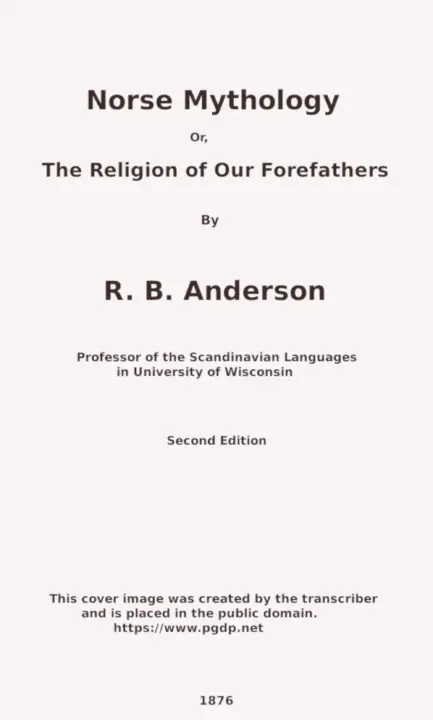
THE CLASSIC COLLECTION · 1875
"Norse Mythology; or, The Religion of Our Forefathers, Containing All the Myths of the Eddas, Systematized and Interpreted" by R. B. Anderson is a comprehensive historical account written in the late 19th century. The work aims to present a complete and systematic understanding of Norse mythology, exploring the myths, deities, and cultural significance of the ancient beliefs of the Scandinavian peoples. Through this volume, the author asserts the importance of Norse mythology for contemporary readers, emphasizing its relevance to the cultural heritage of modern societies. At the start of the book, Anderson discusses the intriguing nature of Scandinavian paganism and its persistence until the 11th century. He reflects on the importance of understanding Norse mythology as a means of connecting with our ancestors and their worldview, which was steeped in a rich tapestry of myths and divine personifications of nature. The text also anticipates a debate regarding the merits of Norse mythology compared to Greek mythology and sets the stage for a systematic exploration of its various aspects, including a detailed examination of key figures such as Odin, Thor, and the concept of creation within this mythological framework. Anderson's aim is to revive interest in the myths preserved in the Eddas and to encourage a deeper appreciation of the Gothic inheritance among readers.
Introduction adapted from the source catalogue; source summaries may be automatically generated.
Free to read · English · 120,183 words · No account needed
MAKE TIME FOR A GOOD BOOK
On by default. Untick to stop anonymous reading totals. Each page counts after 10 seconds in view. How this works.
Anonymous counting is on unless you have switched it off.
128. I counsel thee, Lodfafner,
To take advice;
Thou wilt profit, if thou takest it.
Words thou never
Shouldst exchange
With a witless fool.
124. For from an ill-conditioned man
Thou wilt never get
A return for good;
But a good man will
Bring thee favor
By his praise.
125. There is a mingling of affection,
Where one can tell
Another all his mind.
Everything is better
Than being with the deceitful.
He is not another’s friend
Who ever says as he says.
126. I counsel thee, Lodfafner,
To take advice;
Thou wilt profit, if thou takest it.
Even in three words
Quarrel not with a worse man:
Often the better yields,
When the worse strikes.
127. I counsel thee, Lodfafner,
To take advice;
Thou wilt profit, if thou takest it.
Be not a shoemaker
Nor a shaftmaker,
Unless for thyself it be:
For a shoe, if ill made,
Or a shaft if crooked,
Will call down evil on thee.
128. I counsel thee, Lodfafner,
To take advice;
Thou wilt profit, if thou takest it.
Wherever of injury thou knowest,
Regard that injury as thy own;
And give to thy foes no peace.
129. I counsel thee, Lodfafner,
To take advice;
Thou wilt profit, if thou takest it.
Rejoiced at evil
Be thou never,
But let good give thee pleasure.
130. I counsel thee, Lodfafner,
To take advice;
Thou wilt profit, if thou takest it.
In a battle
Look not up,[18]
(Like swine[19]
The sons of men then become),
That men may not fascinate thee.
131. If thou wilt induce a good woman
To pleasant converse,
Thou must promise fair,
And hold to it:
No one turns from good, if it can be got.
132. I enjoin thee to be wary,
But not over-wary;
At drinking be thou most wary,
And with another’s wife;
And thirdly,
That thieves delude thee not.
133. With insult or derision
Treat thou never
A guest or wayfarer;
They often little know,
Who sit within,
Of what race they are who come.
134. Vices and virtues
The sons of mortals bear
In their breasts mingled;
No one is so good
That no failing attends him,
Nor so bad as to be good for nothing.
135. At a hoary speaker
Laugh thou never,
Often is good that which the aged utter;
Oft from a shriveled hide
Discreet words issue,
From those whose skin is pendent
And decked with scars,
And who go loitering among the vile.
136. I counsel thee, Lodfafner,
To take advice;
Thou wilt profit, if thou takest it.
Rail not at a guest,
Nor from thy gate thrust him;
Treat well the indigent,
They will speak well of thee.
Your reading position is saved on this browser. Take it to another device with a library code. Reading pages adapt to text, rather than matching a printed edition.
BEHIND THE BOOK
This eBook is for the use of anyone anywhere in the United States and most other parts of the world at no cost and with almost no restrictions whatsoever. You may copy it, give it away or re-use it under the terms of the Project Gutenberg License included with this eBook or online at www.gutenberg.org. If you are not located in the United States, you will have to check the laws of the country where you are located before using this eBook. Read the source licence.
The original source file, including credits and licence, is retained by this library. Request an original-format copy at no charge. Please include the book title and Project Gutenberg identifier #65910.
KEEP YOUR CURIOSITY GOING
David Patterson (Spirit) Hatch

David Patterson (Spirit) Hatch

David Patterson (Spirit) Hatch
Cécile Tormay

Moritz Busch
John L. Ransom