THE CLASSIC COLLECTION✦A Brief Account of the Rise and Progress of the People Called QuakersCLASSIC FREE BOOKS
A Brief Account of the Rise and Progress of the People Called Quakers
William Penn
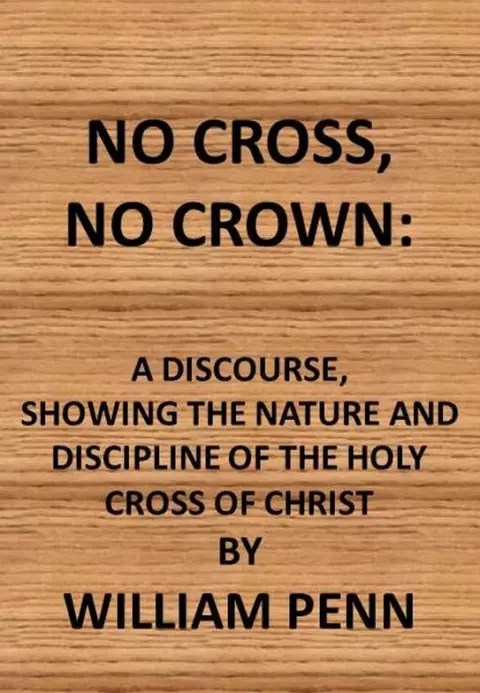
THE CLASSIC COLLECTION · 1682
"No Cross, No Crown: A Discourse Shewing the Nature and Discipline of the Holy Cross of Christ" by William Penn is a religious treatise written in the mid-19th century. This work explores the Christian concept of self-denial and emphasizes the necessity of bearing the cross as part of true discipleship. It reflects on the importance of inner transformation and spiritual obedience, contrasting genuine faith with the superficial Christianity prevalent in society. The opening of the discourse establishes the author’s deep concern for the spiritual condition of Christians who neglect the essential tenets of their faith. Penn calls upon his readers to introspectively examine their lives, discussing the consequences of living in sin and the indifference towards personal commitment to Christ. He emphasizes that embracing the cross—a symbol of suffering and self-denial—is the only path to achieving true salvation and the eternal crown promised by God. Highly reflective and earnest, the beginning of the treatise sets the stage for an exploration of the struggle between worldly desires and the spiritual journey towards righteousness.
Introduction adapted from the source catalogue; source summaries may be automatically generated.
Free to read · English · 121,105 words · No account needed
MAKE TIME FOR A GOOD BOOK
On by default. Untick to stop anonymous reading totals. Each page counts after 10 seconds in view. How this works.
Anonymous counting is on unless you have switched it off.
XXXV. I shall conclude my scripture testimonies against the foregoing respects, with that memorable and close passage of the apostle James against respect of persons in general after the world's fashion: "My brethren, have not the faith of our Lord Jesus Christ, the Lord of glory, with respect of persons: for if there come unto your assembly a man with a gold ring, in goodly apparel: and there come in also a poor man in vile raiment, and ye have respect to him that weareth the gay clothing, and say unto him, Sit thou here in a good place, (or well and seemly, as the word is;) and say to the poor, Stand thou there, or sit here under my footstool; are ye not then partial in yourselves, and are become judges of evil thoughts?" (James, ii. 1-4.) That is, they knew they did amiss: "If ye fulfil the royal law, according to the scripture, Thou shalt love thy neighbour as thyself, ye do well; but if ye have respect to persons, ye commit sin, and are convinced of the law as transgressors." (James, ii. 8, 9.) This is so full there seems nothing left for me to add, or others to object. We are not to respect persons, that is the first thing: and the next thing is, if we do we commit sin, and break the law; At our own peril be it. And yet perhaps some will say, that by this we overthrow all distinction amongst men, under their divers qualities, and introduce a reciprocal and relational respect in the room of it: but if it be so, I cannot help it, the apostle James must answer for it, who has given us this doctrine for Christian and apostolical. And yet one greater than he told his disciples, of whom James was one, "Ye know that the princes of the Gentiles exercise dominion over them, &c. But it shall not be so among you; but whosoever will be chief among you, let him be your servant." (Mat. xx. 25-27.) That is, he that affects rule, and seeks to be uppermost, shall be esteemed least among you. And to say true on the whole matter, whether we regard those early times of the world, that were antecedent to the coming of Christ or soon after, there was yet a greater simplicity than in the times in which we are fallen. For those early times of the world, as bad as they were in other things, were great strangers to the frequency of these follies: nay, they hardly used some of them, at least very rarely. For if we read the Scriptures, such a thing as my lord Adam, though lord of the world, is not to be found: nor my lord Noah neither, the second lord of the earth: nor yet my lord Abraham, the father of the faithful; nor my lord Isaac; nor my lord Jacob; but much less is my lord Paul, &c. to be found in the Bible: and less your holiness, or your grace. Nay, among the Gentiles, the people wore their own names with more simplicity, and used not the ceremony of speech that is now practised among Christians, nor yet anything like it. My lord Solon, my lord Phocion, my lord Plato, my lord Aristotle, my lord Scipio, my lord Fabius, my lord Cato, my lord Cicero, are not to be read in any of the Greek or Latin stories, and yet they were some of the sages and heroes of those great empires. No, their own names were enough to distinguish them from other men, and their virtue and employments in the public service were their titles of honour. Nor has this vanity yet crept far into the Latin writers, where it is familiar for authors to cite the most learned and the most noble, without any addition to their names, unless worthy or learned: and if their works give it them, we make no conscience to deny it them. For instance; the Fathers they only cite thus: Polycarpus, Ignatius, Irenæus, Cyprian, Tertullian, Origen, Arnobius, Lactantius, Chrysostom, Jerom, &c. More modern writers; Damascen, Rabanus, Paschasius, Theophylact, Bernard, &c. And of the last age, Luther, Melancthon, Calvin, Beza, Zuinglius, Marlorat, Vossius, Grotius, Dalleus, Amyralldus, &c. And of our own country, Gildas, Beda, Alcuinus, Horn, Bracton, Grosteed, Littleton, Cranmer, Ridley, Jewel, Whitaker, Seldon, &c. And yet I presume this will not be thought uncivil or rude. Why then is our simplicity (and so honestly grounded too, as conscience against pride in man, that so evilly and perniciously loves and seeks worship and greatness) so much despised and abused, and that by professed Christians too, who take themselves to be the followers of Him, that has forbidden these foolish customs, as plainly as any other impiety condemned in his doctrine? I earnestly beg the lovers, users, and expecters of these ceremonies, to let this I have written have some consideration and weight with them.
Your reading position is saved on this browser. Take it to another device with a library code. Reading pages adapt to text, rather than matching a printed edition.
BEHIND THE BOOK
This eBook is for the use of anyone anywhere in the United States and most other parts of the world at no cost and with almost no restrictions whatsoever. You may copy it, give it away or re-use it under the terms of the Project Gutenberg License included with this eBook or online at www.gutenberg.org. If you are not located in the United States, you will have to check the laws of the country where you are located before using this eBook. Read the source licence.
The original source file, including credits and licence, is retained by this library. Request an original-format copy at no charge. Please include the book title and Project Gutenberg identifier #44895.
KEEP YOUR CURIOSITY GOING

David Patterson (Spirit) Hatch

David Patterson (Spirit) Hatch

David Patterson (Spirit) Hatch

Edwin Abbott Abbott

Richard Watson
T. G. (Theophilus Gould) Steward