THE CLASSIC COLLECTION✦A Brief Account of the Rise and Progress of the People Called QuakersCLASSIC FREE BOOKS
A Brief Account of the Rise and Progress of the People Called Quakers
William Penn
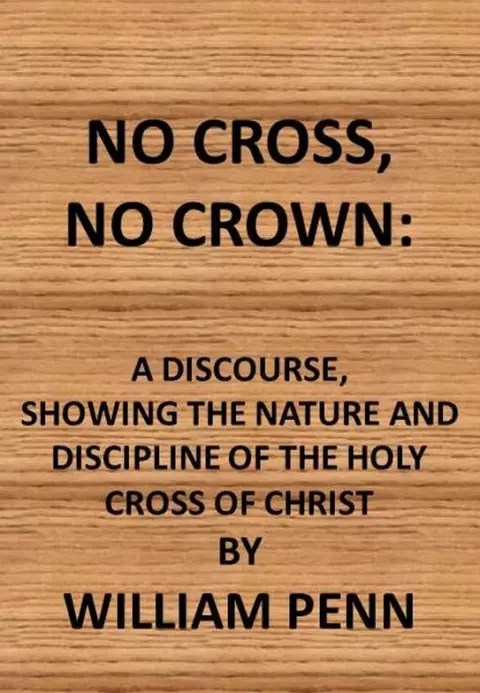
THE CLASSIC COLLECTION · 1682
"No Cross, No Crown: A Discourse Shewing the Nature and Discipline of the Holy Cross of Christ" by William Penn is a religious treatise written in the mid-19th century. This work explores the Christian concept of self-denial and emphasizes the necessity of bearing the cross as part of true discipleship. It reflects on the importance of inner transformation and spiritual obedience, contrasting genuine faith with the superficial Christianity prevalent in society. The opening of the discourse establishes the author’s deep concern for the spiritual condition of Christians who neglect the essential tenets of their faith. Penn calls upon his readers to introspectively examine their lives, discussing the consequences of living in sin and the indifference towards personal commitment to Christ. He emphasizes that embracing the cross—a symbol of suffering and self-denial—is the only path to achieving true salvation and the eternal crown promised by God. Highly reflective and earnest, the beginning of the treatise sets the stage for an exploration of the struggle between worldly desires and the spiritual journey towards righteousness.
Introduction adapted from the source catalogue; source summaries may be automatically generated.
Free to read · English · 121,105 words · No account needed
MAKE TIME FOR A GOOD BOOK
On by default. Untick to stop anonymous reading totals. Each page counts after 10 seconds in view. How this works.
Anonymous counting is on unless you have switched it off.
II. John the Baptist, who was the fore-runner of Christ's appearance in the flesh, did by his own abstinence sufficiently declare what sort of person it was he came to prepare and bespeak people to receive. For, though sanctified from his birth and declared by Christ to be the greatest of all prophets; yet his clothing was but a coarse garment of camel's hair, and a leathern girdle; and his food, only locusts and wild honey: a life very natural, and of great simplicity. This was all the pomp and retinue, which the greatest ambassador that ever came to the world was attended with; about the best of messages, to wit, Repent, for the kingdom of God is at hand: and, there is one coming after me, whose shoes-latchet I am not worthy to unloose, who shall baptize you with fire, and with the Holy Ghost; and is the Lamb of God that taketh away the sin of the world. (Mat. iii. 11; John, i. 29.) Did the fore-runner of the coming of God, for Immanuel is God with men, appear without the state, grandeur, and luxury of the world; and shall those who pretend to receive the message, and that for glad tidings too, and confess the Immanuel, Jesus Christ, to be the Lord, live in the vanity and excess of the world, and care more for their fine clothes, delicate dishes, rich furniture, stately attendance, and pleasant diversion, than for the holy cross of Christ, and blessed narrow way that leadeth to salvation. Be ashamed, and repent!
III. PETER, ANDREW, PHILIP, and the rest of the holy apostles, were, by calling as well as doctrine, not a luxurious people; for they were made up of poor fishermen and mechanics; for Christ called not his disciples out of the higher ranks of men, nor had they ability any more than will to use the excesses herein reproved. You may conceive what their lives were, by what their Master's doctrine was; for they were the true scholars of his heavenly discipline. Peter thus speaks, and exhorteth the Christians of his time, "Let not your adorning be that outward adorning of plaiting the hair, and the wearing of gold, and of putting on of apparel; but let it be the hidden man of the heart, in that which is not corruptible, even the ornament of a meek and quiet spirit, which is in the sight of God of great price; for after this manner, in the old time, the holy women, who also trusted in God, adorned themselves." (1 Pet. iii. 3, 4.) Wherefore gird up the loins of your minds, be sober and hope to the end, as obedient children, not fashioning yourselves according to your former lusts, in your ignorance, but as He which hath called you is holy, so be ye holy in all manner of conversation: (1 Pet. i. 13-15:) and giving all diligence, add to your faith, virtue; to virtue, knowledge; and to knowledge, temperance; and to temperance, patience; and to patience, godliness; and to godliness, brotherly-kindness; and to brotherly-kindness, charity; for if these things be in you and abound, they make you, that you shall be neither barren nor unfruitful: for so an entrance shall be ministered unto you abundantly, into the everlasting kingdom of our Lord and Saviour Jesus Christ; (2 Pet. i. 5-8, 11;) not rendering evil for evil, or railing for railing; but contrariwise, blessing; knowing that ye are thereunto called, that ye shall inherit a blessing: (1 Pet. iii. 9:) for even hereunto were ye called, because Christ also suffered for us, leaving us an example, that ye should follow his steps, who did no sin, neither was guile found in his mouth; who, when He was reviled, reviled not again; when He suffered, He threatened not, but committed himself to Him that judgeth righteously. (1 Pet. ii. 21-23.)
Your reading position is saved on this browser. Take it to another device with a library code. Reading pages adapt to text, rather than matching a printed edition.
BEHIND THE BOOK
This eBook is for the use of anyone anywhere in the United States and most other parts of the world at no cost and with almost no restrictions whatsoever. You may copy it, give it away or re-use it under the terms of the Project Gutenberg License included with this eBook or online at www.gutenberg.org. If you are not located in the United States, you will have to check the laws of the country where you are located before using this eBook. Read the source licence.
The original source file, including credits and licence, is retained by this library. Request an original-format copy at no charge. Please include the book title and Project Gutenberg identifier #44895.
KEEP YOUR CURIOSITY GOING

David Patterson (Spirit) Hatch

David Patterson (Spirit) Hatch

David Patterson (Spirit) Hatch

Edwin Abbott Abbott

Richard Watson
T. G. (Theophilus Gould) Steward