READ · DISCOVER · ENJOYClassic literature · Always free
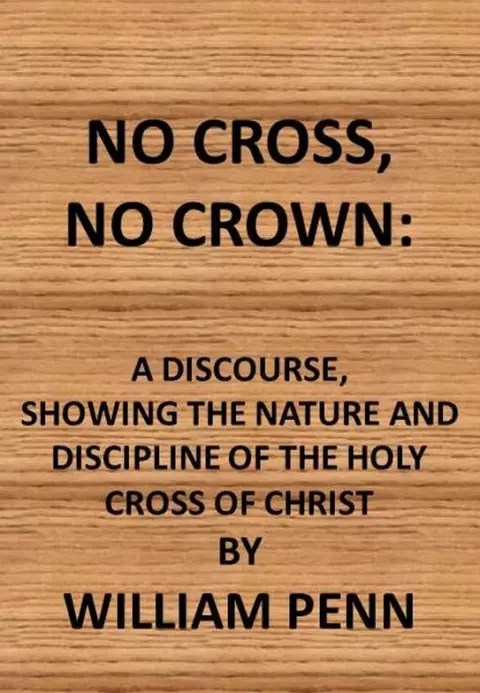
No cross, no crown — digital edition cover

THE CLASSIC COLLECTION · 1682

No cross, no crown

"No Cross, No Crown: A Discourse Shewing the Nature and Discipline of the Holy Cross of Christ" by William Penn is a religious treatise written in the mid-19th century. This work explores the Christian concept of self-denial and emphasizes the necessity of bearing the cross as part of true discipleship. It reflects on the importance of inner transformation and spiritual obedience, contrasting genuine faith with the superficial Christianity prevalent in society. The opening of the discourse establishes the author’s deep concern for the spiritual condition of Christians who neglect the essential tenets of their faith. Penn calls upon his readers to introspectively examine their lives, discussing the consequences of living in sin and the indifference towards personal commitment to Christ. He emphasizes that embracing the cross—a symbol of suffering and self-denial—is the only path to achieving true salvation and the eternal crown promised by God. Highly reflective and earnest, the beginning of the treatise sets the stage for an exploration of the struggle between worldly desires and the spiritual journey towards righteousness.

Introduction adapted from the source catalogue; source summaries may be automatically generated.

Start reading ↓

Free to read · English · 121,105 words · No account needed

MAKE TIME FOR A GOOD BOOK

No cross, no crown

On by default. Untick to stop anonymous reading totals. Each page counts after 10 seconds in view. How this works.

Anonymous counting is on unless you have switched it off.

No cross, no crown

"Here Zeno lies, who tall Olympus scal'd;
Not heaping Pelion on Ossa's head;
Nor by Herculean labours so prevailed;
But found out virtue's paths, which thither led."

The other by Xenodotus, the Stoic, thus:

"Zeno, thy years to hoary age were spent,
Not with vain riches, but with self-content."

XXVII. Seneca, a great and excellent philosopher, who with Epictetus shall conclude the testimonies of the men of their character, hath so much to our purpose that his works are but a kind of continued evidence for us: he saith, "Nature was not so much an enemy, as to give an easy passage of life to all other creatures, and that man alone should not live without so many arts; she hath commanded us none of these things. We have made all things difficult to us, by disdaining things that are easy: houses, clothes, meats, and nourishment of bodies, and those things which are now the care of life, were easy to come by, freely gotten, and prepared with a light labour: for the measure of these things was necessity, not voluptuousness: but we have made them pernicious and admirable: they must be sought with art and skill. Nature sufficeth to that which she requireth.

"Appetite hath revolted from nature, which continually inciteth itself, and increaseth with the ages, helping vice by wit. First it began to desire superfluous, then contrary things: last of all, it sold the mind to the body, and commanded it to serve the lusts thereof. All these arts, wherewith the city is continually set at work, and maketh such a stir, do center in the affairs of the body, to which all things were once performed as to a servant, but now are provided as for a lord: hence the shops of engravers, perfumers, &c. Hence, of those that teach effeminate motions of the body, and vain and wanton songs: for natural behaviour is despised, which completed desires with necessary help; now it is clownishness and ill-breeding to be contented with as much as is requisite. What shall I speak of rich marbles curiously wrought, wherewith temples and houses do shine? What of stately galleries and rich furniture? these are but the devices of most vile slaves; the inventions of men, not of wise men: for wisdom sits deeper; it is the mistress of the mind. Wilt thou know what things she hath found out, what she hath made? Not unseemly motions of the body, nor variable singing by trumpet or flute; nor yet weapons of wars, or fortifications: she endeavoureth profitable things; she favours peace, and calls all mankind to agreement: she leadeth to a blessed estate; she openeth the way to it, and shows what is evil from what is good, and chaseth vanity out of the mind. She giveth solid greatness, but debaseth that which is puffed up, and would be seen of men: she bringeth forth the image of God to be seen in the souls of men: and so from corporeal, she translateth into incorporeal things." Thus in the 90th epistle to Luculius. To Gallio, he writeth thus: "All men, brother Gallio, are desirous to live happy, yet blind to the means of that blessedness. As long as we wander hither and thither, and follow not our guide, but the dissonant clamour of those that call on us to undertake different ways, our short life is wearied and worn away amongst errors, although we labour to get us a good mind: there is nothing therefore to be more avoided, than following the multitude without examination, and believing anything without judging. Let us inquire, what is best done, not what is more usually done; and what planted us in the possession of eternal felicity; not what is ordinarily allowed of by the multitude, which is the worst interpreter of truth. I call the multitude, as well those that are clothed in white, as those in other colours: for I examine not the colours of the garments, wherewith their bodies are clothed: I trust not mine eyes to inform me what a man is; I have a better and truer light, whereby I can distinguish truth from falsehood. Let the soul find out the good of the soul; if once she may have leisure to withdraw into herself, Oh! how will she confess, I wish all I have done were undone; and all I have said, when I recollect it, I am ashamed of it, when I now hear the like in others. These things below, whereat we gaze, and whereat we stay, and which one man with admiration shows unto another, do outwardly shine, but are inwardly empty. Let us seek out somewhat that is good, not in appearance, but solid, united, and best, in that which least appears: let us discover this. Neither is it far from us: we shall find it if we seek it. For it is wisdom not to wander from that immortal nature, but to form ourselves according to his law and example. Blessed is the man who judgeth rightly: blessed is he who is contented with his present condition: and blessed is he who giveth ear to that immortal principle, in the government of his life." A whole volume of these excellent things hath he written. No wonder a man of his doctrine and life escaped not the cruelty of brutish Nero, under whom he suffered death; as also did the apostle Paul, with whom, it is said Seneca had conversed. When Nero's messenger brought him the news, that he was to die; with a composed and undaunted countenance he received the errand, and presently called for pen, ink, and paper, to write his last will and testament; which the captain refusing, he turned towards his friends, and took his leave thus: "Since, my loving friends, I cannot bequeath you any other thing in acknowledgment of what I owe you, I leave you at least the richest and best portion I have, that is the image of my manners and life, which doing, you will obtain true happiness." His friends showing great trouble for the loss of him; "Where," saith he, "are those memorable precepts of philosophy? And what is become of those provisions, which for so many years together we have laid up against the brunts and afflictions of Providence? Was Nero's cruelty unknown to us? What could we expect better at his hands, that killed his brother and murdered his mother, but that he would put also his tutor and governor to death?" Then turning to his wife Pompeia Paulina, a Roman lady, young and noble, besought her for the love she bore him and his philosophy, to suffer patiently his affliction: "For," saith he, "my hour is come wherein I must show, not only by discourse but by death, the fruit I have reaped by my meditations; I embrace it without grief, wherefore do not dishonour it with thy tears. Assuage thy sorrow, and comfort thyself in the knowledge thou hast had of me, and of my actions; and lead the rest of thy life with that honest industry thou hast addicted thyself unto." And dedicating his life to God, he expired.

Your reading position is saved on this browser. Take it to another device with a library code. Reading pages adapt to text, rather than matching a printed edition.

More from this author

BEHIND THE WORDS

About William Penn

William Penn (1644–1718). Explore No cross, no crown, A Brief Account of the Rise and Progress of the People Called Quakers in this collection. These books span religion & spirituality, history.

Explore this author’s books →

THE READERS’ VERDICT

How did this story stay with you?

Not rated yet
Your rating for No cross, no crown

Be the first to share your verdict.

One rating per browser, which you can change or remove. A necessary browser identifier remembers your vote. How ratings work

A GOOD STORY DESERVES COMPANY

Pass this book along.

A great read is even better when it’s shared.

SEND A LITTLE INSPIRATION

Share this book

BEHIND THE BOOK

Edition & source details.

Title
No cross, no crown
Author
William Penn
First publication (Open Library catalogue match)
1682
Digital edition publisher
Project Gutenberg
Gutenberg release date
2014-02-13
Language
English
Source edition imprint
Not stated in source catalogue
Source identifier
Project Gutenberg #44895
Contributors
No additional named contributors in source metadata

Public-domain source & licence

This eBook is for the use of anyone anywhere in the United States and most other parts of the world at no cost and with almost no restrictions whatsoever. You may copy it, give it away or re-use it under the terms of the Project Gutenberg License included with this eBook or online at www.gutenberg.org. If you are not located in the United States, you will have to check the laws of the country where you are located before using this eBook. Read the source licence.

Full source licence and obtaining an original copy

The original source file, including credits and licence, is retained by this library. Request an original-format copy at no charge. Please include the book title and Project Gutenberg identifier #44895.

the full Project Gutenberg License must appear
prominently whenever any copy of a Project Gutenberg work (any work
on which the phrase “Project Gutenberg” appears, or with which the
phrase “Project Gutenberg” is associated) is accessed, displayed,
performed, viewed, copied or distributed:

This eBook is for the use of anyone anywhere in the United States and most
other parts of the world at no cost and with almost no restrictions
whatsoever. You may copy it, give it away or re-use it under the terms
of the Project Gutenberg™ License included with this eBook or online
at www.gutenberg.org. If you
are not located in the United States, you will have to check the laws
of the country where you are located before using this eBook.

1.E.2. If an individual Project Gutenberg electronic work is
derived from texts not protected by U.S. copyright law (does not
contain a notice indicating that it is posted with permission of the
copyright holder), the work can be copied and distributed to anyone in
the United States without paying any fees or charges. If you are
redistributing or providing access to a work with the phrase “Project
Gutenberg” associated with or appearing on the work, you must comply
either with the requirements of paragraphs 1.E.1 through 1.E.7 or
obtain permission for the use of the work and the Project Gutenberg
trademark as set forth in paragraphs 1.E.8 or 1.E.9.

1.E.3. If an individual Project Gutenberg electronic work is posted
with the permission of the copyright holder, your use and distribution
must comply with both paragraphs 1.E.1 through 1.E.7 and any
additional terms imposed by the copyright holder. Additional terms
will be linked to the Project Gutenberg License for all works
posted with the permission of the copyright holder found at the
beginning of this work.

1.E.4. Do not unlink or detach or remove the full Project Gutenberg
License terms from this work, or any files containing a part of this
work or any other work associated with Project Gutenberg.

1.E.5. Do not copy, display, perform, distribute or redistribute this
electronic work, or any part of this electronic work, without
prominently displaying the sentence set forth in paragraph 1.E.1 with
active links or immediate access to the full terms of the Project
Gutenberg License.

1.E.6. You may convert to and distribute this work in any binary,
compressed, marked up, nonproprietary or proprietary form, including
any word processing or hypertext form. However, if you provide access
to or distribute copies of a Project Gutenberg work in a format
other than “Plain Vanilla ASCII” or other format used in the official
version posted on the official Project Gutenberg website
(www.gutenberg.org), you must, at no additional cost, fee or expense
to the user, provide a copy, a means of exporting a copy, or a means
of obtaining a copy upon request, of the work in its original “Plain
Vanilla ASCII” or other form. Any alternate format must include the
full Project Gutenberg License as specified in paragraph 1.E.1.

1.E.7. Do not charge a fee for access to, viewing, displaying,
performing, copying or distributing any Project Gutenberg works
unless you comply with paragraph 1.E.8 or 1.E.9.

1.E.8. You may charge a reasonable fee for copies of or providing
access to or distributing Project Gutenberg electronic works
provided that:

• You pay a royalty fee of 20% of the gross profits you derive from
the use of Project Gutenberg works calculated using the method
you already use to calculate your applicable taxes. The fee is owed
to the owner of the Project Gutenberg trademark, but he has
agreed to donate royalties under this paragraph to the Project
Gutenberg Literary Archive Foundation. Royalty payments must be paid
within 60 days following each date on which you prepare (or are
legally required to prepare) your periodic tax returns. Royalty
payments should be clearly marked as such and sent to the Project
Gutenberg Literary Archive Foundation at the address specified in
Section 4, “Information about donations to the Project Gutenberg
Literary Archive Foundation.”

• You provide a full refund of any money paid by a user who notifies
you in writing (or by e-mail) within 30 days of receipt that s/he
does not agree to the terms of the full Project Gutenberg™
License. You must require such a user to return or destroy all
copies of the works possessed in a physical medium and discontinue
all use of and all access to other copies of Project Gutenberg™
works.

• You provide, in accordance with paragraph 1.F.3, a full refund of
any money paid for a work or a replacement copy, if a defect in the
electronic work is discovered and reported to you within 90 days of
receipt of the work.

• You comply with all other terms of this agreement for free
distribution of Project Gutenberg™ works.


1.E.9. If you wish to charge a fee or distribute a Project
Gutenberg™ electronic work or group of works on different terms than
are set forth in this agreement, you must obtain permission in writing
from the Project Gutenberg Literary Archive Foundation, the manager of
the Project Gutenberg™ trademark. Contact the Foundation as set
forth in Section 3 below.

1.F.

1.F.1. Project Gutenberg volunteers and employees expend considerable
effort to identify, do copyright research on, transcribe and proofread
works not protected by U.S. copyright law in creating the Project
Gutenberg™ collection. Despite these efforts, Project Gutenberg™
electronic works, and the medium on which they may be stored, may
contain “Defects,” such as, but not limited to, incomplete, inaccurate
or corrupt data, transcription errors, a copyright or other
intellectual property infringement, a defective or damaged disk or
other medium, a computer virus, or computer codes that damage or
cannot be read by your equipment.

1.F.2. LIMITED WARRANTY, DISCLAIMER OF DAMAGES - Except for the “Right
of Replacement or Refund” described in paragraph 1.F.3, the Project
Gutenberg Literary Archive Foundation, the owner of the Project
Gutenberg™ trademark, and any other party distributing a Project
Gutenberg™ electronic work under this agreement, disclaim all
liability to you for damages, costs and expenses, including legal
fees. YOU AGREE THAT YOU HAVE NO REMEDIES FOR NEGLIGENCE, STRICT
LIABILITY, BREACH OF WARRANTY OR BREACH OF CONTRACT EXCEPT THOSE
PROVIDED IN PARAGRAPH 1.F.3. YOU AGREE THAT THE FOUNDATION, THE
TRADEMARK OWNER, AND ANY DISTRIBUTOR UNDER THIS AGREEMENT WILL NOT BE
LIABLE TO YOU FOR ACTUAL, DIRECT, INDIRECT, CONSEQUENTIAL, PUNITIVE OR
INCIDENTAL DAMAGES EVEN IF YOU GIVE NOTICE OF THE POSSIBILITY OF SUCH
DAMAGE.

1.F.3. LIMITED RIGHT OF REPLACEMENT OR REFUND - If you discover a
defect in this electronic work within 90 days of receiving it, you can
receive a refund of the money (if any) you paid for it by sending a
written explanation to the person you received the work from. If you
received the work on a physical medium, you must return the medium
with your written explanation. The person or entity that provided you
with the defective work may elect to provide a replacement copy in
lieu of a refund. If you received the work electronically, the person
or entity providing it to you may choose to give you a second
opportunity to receive the work electronically in lieu of a refund. If
the second copy is also defective, you may demand a refund in writing
without further opportunities to fix the problem.

1.F.4. Except for the limited right of replacement or refund set forth
in paragraph 1.F.3, this work is provided to you ‘AS-IS’, WITH NO
OTHER WARRANTIES OF ANY KIND, EXPRESS OR IMPLIED, INCLUDING BUT NOT
LIMITED TO WARRANTIES OF MERCHANTABILITY OR FITNESS FOR ANY PURPOSE.

1.F.5. Some states do not allow disclaimers of certain implied
warranties or the exclusion or limitation of certain types of
damages. If any disclaimer or limitation set forth in this agreement
violates the law of the state applicable to this agreement, the
agreement shall be interpreted to make the maximum disclaimer or
limitation permitted by the applicable state law. The invalidity or
unenforceability of any provision of this agreement shall not void the
remaining provisions.

1.F.6. INDEMNITY - You agree to indemnify and hold the Foundation, the
trademark owner, any agent or employee of the Foundation, anyone
providing copies of Project Gutenberg™ electronic works in
accordance with this agreement, and any volunteers associated with the
production, promotion and distribution of Project Gutenberg™
electronic works, harmless from all liability, costs and expenses,
including legal fees, that arise directly or indirectly from any of
the following which you do or cause to occur: (a) distribution of this
or any Project Gutenberg work, (b) alteration, modification, or
additions or deletions to any Project Gutenberg work, and (c) any
Defect you cause.

Section 2. Information about the Mission of Project Gutenberg

Project Gutenberg is synonymous with the free distribution of
electronic works in formats readable by the widest variety of
computers including obsolete, old, middle-aged and new computers. It
exists because of the efforts of hundreds of volunteers and donations
from people in all walks of life.

Volunteers and financial support to provide volunteers with the
assistance they need are critical to reaching Project Gutenberg’s
goals and ensuring that the Project Gutenberg collection will
remain freely available for generations to come. In 2001, the Project
Gutenberg Literary Archive Foundation was created to provide a secure
and permanent future for Project Gutenberg and future
generations. To learn more about the Project Gutenberg Literary
Archive Foundation and how your efforts and donations can help, see
Sections 3 and 4 and the Foundation information page at www.gutenberg.org.

Section 3. Information about the Project Gutenberg Literary Archive Foundation

The Project Gutenberg Literary Archive Foundation is a non-profit
501(c)(3) educational corporation organized under the laws of the
state of Mississippi and granted tax exempt status by the Internal
Revenue Service. The Foundation’s EIN or federal tax identification
number is 64-6221541. Contributions to the Project Gutenberg Literary
Archive Foundation are tax deductible to the full extent permitted by
U.S. federal laws and your state’s laws.

The Foundation’s business office is located at 41 Watchung Plaza #516,
Montclair NJ 07042, USA, +1 (862) 621-9288. Email contact links and up
to date contact information can be found at the Foundation’s website
and official page at www.gutenberg.org/contact

Section 4. Information about Donations to the Project Gutenberg
Literary Archive Foundation

Project Gutenberg™ depends upon and cannot survive without widespread
public support and donations to carry out its mission of
increasing the number of public domain and licensed works that can be
freely distributed in machine-readable form accessible by the widest
array of equipment including outdated equipment. Many small donations
($1 to $5,000) are particularly important to maintaining tax exempt
status with the IRS.

The Foundation is committed to complying with the laws regulating
charities and charitable donations in all 50 states of the United
States. Compliance requirements are not uniform and it takes a
considerable effort, much paperwork and many fees to meet and keep up
with these requirements. We do not solicit donations in locations
where we have not received written confirmation of compliance. To SEND
DONATIONS or determine the status of compliance for any particular state
visit www.gutenberg.org/donate.

While we cannot and do not solicit contributions from states where we
have not met the solicitation requirements, we know of no prohibition
against accepting unsolicited donations from donors in such states who
approach us with offers to donate.

International donations are gratefully accepted, but we cannot make
any statements concerning tax treatment of donations received from
outside the United States. U.S. laws alone swamp our small staff.

Please check the Project Gutenberg web pages for current donation
methods and addresses. Donations are accepted in a number of other
ways including checks, online payments and credit card donations. To
donate, please visit: www.gutenberg.org/donate.

Section 5. General Information About Project Gutenberg electronic works

Professor Michael S. Hart was the originator of the Project
Gutenberg concept of a library of electronic works that could be
freely shared with anyone. For forty years, he produced and
distributed Project Gutenberg eBooks with only a loose network of
volunteer support.

Project Gutenberg eBooks are often created from several printed
editions, all of which are confirmed as not protected by copyright in
the U.S. unless a copyright notice is included. Thus, we do not
necessarily keep eBooks in compliance with any particular paper
edition.

Most people start at our website which has the main PG search
facility: www.gutenberg.org.

This website includes information about Project Gutenberg,
including how to make donations to the Project Gutenberg Literary
Archive Foundation, how to help produce our new eBooks, and how to
subscribe to our email newsletter to hear about new eBooks.


KEEP YOUR CURIOSITY GOING

Your next chapter awaits.