
Dead letters
Maurice Baring
THE CLASSIC COLLECTION · 1904
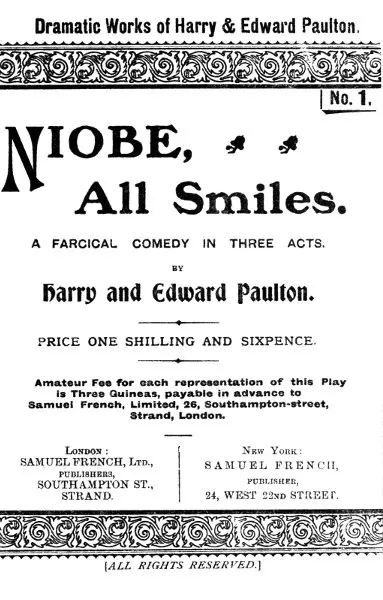
"Niobe, All Smiles: A Farcical Comedy in Three Acts" by Harry and Edward Paulton is a comedic play written in the late 19th century. This farcical work revolves around the amusing interactions within a household that unexpectedly sees the reawakening of a statue, Niobe, who has been brought to life after centuries. The narrative highlights the comical chaos that ensues as Dunn, the bewildered householder, grapples with the presence of this ancient figure, his family dynamics, and the implications of their interactions. At the start of the play, the Dunn family is preparing to leave for the theater, and various characters engage in light banter reflecting their unique personalities. The dialogue humorously reveals the complexities of their relationships, particularly focusing on Peter Dunn, who is portrayed as somewhat beleaguered under the weight of his domestic life. As the scene unfolds, we learn about Peter's wife, Helen, and her critical nature, as well as the peculiarities surrounding a statue of Niobe that has been recently acquired. The opening acts hint at a comedic mix of misunderstandings and social commentary, culminating in the whimsical arrival of Niobe herself, set to further complicate the household's affairs and amuse the audience with her anachronistic demeanor.
Introduction adapted from the source catalogue; source summaries may be automatically generated.
Free to read · English · 23,493 words · No account needed
MAKE TIME FOR A GOOD BOOK
On by default. Untick to stop anonymous reading totals. Each page counts after 10 seconds in view. How this works.
Anonymous counting is on unless you have switched it off.
SCENE.--DUNN'S drawing-room, the opposite end to Act I. Conservatory with steps at back C. Bay window R. Plain window or blank piece above. Blank piece or Alcove L. Door above to Library. Table R. C. with chairs. Couch L. Footstool L. C. Screen is not on; is supposed to be at audience side of room. Piano against flat. Paper on table.
HELEN up C. and CARRIE at window R. dressed for walking; discovered interviewing MARY, up L. C.
HEL. Can you not tell us Mary, at what hour she came?
MARY. I don't know, ma'am--I didn't hear her come and I didn't let her
in.
HEL. You hear Carrie, he let her in himself.
CAR. (R. C.) I don't see why we should attach any importance to that!
MARY. No Ma'am, for she might have got in by herself; she is the strangest person I ever met, Ma'am.
HEL. In what way?
HATTIE enters L., goes to couch, playing with mechanical toy.
MARY. Why, the name she gives things. She asked me at breakfast to hand her the Mazas, and when I didn't understand her, she called me Helot, and pointed to the muffins.
HAT. If you're talking about Miss Mifton, she is a treat. She's got a
new name for sausages.
CAR. If she will only be good to the children.
HAT. You needn't worry about that. If you'd seen the way she wept over them, and kissed and fondled them. And called them Hippicus and Alophagos.
HEL. (sternly) Who are they?
HAT. Oh, I didn't like to ask--some connections of her own, perhaps.
HEL. No doubt! They are sufficiently outlandish; the idea of a Governess, wandering about the house in an extravagant tea gown; impertinence I call it.
MARY. I suppose we're to take our orders from you as usual, Mum?
HEL. Yes! Certainly!
MARY. Thank ye! I don't want to have that person lording it over me.
MARY exits L. D. with an indignant toss of her head.
CAR. (R.) She's no doubt one of those highly emotional creatures, who grow hysterical at almost anything.
HEL. (coming slightly forward) Carrie, you're so confiding; such affectation wouldn't suit me.
CAR. But you always were superior to ordinary woman's weakness.
HAT. Weakness! Oh, there's no flipperty flop about Helen.
HEL. (advances towards HATTIE) Hattie! When you are more like me, you will have more cause for self-respect.
HAT. Oh! I've nothing against myself as I am.
CAR. When we return you must examine her Helen, and find out if she is competent to teach the children.
Your reading position is saved on this browser. Take it to another device with a library code. Reading pages adapt to text, rather than matching a printed edition.
BEHIND THE BOOK
This eBook is for the use of anyone anywhere in the United States and most other parts of the world at no cost and with almost no restrictions whatsoever. You may copy it, give it away or re-use it under the terms of the Project Gutenberg License included with this eBook or online at www.gutenberg.org. If you are not located in the United States, you will have to check the laws of the country where you are located before using this eBook. Read the source licence.
The original source file, including credits and licence, is retained by this library. Request an original-format copy at no charge. Please include the book title and Project Gutenberg identifier #46226.
KEEP YOUR CURIOSITY GOING
Maurice Baring
Francis Greenleaf Allinson & Anne C. E. (Anne Crosby Emery) Allinson
Maurice Baring
Stuart Dodgson Collingwood
Percy Keese Fitzhugh
W. B. (William Butler) Yeats