
Dead letters
Maurice Baring
THE CLASSIC COLLECTION · 1904
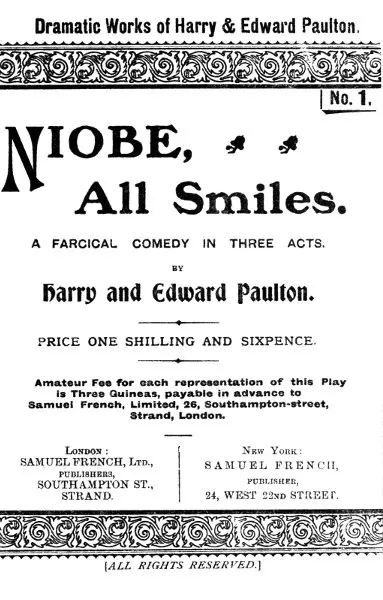
"Niobe, All Smiles: A Farcical Comedy in Three Acts" by Harry and Edward Paulton is a comedic play written in the late 19th century. This farcical work revolves around the amusing interactions within a household that unexpectedly sees the reawakening of a statue, Niobe, who has been brought to life after centuries. The narrative highlights the comical chaos that ensues as Dunn, the bewildered householder, grapples with the presence of this ancient figure, his family dynamics, and the implications of their interactions. At the start of the play, the Dunn family is preparing to leave for the theater, and various characters engage in light banter reflecting their unique personalities. The dialogue humorously reveals the complexities of their relationships, particularly focusing on Peter Dunn, who is portrayed as somewhat beleaguered under the weight of his domestic life. As the scene unfolds, we learn about Peter's wife, Helen, and her critical nature, as well as the peculiarities surrounding a statue of Niobe that has been recently acquired. The opening acts hint at a comedic mix of misunderstandings and social commentary, culminating in the whimsical arrival of Niobe herself, set to further complicate the household's affairs and amuse the audience with her anachronistic demeanor.
Introduction adapted from the source catalogue; source summaries may be automatically generated.
Free to read · English · 23,493 words · No account needed
MAKE TIME FOR A GOOD BOOK
On by default. Untick to stop anonymous reading totals. Each page counts after 10 seconds in view. How this works.
Anonymous counting is on unless you have switched it off.
TOMP. Let me thank you, Mr. Dunn, for taking such particular care of my treasure. It was most considerate of you to bring it into your own house.
TOMPKINS posing L. C.
DUNN. (R. C.) Not at all! I was anxious to have it unpacked, just to make sure it hadn't suffered in shipment.
TOMP. (enthusiastically--taking off gloves) Ah! you thought of the centuries that beautiful form had retained its completeness, without damage or disfigurement, and were impressed with a tender, almost loving, care.
DUNN. Not a bit! I thought of the loss to our Company if it got chipped. There was no sentiment or friendship in the business. Sentiment's all very well, but there's no money in it.
DUNN crosses to window, L. C.; SILLOCKS enters from dining-room R.; lights begin to go slowly down.
SILL. (R. C.) How do you do, Mr. Tompkins. I congratulate you Sir, on the possession of such a gem.
TOMP. (L. C.) Beautiful, is it not?
SILL. (R. C.) Grand! A painting like that----
TOMP. Painting! I am speaking of my Statue, Niobe.
SILL. Oh, I haven't seen it.
TOMP. (C.) Ah, when you do! Where among your moderns is a work like it? Where among your Sculptors, the peer of Phidias, Praxiteles, Scophas or Polydorus of Rhodes?
DUNN. (L. of table) And which of the whole lot would compare with
Edison?
TOMP. Ah, Dunn! You are not familiar with the Elgin Marbles.
DUNN. Haven't played a game since I was a boy! (sits L. of table)
TOMP. (despondently) Sculpture is dead now Sillocks.
SILL. Don't despond Tompkins, it may revive!
DUNN. Sculpture's right enough in its way--but it isn't in it with the Telephone, or the Telegraph, or the Tape, or the Typewriter.
TOMP. Ugh! All such inventions tend to warp the noblest traits of human
nature.
DUNN. Statues are all right for decorating Parks, but there's no money
in them.
SILL. I'm in favor of the modern myself.
TOMP. And I sigh for the Antique--(sits R. of table L. C.) I should like to have lived in the days of Homer!
DUNN. Not for me. I can't fancy existence without cheap postage, fast steamers, and penny-in-the-slot machines. I countenance every improvement. Move with the times I say, and get ahead of 'em if you can. (rise) I'm getting the Electric light put in now; we make our connection from the street here, just as you do with your gas.
TOMP. I hate gas. I would go back to the pine torch or the days of
candles!
DUNN. (L.) Yes! You're crazed on the subject of Early Greece.
SILLOCKS laughs.
TOMP. (L. C.) I am, and I glory in it.
Your reading position is saved on this browser. Take it to another device with a library code. Reading pages adapt to text, rather than matching a printed edition.
BEHIND THE BOOK
This eBook is for the use of anyone anywhere in the United States and most other parts of the world at no cost and with almost no restrictions whatsoever. You may copy it, give it away or re-use it under the terms of the Project Gutenberg License included with this eBook or online at www.gutenberg.org. If you are not located in the United States, you will have to check the laws of the country where you are located before using this eBook. Read the source licence.
The original source file, including credits and licence, is retained by this library. Request an original-format copy at no charge. Please include the book title and Project Gutenberg identifier #46226.
KEEP YOUR CURIOSITY GOING
Maurice Baring
Francis Greenleaf Allinson & Anne C. E. (Anne Crosby Emery) Allinson
Maurice Baring
Stuart Dodgson Collingwood
Percy Keese Fitzhugh
W. B. (William Butler) Yeats