
The lost dirigible
Ralph Henry Barbour
THE CLASSIC COLLECTION · 1923
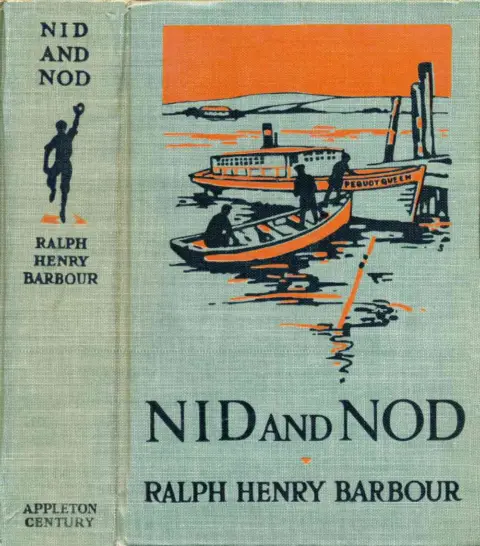
"Nid and Nod" by Ralph Henry Barbour is a novel written in the early 20th century. The story revolves around twin brothers, Nid and Nod Turner, and their adventures at a boarding school, particularly with their overweight friend Kewpie Proudtree. The book explores themes of friendship, loyalty, and the struggles of fitting in, especially in a school environment where sports play a significant role. At the start of "Nid and Nod," readers are introduced to the lively atmosphere of the local soda shop where Kewpie engages in humorous banter with Polly, the shopkeeper's daughter, about his eating habits and his aspirations in sports. The chapter sets the tone for the friendships between Kewpie, Nid, and their friends as they navigate the challenges of adolescence together. Kewpie, feeling a need to prove himself, expresses a desire to join the baseball team, prompting Nid to consider how they might help him achieve this goal. Thus, the opening scene forms the foundation for both individual and collective struggles, setting the stage for the unfolding narrative.
Introduction adapted from the source catalogue; source summaries may be automatically generated.
Free to read · English · 66,981 words · No account needed
MAKE TIME FOR A GOOD BOOK
On by default. Untick to stop anonymous reading totals. Each page counts after 10 seconds in view. How this works.
Anonymous counting is on unless you have switched it off.
“You do it in less,” challenged Bob indignantly.
“I have. Here’s Ned’s:
“Sister-in-law to be turned out of home unless you come to
rescue immediately.”
“Sounds as though you meant your own sister-in-law,” commented Laurie. “That’s not bad, though.”
“Sounds all right to me,” said Ned. “Let’s hear yours.”
“Is Miss Comfort being evicted from house by your order? Public opinion in arms. Answer.”
“Huh,” said Ned, “public opinion can’t be ‘in arms,’ you silly chump.”
“That’s only two words less than mine,” said Bob.
“Well, we’ll see if we can’t get it into ten,” replied Laurie untroubledly. “Now then!” He took up his pencil again. “We might say ‘Comfort’ instead of ‘Miss Comfort,’ but it doesn’t sound quite respectful.”
“Leave out ‘from house,’” suggested Bob. “He will understand that she isn’t being evicted from the stable!”
“That’s so! ‘Is Miss Comfort being evicted by your order? Public opinion――er――’”
“‘Against it,’” offered Ned.
“‘Opposed,’” said Bob.
“I’ve got it!” exclaimed Laurie, erasing and starting a new draft. “How’s this? ‘Have you authorized eviction aged sister-in-law? Orstead indignant. Answer immediately.’ That ought to fetch him! Only ten words, too!”
“How about sister-in-law?” asked Bob. “Will they call it one word or
three?”
“One, of course. Or ‘aged relative’ might do just as well. ‘Orstead indignant’ will give him a jolt, I’ll bet!”
“What are you going to sign it?” asked Ned anxiously.
Laurie hadn’t thought of that. Bob suggested “Friend,” but Ned reminded him that if they expected to get a reply they’d have to give more of an address than that. Laurie took a deep breath and leaped the Rubicon. He signed “Laurence S. Turner” boldly and drew a heavy mark under it for emphasis. Ned shook his head doubtfully, but Bob was thrilled.
“He will probably think you’re one of the town’s leading citizens,” he
chuckled.
“Well, so I am,” answered Laurie, “in this affair. Now we’ll go down and get it off at night-rates.”
“Say,” said Ned, “we’re a set of dumb-bells! We could have sent a night-letter of fifty words for the same price.”
“That’s so,” admitted Laurie. “I think a night-letter costs a little more, though, doesn’t it? Anyway, this is more――more succinct. It sounds more businesslike. What do you think?”
Your reading position is saved on this browser. Take it to another device with a library code. Reading pages adapt to text, rather than matching a printed edition.
Ralph Henry Barbour
Ralph Henry Barbour

Ralph Henry Barbour

Ralph Henry Barbour
BEHIND THE BOOK
This eBook is for the use of anyone anywhere in the United States and most other parts of the world at no cost and with almost no restrictions whatsoever. You may copy it, give it away or re-use it under the terms of the Project Gutenberg License included with this eBook or online at www.gutenberg.org. If you are not located in the United States, you will have to check the laws of the country where you are located before using this eBook. Read the source licence.
The original source file, including credits and licence, is retained by this library. Request an original-format copy at no charge. Please include the book title and Project Gutenberg identifier #71633.
KEEP YOUR CURIOSITY GOING
Coulson Kernahan

Maurice Baring
Frances Wright
Cécile Tormay

Frederic Jesup Stimson

W. H. P. (William Henry Pope) Jarvis