
The lost dirigible
Ralph Henry Barbour
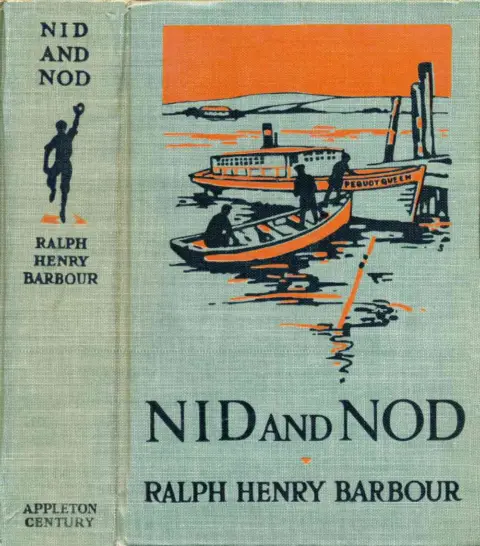
THE CLASSIC COLLECTION · 1923
"Nid and Nod" by Ralph Henry Barbour is a novel written in the early 20th century. The story revolves around twin brothers, Nid and Nod Turner, and their adventures at a boarding school, particularly with their overweight friend Kewpie Proudtree. The book explores themes of friendship, loyalty, and the struggles of fitting in, especially in a school environment where sports play a significant role. At the start of "Nid and Nod," readers are introduced to the lively atmosphere of the local soda shop where Kewpie engages in humorous banter with Polly, the shopkeeper's daughter, about his eating habits and his aspirations in sports. The chapter sets the tone for the friendships between Kewpie, Nid, and their friends as they navigate the challenges of adolescence together. Kewpie, feeling a need to prove himself, expresses a desire to join the baseball team, prompting Nid to consider how they might help him achieve this goal. Thus, the opening scene forms the foundation for both individual and collective struggles, setting the stage for the unfolding narrative.
Introduction adapted from the source catalogue; source summaries may be automatically generated.
Free to read · English · 66,981 words · No account needed
MAKE TIME FOR A GOOD BOOK
On by default. Untick to stop anonymous reading totals. Each page counts after 10 seconds in view. How this works.
Anonymous counting is on unless you have switched it off.
“Count me out,” said Ned. “This isn’t our affair at all, and you’ll get yourself in trouble if you butt in on it.”
Laurie viewed his brother disappointedly and sighed. Now he would have to start all over again! “Gee,” he said sadly, “I thought you had a heart, Ned.”
“I have,” answered Ned. “And I’ve got some common sense, too.”
“Sure, but now listen, will you? I talked it all over with Mrs. Deane and Polly, and they agreed that――well, Mrs. Deane did, anyhow――that if Miss Comfort wouldn’t write to her brother-in-law some one ought to do it for her. And――”
“Glad Polly had some sense, if you hadn’t,” said Ned.
“Polly wasn’t there then. Now, listen, will you?”
“Yes, let him tell you, Ned,” begged Bob.
“Gosh, I am listening! But I don’t hear anything but piffle, and――”
“It isn’t piffle, you stubborn chump. Some one’s got to do something, haven’t they? You don’t want to see that poor old lady dumped right out on the sidewalk, do you? At her age? Nearly――” Laurie stifled “ninety” and substituted “eighty.” “Gee, I supposed you’d be glad to help, instead of――of throwing obstacles in the way. Gee, supposing she was your aunt or――or something――”
“She isn’t,” said Ned briefly.
“Well, she might be. If she was――”
“I guess she’s somebody’s aunt,” said Bob feelingly.
“Oh, shut up! I’d like to help her, of course, you idiots, but I don’t see where we have any right to butt in and――”
“That’s what I’m trying to explain to you,” interrupted Laurie. “If you’ll just listen a minute――”
Ten minutes later Ned capitulated. Two minutes after that the three boys were busy concocting a telegram to send to Mr. Goupil in Sioux City, Iowa. It was decided that each should compose what he considered the proper message and that they would subsequently write a fourth draft comprised of the best points of each. So they each set to work with pencil and paper and furrowed brows, and for several minutes all was very still in No. 16, East Hall. Having given the matter some previous thought, Laurie naturally finished first. Then Bob’s composition was laid on the desk, and finally, considerably later, Ned’s.
Laurie read them aloud, Bob’s first. Bob’s was as follows:
“A. G. Goupil,
“Goupil Machinery Co.,
“Sioux City, Iowa.
“What’s the big idea turning your sister-in-law into street at her age? You ought to be ashamed.”
“Gee,” laughed Laurie, “you don’t mind how many words you use, do you?”
Your reading position is saved on this browser. Take it to another device with a library code. Reading pages adapt to text, rather than matching a printed edition.
Ralph Henry Barbour
Ralph Henry Barbour

Ralph Henry Barbour

Ralph Henry Barbour
BEHIND THE BOOK
This eBook is for the use of anyone anywhere in the United States and most other parts of the world at no cost and with almost no restrictions whatsoever. You may copy it, give it away or re-use it under the terms of the Project Gutenberg License included with this eBook or online at www.gutenberg.org. If you are not located in the United States, you will have to check the laws of the country where you are located before using this eBook. Read the source licence.
The original source file, including credits and licence, is retained by this library. Request an original-format copy at no charge. Please include the book title and Project Gutenberg identifier #71633.
KEEP YOUR CURIOSITY GOING
Coulson Kernahan

Maurice Baring
Frances Wright
Cécile Tormay

Frederic Jesup Stimson

W. H. P. (William Henry Pope) Jarvis