THE CLASSIC COLLECTION✦Types of News WritingCLASSIC FREE BOOKS
Types of News Writing
Willard Grosvenor Bleyer
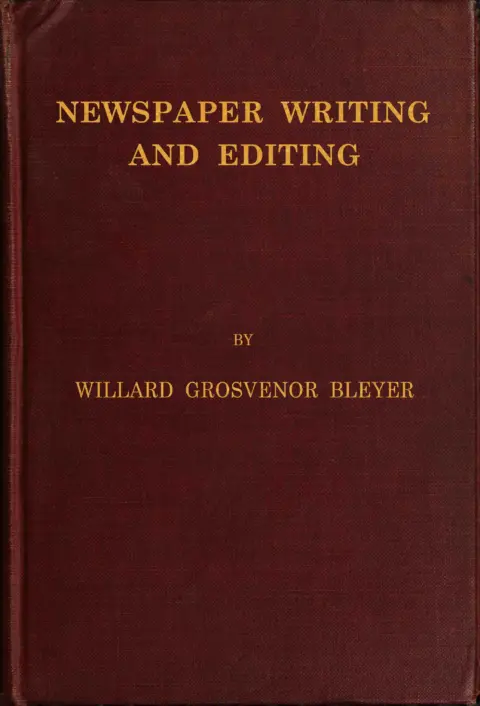
THE CLASSIC COLLECTION · 1913
"Newspaper Writing and Editing" by Willard Grosvenor Bleyer is a practical handbook on journalism written in the early 20th century. This text serves as a guide for students of journalism and aspiring writers to understand and practice the essential principles of newspaper writing and editing. The book covers various aspects of the newspaper production process, from gathering news to editing and presenting it effectively. The opening of the book sets the stage for its instructional content, emphasizing the author's experience in teaching journalism and the need for a comprehensive textbook to guide students in practical newspaper work. Bleyer discusses the importance of having organized learning resources that provide clear examples and analyses of current practices in journalism. He introduces the book's structure and its intended audience, making it clear that both students and interested individuals can benefit from the outlined principles and techniques involved in writing and editing for newspapers.
Introduction adapted from the source catalogue; source summaries may be automatically generated.
Free to read · English · 108,582 words · No account needed
MAKE TIME FOR A GOOD BOOK
On by default. Untick to stop anonymous reading totals. Each page counts after 10 seconds in view. How this works.
Anonymous counting is on unless you have switched it off.
Names, accuracy in printing, 51.
News, accuracy and completeness of, 341.
News, adulterated, 349.
News associations, 56.
News, boiling down, 205.
News bureaus, city, 32.
News, coloring of, 346, 349.
News, covering big, 33.
News, defined by editors, 17.
News, definition of, 18.
News editor, 5.
News, effects of adulterated, 349.
News, essentials of, 18.
News, following up the, 43, 194.
News gathering, 29, 34, 36.
News, getting it into print, 6, 12.
News, grouping of, in make-up, 325.
News items, 206.
News, nose for, 50.
News policy, sinister influences on, 343.
News policy determined by editors, 356.
News runs, 31.
News sources, 30.
News staff, 5.
News, suppression of, 53, 343, 352.
News, timeliness in, 19.
News values, 18.
New York Evening Post, stories from, 181, 232, 238.
New York Herald, establishment of, 332.
New York Sun, stories from, 78, 80, 174, 187, 215, 218, 236,
240.
New York Times, story from, 244.
New York Tribune, establishment of, 332.
New York Tribune, stories from, 178, 216, 230.
Night city editor, 5.
Night editor, 5.
Night press rate, telegraph, 57.
Noon edition, 327.
Nose for news, 50.
Note book in reporting, 52.
Note taking, 46.
Obituaries, 183.
Organization of a newspaper, 2.
Ownership of newspapers, 333.
Ownership of newspapers, influence of, on policy, 343, 347.
Paragraph length in news stories, 64.
Paragraph marks in copy, 61, 266.
Pathetic feature stories, 222.
Pathetic feature stories, style in, 213.
Personality sketch, 228.
Personal journalism, decline of, 335.
Photographer, staff, 49.
Photographs for newspaper cuts, 49.
Pi, type, 9.
Pica as type measure, 265.
Pied type, 9.
Pittsburgh Gazette-Times, story from, 222.
Planer, 329.
Planing down forms, 329.
Plate, stereotyping, 9.
Platform, political, boxed, 87.
Point system of measuring type, 263.
Police headquarters as news source, 30.
Police news stories, 110.
Political subjects for feature stories, 228.
Politics, news value of, 22.
Position of advertisements, 8.
Practice work, 94, 116, 156, 191, 208, 249, 306.
Press associations, 56.
Presses, newspaper, 10.
Press, proof, 7.
Press room, 3.
Printing newspapers, process of, 9.
Printing presses, newspaper, 10.
Proof correcting, 315.
Proof, example of corrected, 319.
Proof, galley, 7, 315.
Proof, marks for correcting, 316.
Proof, revised, 8.
Proof-reading, 3, 315.
Proof-room, 315.
Punctuation, common errors in, 257.
Pyramid banks in headlines, 274, 276.
Queries, schedule of, 55.
Query, correspondent’s, 54.
Questions at beginning of lead, 82.
Quoins, 9, 329.
Quotation marks in copy, 60, 266.
Quotations in lead of news stories, 128.
Quotations, misleading, playing up, 128.
Quotations, verbatim in news stories, 126.
Railroad editor, 5.
Real estate editor, 5.
Receptions, stories of, 169.
Release date on advance stories, 48, 57.
Reporter, ethical problems of, 352, 357.
Reporter, how he gets news, 36.
Reporter, qualifications of, 50.
Reporter, suppression of news by, 53, 352.
Revises, proof, 8.
Rewrite man, 5, 194.
Rewrite stories, 194.
Robberies, news stories of, 110.
Rules, column, 8.
Running stories, 46.
Runs, reporters’, 31.
Your reading position is saved on this browser. Take it to another device with a library code. Reading pages adapt to text, rather than matching a printed edition.
Willard Grosvenor Bleyer
Willard Grosvenor Bleyer
BEHIND THE BOOK
This eBook is for the use of anyone anywhere in the United States and most other parts of the world at no cost and with almost no restrictions whatsoever. You may copy it, give it away or re-use it under the terms of the Project Gutenberg License included with this eBook or online at www.gutenberg.org. If you are not located in the United States, you will have to check the laws of the country where you are located before using this eBook. Read the source licence.
The original source file, including credits and licence, is retained by this library. Request an original-format copy at no charge. Please include the book title and Project Gutenberg identifier #65884.
KEEP YOUR CURIOSITY GOING

Charles G. (Charles Griffith) Ross
Hannah Webster Foster

Emily Lawless
Edwin Hamlin Carr

Charles De Lano Hine
Andrew Ure