THE CLASSIC COLLECTION✦Types of News WritingCLASSIC FREE BOOKS
Types of News Writing
Willard Grosvenor Bleyer
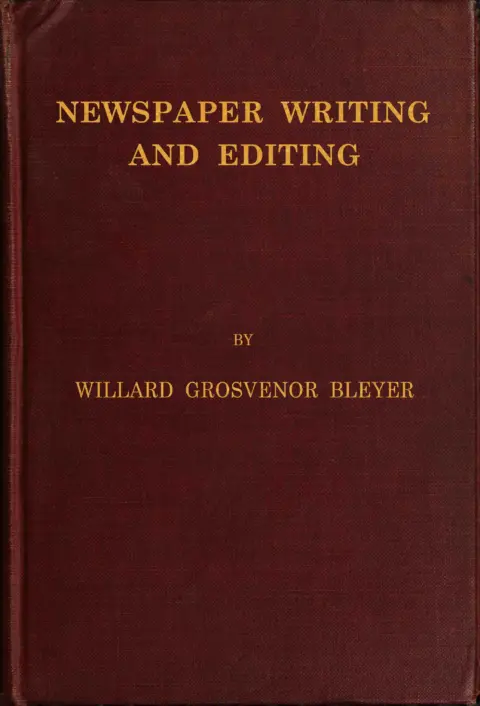
THE CLASSIC COLLECTION · 1913
"Newspaper Writing and Editing" by Willard Grosvenor Bleyer is a practical handbook on journalism written in the early 20th century. This text serves as a guide for students of journalism and aspiring writers to understand and practice the essential principles of newspaper writing and editing. The book covers various aspects of the newspaper production process, from gathering news to editing and presenting it effectively. The opening of the book sets the stage for its instructional content, emphasizing the author's experience in teaching journalism and the need for a comprehensive textbook to guide students in practical newspaper work. Bleyer discusses the importance of having organized learning resources that provide clear examples and analyses of current practices in journalism. He introduces the book's structure and its intended audience, making it clear that both students and interested individuals can benefit from the outlined principles and techniques involved in writing and editing for newspapers.
Introduction adapted from the source catalogue; source summaries may be automatically generated.
Free to read · English · 108,582 words · No account needed
MAKE TIME FOR A GOOD BOOK
On by default. Untick to stop anonymous reading totals. Each page counts after 10 seconds in view. How this works.
Anonymous counting is on unless you have switched it off.
=The Problem of News Gathering.= The mystery of newspaper making, to the uninitiated, is how editors and reporters find out everything that happens and how they get it into print in a very short time. It seems strange to the average person that when an accident occurs in the block in which he lives, the first news of it often reaches him through the newspaper. The apparent omnipresence, not to say omniscience, of the reporter leads to the not unnatural assumption that the news gatherer walks about the city waiting Micawber-like for “something to turn up.” The size of the staff of reporters that would be required to maintain a patrol of the streets would approximate that of the police force, and would bankrupt the most prosperous newspaper. Such a system is not only impossible but quite unnecessary. News gathering is really no mystery at all, but merely a good example of efficient organization.
In organizing its news collecting, the newspaper only takes advantage of information filed for various official purposes by many different persons in no way connected with the newspaper. Policemen, firemen, sheriffs, coroners, and practically all officials of local, state, and national governments, as well as doctors, lawyers, and merchants are all unintentionally serving as reporters of news. The public records in all public or private offices are the reports which these men, many times quite unconsciously, furnish for the newspapers. What the news editors do is to see that a careful watch is maintained by their reporters at all places where news is thus recorded so that they may select whatever part of it is of interest to their readers.
=News Sources.= The places where news is recorded, not primarily for the newspapers but really to their great advantage, and the kinds of news to be found at each place are indicated by the following list of news sources:—
Police Headquarters —crimes, arrests, accidents, suicides, fires, disappearances, sudden deaths, and news of the police department organization.
Fire Headquarters —fires, fire losses, and news of the fire department organization.
Coroner’s Office —fatal accidents, sudden deaths, suicides, and murders.
Health Department —deaths, contagious diseases, sanitary reports, and condition of city water.
Recorder or Register —sales and transfers of property and mortgages.
of Deeds
City Clerk —marriage licenses.
County Jail —crimes, arrests, and executions.
Mayor’s Office —appointments and removals, municipal policies.
Criminal Courts —arraignments, hearings, and trials.
Civil Courts —complaints, answers, trials, verdicts, and decisions in civil suits.
Probate Office —estates, wills.
Referee in Bankruptcy —assignments, failures, appointment of receivers, meetings of creditors, settlements of bankrupts.
Building Inspector —permits for new buildings and alterations, condemnations of unsafe buildings, regulation of fire escapes, and fire prevention devices.
Your reading position is saved on this browser. Take it to another device with a library code. Reading pages adapt to text, rather than matching a printed edition.
Willard Grosvenor Bleyer
Willard Grosvenor Bleyer
BEHIND THE BOOK
This eBook is for the use of anyone anywhere in the United States and most other parts of the world at no cost and with almost no restrictions whatsoever. You may copy it, give it away or re-use it under the terms of the Project Gutenberg License included with this eBook or online at www.gutenberg.org. If you are not located in the United States, you will have to check the laws of the country where you are located before using this eBook. Read the source licence.
The original source file, including credits and licence, is retained by this library. Request an original-format copy at no charge. Please include the book title and Project Gutenberg identifier #65884.
KEEP YOUR CURIOSITY GOING

Charles G. (Charles Griffith) Ross
Hannah Webster Foster

Emily Lawless
Edwin Hamlin Carr

Charles De Lano Hine
Andrew Ure