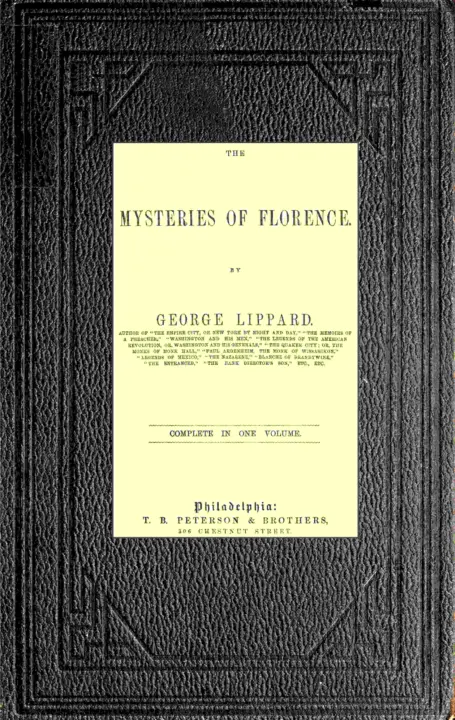
The Mysteries of Florence
George Lippard
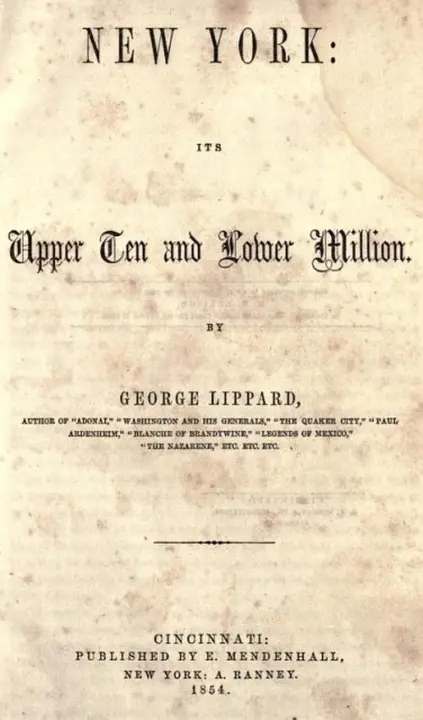
THE CLASSIC COLLECTION · 1854
"New York: Its Upper Ten and Lower Million" by George Lippard is a novel written in the mid-19th century. The narrative dives into the contrasting lives of wealth and poverty in New York City, leading the reader through the tumultuous tale of the Van Huyden family. Central to the story are characters such as Gulian Van Huyden, his brother Charles, and a mysterious child that intertwines their fates. At the start of the novel, readers are introduced to a dark Christmas Eve in 1823, marking a significant turning point for the Van Huyden family, steeped in jealousy and despair. Gulian Van Huyden, the family's wealthy patriarch, hosts a banquet while a tragedy unfolds simultaneously—a secret adoption of a newborn child by a struggling mechanic and his wife. The narrative hints at dramatic events to unfold over the next twenty-one years, including Gulian’s suicide and the enigmatic life that awaits the mysterious child and the ensuing search for heirs, underscoring themes of wealth, morality, and social disparity in a rapidly changing society.
Introduction adapted from the source catalogue; source summaries may be automatically generated.
Free to read · English · 193,620 words · No account needed
MAKE TIME FOR A GOOD BOOK
On by default. Untick to stop anonymous reading totals. Each page counts after 10 seconds in view. How this works.
Anonymous counting is on unless you have switched it off.
Meanwhile in the banquet-room, the Legate of the Pope, with the form of his daughter, in her male attire, nestling on his breast, raised his head, and surveyed the faces of the spectators, who had not yet recovered from their surprise. His face pale and worn, as with years of consuming thought, his eyes bright as with the fire of a soul never at rest, held every gaze enchained as he spoke,--
"Rise Martin Fulmer!" he extended his hand to the kneeling man, "rise, and let me look upon the face of--an honest man."
As though disturbed in the midst of a dream, Martin Fulmer rose, his head with his snow-white hair and protuberant brow, presenting a strong contrast to the pallid face, dark hair and beard of the Legate.
"Look upon me, Martin Fulmer, and steadily. Do you recognize me."
"Gulian Van Huyden!" ejaculated the old man.
The Legate surveyed Randolph, Godlike, Yorke, who formed a group behind the Doctor, while in the background, the lights burned faintly around the iron chest and coffin. Even as the Legate looked around, Randolph turned aside, and leaning against frame of yonder window, pushed the curtains aside, and looked forth upon the cold, dark night. Not so cold and dark as his own bitter fate! Well was it for him, that his face was turned from the light! That face, terribly distorted, now revealed the hell which was raging in his breast. His soul stained with crime, his last hope blotted out, whither should he turn? Grandson of ---- ---- it had been better for you, had you never been born!
After his silent survey, the Legate spoke:
"Another place and another hour, will be needed, to repeat the full details of my life, since twenty-one years ago, I left this house,--to die," in an attitude of calm dignity, and with a voice and look, that held every soul, the Legate spoke these words,--"I was rescued from the waves, by a boat that chanced to be passing from the shore to a ship in the bay. Upon that ship, I again unclosed my eyes to life, and watched through the cabin windows, the last glimpse of the American shore, growing faint and fainter over the waves. Thus called back to life,--my name in my native land, only known as the name of the Suicide, my estates in the hands of Martin Fulmer, left to the chances or the providence of twenty-one years,--I resolved to live. The ship (the captain and crew were foreigners,) bore me to an Italian port. I sold the jewels which were about my person when I plunged into the river, and found myself in possession of a competence. Then, in search of peace, anxious to drown the past, and still every emotion of other days, by a life of self-denial, I went to Rome, I entered the Propaganda. In the course of time I became a priest, and then,----well! twenty-one years passed in the service of the church have left me as I am. Your hand, brave Martin Fulmer! Think not that your course has been unknown to me! You have been watched,--your every step marked,--your very thoughts recorded,--and now it is the Legate of the Pope, who takes you by the hand, and calls you by a title, which it is beyond the power of Pope or King to create,--an honest man! Twenty times I have been near you in the course of twenty-one years,--once in Paris, when you were there on business of the estate,--once in Mexico,--once in China,--once on the Ocean,--once in Rome! How my heart yearned to disclose myself to you! But I left you go your way, and now at the end of twenty-one years, we stand face to face. And thou, my child,--" he gazed tenderly into the face of the girl, whose eyes were upraised to meet his own,--"my beautiful! my own! Think not that the garment of the priest, chills the heart of the father!"
Your reading position is saved on this browser. Take it to another device with a library code. Reading pages adapt to text, rather than matching a printed edition.
George Lippard
BEHIND THE BOOK
This eBook is for the use of anyone anywhere in the United States and most other parts of the world at no cost and with almost no restrictions whatsoever. You may copy it, give it away or re-use it under the terms of the Project Gutenberg License included with this eBook or online at www.gutenberg.org. If you are not located in the United States, you will have to check the laws of the country where you are located before using this eBook. Read the source licence.
The original source file, including credits and licence, is retained by this library. Request an original-format copy at no charge. Please include the book title and Project Gutenberg identifier #57785.
KEEP YOUR CURIOSITY GOING
Coulson Kernahan

Maurice Baring
Frances Wright
Cécile Tormay

Frederic Jesup Stimson

W. H. P. (William Henry Pope) Jarvis