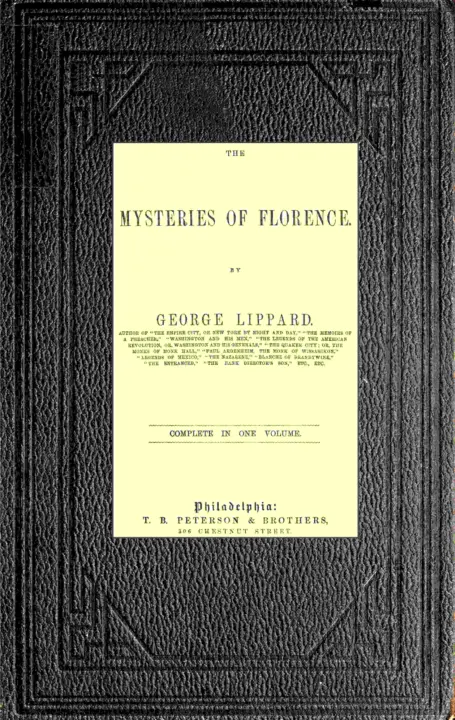
The Mysteries of Florence
George Lippard
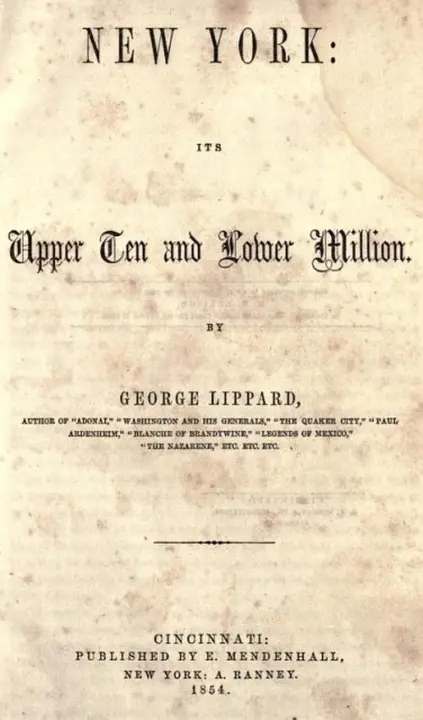
THE CLASSIC COLLECTION · 1854
"New York: Its Upper Ten and Lower Million" by George Lippard is a novel written in the mid-19th century. The narrative dives into the contrasting lives of wealth and poverty in New York City, leading the reader through the tumultuous tale of the Van Huyden family. Central to the story are characters such as Gulian Van Huyden, his brother Charles, and a mysterious child that intertwines their fates. At the start of the novel, readers are introduced to a dark Christmas Eve in 1823, marking a significant turning point for the Van Huyden family, steeped in jealousy and despair. Gulian Van Huyden, the family's wealthy patriarch, hosts a banquet while a tragedy unfolds simultaneously—a secret adoption of a newborn child by a struggling mechanic and his wife. The narrative hints at dramatic events to unfold over the next twenty-one years, including Gulian’s suicide and the enigmatic life that awaits the mysterious child and the ensuing search for heirs, underscoring themes of wealth, morality, and social disparity in a rapidly changing society.
Introduction adapted from the source catalogue; source summaries may be automatically generated.
Free to read · English · 193,620 words · No account needed
MAKE TIME FOR A GOOD BOOK
On by default. Untick to stop anonymous reading totals. Each page counts after 10 seconds in view. How this works.
Anonymous counting is on unless you have switched it off.
On the sofa, sat three grave gentlemen, clad in solemn black, their severe features, rendered even more stern and formal, by the relief of a white cravat. Each of these gentlemen held his hat in one hand, and in the other a cane, surmounted by a head of white bone.
As Bulgin turned, the three gentlemen quietly rose, and said politely,
with one voice:
"Good morning Dr. Bulgin."
And then as quietly sat down again.
The Doctor looked as though he had been lost in a railroad collision. He was paralyzed. He had not even the presence of mind, to release the grasp which gathered the young form of his lovely nephew to his side.
The exact position of affairs, at this crisis, will be better understood, when you are informed, that in these three gentlemen, the Rev. Dr. Bulgin recognized Mr. Watkins, Mr. Potts, and Mr. Burns, the leading members, perchance Deacons of his wealthy congregation. The one with the slight form, and short stiff gray, hair,--Watkins. Mr. Potts, is a small man, with a bald head, and the slightest tendency in the world to corpulence. Mr. Burns is tall and lean, with angular features, and an immense nose. Altogether, as grave and respectable men as you will meet in a day's walk, from Wall Street, to the head of Broadway. But what do they in the TEMPLE, at any time, but especially at this unusual hour?
That was precisely the question which troubled Bulgin.
"W-e-l-l Gentle-m-e-n," he said, not exactly knowing what else to say.
To which they all responded with a singular unanimity,--"W-e-l-l
D-o-c-t-o-r!"
"Did not I,--did not I,--tell,--tell you not to come in here?" sobbed the nephew,--that is Julia.
Mr. Watkins arose and passed his hand through his stiff gray hair,--
"Allow me to compliment you upon the becoming character of your
costume!" and sat down again.
Then Mr. Potts, whose bald head shone in the light as he rose,--
"And allow me to congratulate you upon the character of this house, and especially the elegant seclusion of this chamber." And Mr. Potts sat down.
Mr. Burns' lean form next ascended, and his nose seemed to increase in size, as he projected it in a low bow,--
"And allow me,--" what a deep voice! "to congratulate you upon the society of your companion, who becomes her male attire exceedingly." And Mr. Burns gravely resumed his seat.
"Did--I--not--tell, tell--you,--n-o-t to come in," sobbed Julia.
The Doctor's face was partly hidden by his plumes, but that portion of it which was visible, resembled nothing so much in color, as a boiled lobster.
Your reading position is saved on this browser. Take it to another device with a library code. Reading pages adapt to text, rather than matching a printed edition.
George Lippard
BEHIND THE BOOK
This eBook is for the use of anyone anywhere in the United States and most other parts of the world at no cost and with almost no restrictions whatsoever. You may copy it, give it away or re-use it under the terms of the Project Gutenberg License included with this eBook or online at www.gutenberg.org. If you are not located in the United States, you will have to check the laws of the country where you are located before using this eBook. Read the source licence.
The original source file, including credits and licence, is retained by this library. Request an original-format copy at no charge. Please include the book title and Project Gutenberg identifier #57785.
KEEP YOUR CURIOSITY GOING
Coulson Kernahan

Maurice Baring
Frances Wright
Cécile Tormay

Frederic Jesup Stimson

W. H. P. (William Henry Pope) Jarvis