The Mysteries of Florence
George Lippard
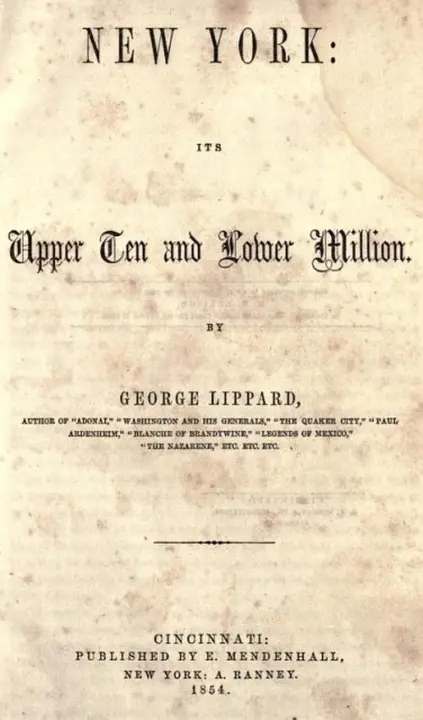
THE CLASSIC COLLECTION · 1854
"New York: Its Upper Ten and Lower Million" by George Lippard is a novel written in the mid-19th century. The narrative dives into the contrasting lives of wealth and poverty in New York City, leading the reader through the tumultuous tale of the Van Huyden family. Central to the story are characters such as Gulian Van Huyden, his brother Charles, and a mysterious child that intertwines their fates. At the start of the novel, readers are introduced to a dark Christmas Eve in 1823, marking a significant turning point for the Van Huyden family, steeped in jealousy and despair. Gulian Van Huyden, the family's wealthy patriarch, hosts a banquet while a tragedy unfolds simultaneously—a secret adoption of a newborn child by a struggling mechanic and his wife. The narrative hints at dramatic events to unfold over the next twenty-one years, including Gulian’s suicide and the enigmatic life that awaits the mysterious child and the ensuing search for heirs, underscoring themes of wealth, morality, and social disparity in a rapidly changing society.
Introduction adapted from the source catalogue; source summaries may be automatically generated.
Free to read · English · 193,620 words · No account needed
MAKE TIME FOR A GOOD BOOK
On by default. Untick to stop anonymous reading totals. Each page counts after 10 seconds in view. How this works.
Anonymous counting is on unless you have switched it off.
This gentleman is almost a giant; his chest is broad; his limbs brawny; and his face, black as the "ace of spades," is in strong contrast with his white teeth, white eyeballs, white eyebrows, and white wool. He is a negro, with flat nose, thick lips, and mouth reaching from ear to ear. His almost giant frame is clad in a sleek suit of blue cloth, and he wears a cravat of spotless whiteness.
His auditors are not so fortunate in the way of dress. Of all colors, from jet black to chocolate-brown, they are clad in all sorts of costumes, only alike in raggedness and squalor.
This is the Black Senate, which has met for business to-night, in this den, two stories under ground. Its deliberations, in point of decorum, may well compare with some other senates,--one in especial, where 'Liar!' is occasionally called, fisticuffs exchanged, knives and pistols drawn; and it embraces representatives from all parts of the Union. Whether, like another senate, it has its dramatic characters,--its low clown, melodramatic ruffians, genteel comedian, and high tragedy hero, remains to be seen.
The very black gentleman, by the packing-box--book in one hand and paper and pencil before him--is the speaker of the house. It is our old acquaintance "ROYAL BILL," lately from South Carolina.
"The genelman frum Varginny hab de floor," said the speaker, with true
parliamentary politeness.
The gentleman from Virginia was a six-foot mulatto, dressed in a ragged coat and trowsers of iron gray. As he rose there was an evident sensation; white teeth were shown, and "Go in nigga!" uttered encouragingly by more than one of the colored congressmen.
"Dis nigga rise to de point ob ordah. Dis nigga am taught a great many tings by philosopy. One day, in de 'baccy field, dis nigga says to hisself, says he. 'Dat are pig b'longs to massa, so does dis nigga. Dis nigga kill dat pig un eat 'um--dat be stealin'? Lordy Moses--no! It only be puttin' one ting dat b'longs to massa into anoder ting dat also b'longs to massa:'--dat's philosopy--"
"S'pose de nigga be caught?" interrupted a colored gentleman, lighting his pipe at the red-hot stove.
"Dat wouldn't be philosopy," responded the gentleman from Virginia. "It ain't philosopy to be caught. On de contrary it am dam foolishness."
A murmur of assent pervaded the place.
"Soh, reasonin' from de pig, dis nigga wor taught by philosopy to tink a great deal--to tink berry much;--and soh, one day de nigga got a kind o' absen' minded, and walked off, and forgot to come back.--Dis nigga actooaly did."
"Dat wor philosopy!" said a voice.
Your reading position is saved on this browser. Take it to another device with a library code. Reading pages adapt to text, rather than matching a printed edition.
George Lippard
BEHIND THE BOOK
This eBook is for the use of anyone anywhere in the United States and most other parts of the world at no cost and with almost no restrictions whatsoever. You may copy it, give it away or re-use it under the terms of the Project Gutenberg License included with this eBook or online at www.gutenberg.org. If you are not located in the United States, you will have to check the laws of the country where you are located before using this eBook. Read the source licence.
The original source file, including credits and licence, is retained by this library. Request an original-format copy at no charge. Please include the book title and Project Gutenberg identifier #57785.
KEEP YOUR CURIOSITY GOING
Coulson Kernahan

Maurice Baring
Frances Wright
Cécile Tormay

Frederic Jesup Stimson

W. H. P. (William Henry Pope) Jarvis