The Mysteries of Florence
George Lippard
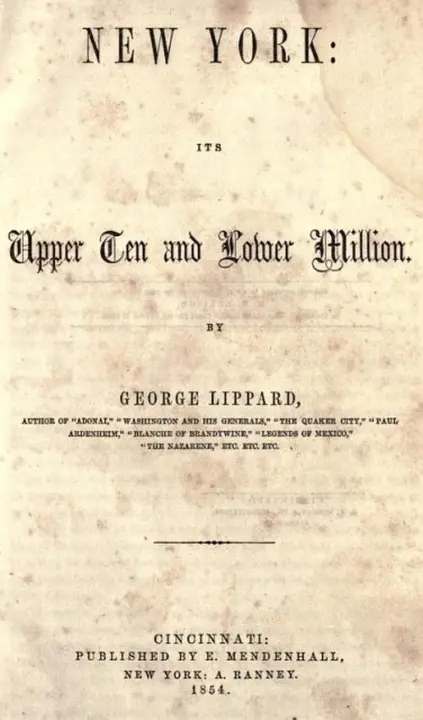
THE CLASSIC COLLECTION · 1854
"New York: Its Upper Ten and Lower Million" by George Lippard is a novel written in the mid-19th century. The narrative dives into the contrasting lives of wealth and poverty in New York City, leading the reader through the tumultuous tale of the Van Huyden family. Central to the story are characters such as Gulian Van Huyden, his brother Charles, and a mysterious child that intertwines their fates. At the start of the novel, readers are introduced to a dark Christmas Eve in 1823, marking a significant turning point for the Van Huyden family, steeped in jealousy and despair. Gulian Van Huyden, the family's wealthy patriarch, hosts a banquet while a tragedy unfolds simultaneously—a secret adoption of a newborn child by a struggling mechanic and his wife. The narrative hints at dramatic events to unfold over the next twenty-one years, including Gulian’s suicide and the enigmatic life that awaits the mysterious child and the ensuing search for heirs, underscoring themes of wealth, morality, and social disparity in a rapidly changing society.
Introduction adapted from the source catalogue; source summaries may be automatically generated.
Free to read · English · 193,620 words · No account needed
MAKE TIME FOR A GOOD BOOK
On by default. Untick to stop anonymous reading totals. Each page counts after 10 seconds in view. How this works.
Anonymous counting is on unless you have switched it off.
Thus, vast and roomy, the apartment was furnished in a style which might well excite the attentive gaze of the stranger.
In the center of the southern wall, stood the bookcase, an elegant fabric of rosewood, surmounted by richly-carved work, and crowned with an alabaster bust of Leo the Tenth; the voluptuous Pope who drank his wine, while poor Martin Luther was overturning the world.
The shelves of this bookcase were stored with the choicest books of five languages; some glittering in splendid binding, and others looking ancient and venerable in their faded covers. There were the most recondite works in English, French, German, Spanish; and there were also the most popular works in as many languages. Theology, metaphysics, mathematics, geometry, poetry, the drama, history, fact, fiction,--all were there, and of all manner of shapes, styles and ages. It was a very Noah's Ark of literature, into which seemed to have been admitted one specimen, at least, of every book in the universe.
On the right of the bookcase was a sofa that made you sleepy just to look at it; it was so roomy, and its red-velvet cushioning looked so soft and tempting. This sofa was framed in rosewood, with little rosewood cupids wreathed around its legs.
And on the left of the bookcase was another sofa of a richer style, and of a more sleep-impelling exterior.
Above each sofa hung a picture, concealed by a thick curtain.
Along the northern wall of the study were disposed a sofa as magnificent as the others, and a series of marble pedestals and red-velvet arm-chairs. Every pedestal was crowned by an alabaster vase or statue of white marble. There were Eve, Apollo, Canova's Venus, and the Three Graces,--all exquisite originals or exquisite copies, in snowy marble.
The arm-chairs were arm-chairs indeed. Red-velvet cushions and high backs and great broad arms; they were the idea of a happy brain, impregnated with belief in Sancho's "Blessed be the man that invented sleep."
And this northern wall was hung with pictures in massive frames, richly gilt; the frames were exposed, but the pictures were vailed.
In the intervals between the western windows were pedestals crowned with vases, and mosaic tables loaded with objects of virtu: exquisite trifles of all sorts, gleaned from the Old World.
And in the intervals between the eastern windows were recesses, covered with hangings of pale crimson. What is concealed in those recesses, doth not yet appear. Both eastern and western windows were curtained with folds of intermingled white and damask, floating luxuriantly from the ceiling to the floor.
The floor was covered with an Axminster carpet of the richest dyes.
Your reading position is saved on this browser. Take it to another device with a library code. Reading pages adapt to text, rather than matching a printed edition.
George Lippard
BEHIND THE BOOK
This eBook is for the use of anyone anywhere in the United States and most other parts of the world at no cost and with almost no restrictions whatsoever. You may copy it, give it away or re-use it under the terms of the Project Gutenberg License included with this eBook or online at www.gutenberg.org. If you are not located in the United States, you will have to check the laws of the country where you are located before using this eBook. Read the source licence.
The original source file, including credits and licence, is retained by this library. Request an original-format copy at no charge. Please include the book title and Project Gutenberg identifier #57785.
KEEP YOUR CURIOSITY GOING
Coulson Kernahan

Maurice Baring
Frances Wright
Cécile Tormay

Frederic Jesup Stimson

W. H. P. (William Henry Pope) Jarvis