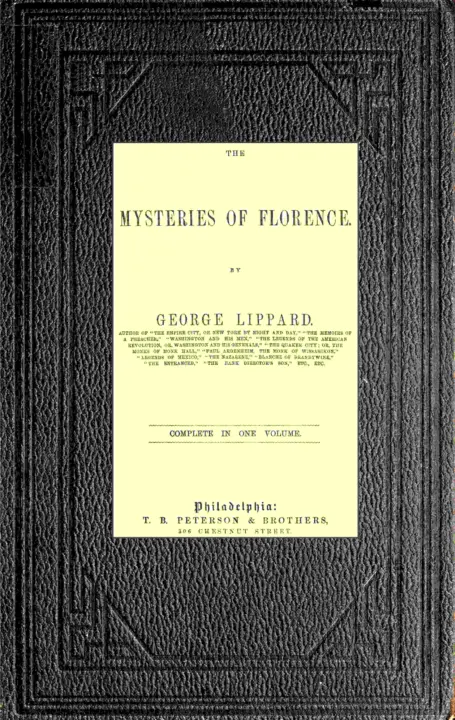
The Mysteries of Florence
George Lippard
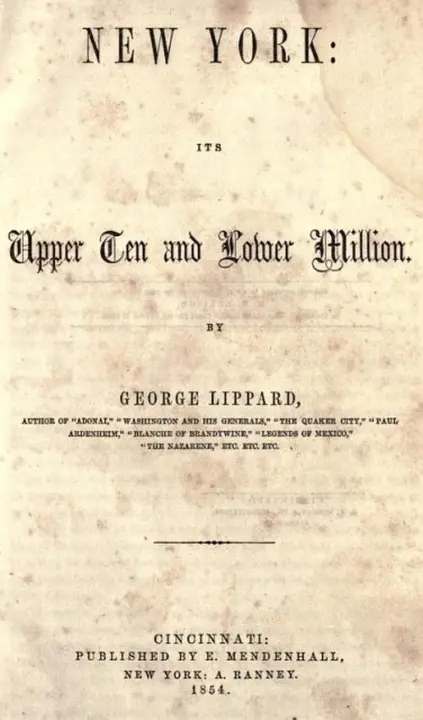
THE CLASSIC COLLECTION · 1854
"New York: Its Upper Ten and Lower Million" by George Lippard is a novel written in the mid-19th century. The narrative dives into the contrasting lives of wealth and poverty in New York City, leading the reader through the tumultuous tale of the Van Huyden family. Central to the story are characters such as Gulian Van Huyden, his brother Charles, and a mysterious child that intertwines their fates. At the start of the novel, readers are introduced to a dark Christmas Eve in 1823, marking a significant turning point for the Van Huyden family, steeped in jealousy and despair. Gulian Van Huyden, the family's wealthy patriarch, hosts a banquet while a tragedy unfolds simultaneously—a secret adoption of a newborn child by a struggling mechanic and his wife. The narrative hints at dramatic events to unfold over the next twenty-one years, including Gulian’s suicide and the enigmatic life that awaits the mysterious child and the ensuing search for heirs, underscoring themes of wealth, morality, and social disparity in a rapidly changing society.
Introduction adapted from the source catalogue; source summaries may be automatically generated.
Free to read · English · 193,620 words · No account needed
MAKE TIME FOR A GOOD BOOK
On by default. Untick to stop anonymous reading totals. Each page counts after 10 seconds in view. How this works.
Anonymous counting is on unless you have switched it off.
"Ah, that is, indeed, a fearful question. A question that may well make one shudder. One of two things must happen. From the rocks and sands of the golden land, the oppressors of the world will derive new means of oppression, or from those rocks and sands, will come the instrument, which is to lift up the masses and shake the oppressors to the dust. What shall be the result? Shall new and more damning chains, for human hearts, be forged upon the gold of these sands and rocks? Or, tottering among these rocks and sands, shall poor humanity at last discover the instrument of her redemption? God alone can tell."
The Prelate was silent. Folding his hands he surveyed the pallid visage of the Legate, with a look hard to define.
"The first wind that blows intelligence from this land of gold, will convulse the world. A few years hence, and these sands, now sparkling with ore, will be white with human skeletons. Thousands and hundreds of thousands will rush to seek the glittering ore, and find a grave, in the mud by the rivers' banks; hundreds of thousands will lie unburied in the depths of trackless deserts, or in the darkness of trackless ravines; the dog and the wolf will feed well upon human hearts."
Suppressing the emotion aroused, by a portion of the Legate's remarks,
the Prelate asked:
"And the thousand barren acres contain incredible stores of gold?"
"Gold sufficient to affect the destiny of one-half the globe," replied the Legate: "gold, that employed in a good cause, would bless and elevate millions of the oppressed, or devoted to purposes of evil, might curse the dearest rights of half the human race."
"And it is in your power to establish the right of our Church to these
lands?"
"It is. A word from me, and the thing is done."
"Pardon me," said the Prelate, slowly, and measuring every word,--"some portions of your remarks excite my curiosity. You speak of the oppressed, and of the oppressors. Now,--now,--from any lips but yours, these words, and the manner in which you use them, would sound like the doctrines of the French Socialists. What do you precisely mean by 'oppressed,'--and who, in your estimation, are the 'oppressors?'"
The Legate rose from his seat, and fixed his eyes upon the Prelate's
face:
"There are many kinds of oppressors, but the most infamous, are those who use the Church of God, as the engine of their atrocious crimes."
This remark fell like a thunderbolt.
The Prelate slowly rose from his chair, his face flushed and his chest
heaving.
"Sir!" he cried in a voice of thunder.
Your reading position is saved on this browser. Take it to another device with a library code. Reading pages adapt to text, rather than matching a printed edition.
George Lippard
BEHIND THE BOOK
This eBook is for the use of anyone anywhere in the United States and most other parts of the world at no cost and with almost no restrictions whatsoever. You may copy it, give it away or re-use it under the terms of the Project Gutenberg License included with this eBook or online at www.gutenberg.org. If you are not located in the United States, you will have to check the laws of the country where you are located before using this eBook. Read the source licence.
The original source file, including credits and licence, is retained by this library. Request an original-format copy at no charge. Please include the book title and Project Gutenberg identifier #57785.
KEEP YOUR CURIOSITY GOING
Coulson Kernahan

Maurice Baring
Frances Wright
Cécile Tormay

Frederic Jesup Stimson

W. H. P. (William Henry Pope) Jarvis