THE CLASSIC COLLECTION✦My diaries, being a personal narrative of events 1888-1914, Part 2 (1900-1914)CLASSIC FREE BOOKS
My diaries, being a personal narrative of events 1888-1914, Part 2 (1900-1914)
Wilfrid Scawen Blunt
THE CLASSIC COLLECTION · 1876
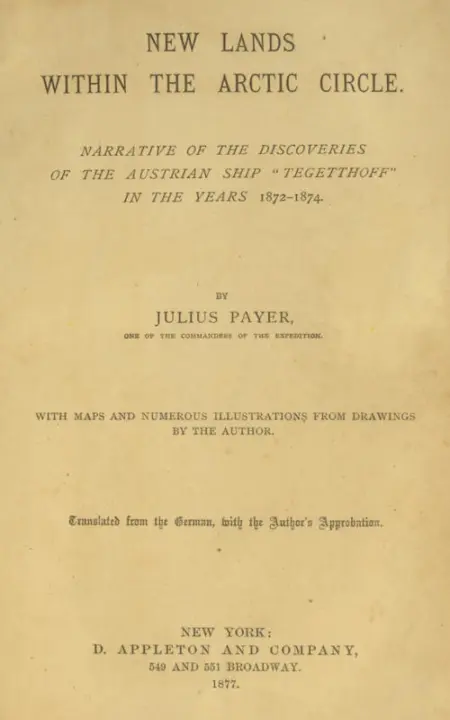
"New Lands Within the Arctic Circle" by Julius Payer is a historical account written in the late 19th century. The narrative chronicles the daring finds and hardships faced during the Austrian ship "Tegetthoff's" expedition from 1872 to 1874 as it navigated uncharted territories within the Arctic. The author provides insights into the crew's experiences, scientific observations, and the formidable natural challenges they encountered, presenting a detailed picture of Arctic exploration. The opening of the narrative establishes the context and significance of the expedition, emphasizing the roles of key figures such as Lieutenant Weyprecht and Dr. Kepes. Payer reflects on the dynamics of leadership and teamwork while setting the stage for the harrowing adventures that lie ahead. The narrative alludes to their struggle against the ice, the challenges of navigation, and the aim of discovering new lands, particularly focusing on the hardships endured during the harsh Arctic winters. These early pages lay the groundwork for the epic and often perilous journey that will unfold, inviting the reader to join in an era of exploration filled with excitement and scientific discovery.
Introduction adapted from the source catalogue; source summaries may be automatically generated.
Free to read · English · 133,616 words · No account needed
MAKE TIME FOR A GOOD BOOK
On by default. Untick to stop anonymous reading totals. Each page counts after 10 seconds in view. How this works.
Anonymous counting is on unless you have switched it off.
6. All our inquiries were met also with the prediction of an exceedingly unfavourable year for the ice. The spring of 1871 had been unusually severe, and even to the middle of June the northern parts of Norway were covered with a mantle of snow reaching down to the sea. It was inferred, therefore, that there would be an excessive accumulation of ice in the seas further north. We heard even, that there was ice at the distance of about twenty (Norwegian) miles from North Cape. And it was certainly true, that the north winds, which prevailed for some weeks, kept a number of Norwegian fishing and seal-hunting vessels weatherbound off the “Scheeren.” All this notwithstanding, we determined to keep to our plan of sailing to Hope Island, and of following from thence the ice-barrier towards the east, our progress, of course, being dependent on favourable conditions of the ice, and perhaps on the influences of the Gulf Stream. As it was within the verge of possibility to make Gillis’ Land during the season of our operations, we considered it advisable not to pass beyond 40° E. Long. while we penetrated northward.
7. On the 20th of June we left Tromsoe during a drizzling snow-storm, and while we were sailing up the “Qualsund” without a pilot, we touched the ground—a danger we incurred from the desire of our married sailors to put their wives ashore, after leave-taking, as near the land as possible. At Rysoe we fell in with the fleet of the Tromsoe fishing-boats at anchor, waiting for a change of weather, and with them some vessels which, we thought, would have been by this time in the ice, having left Tromsoe four weeks before.
8. The rocky islands off the coast of Finnmark are surrounded by bleak cliffs, rising to the height of 2,500 feet, and upwards. Trees cease to grow there; occasionally the birch appears, but never in sufficient numbers to form a wood. The numerous islands of a gneiss formation show the same landscape which characterizes Norway—indescribably bleak table-lands, deep secluded valleys and gorges, interspersed with lonely mountain lakes. The bold, picturesque outlines of these islands are exceedingly striking, though their fertility is meagre in the extreme. The solitary rocky shores are inhabited by poor families, secluded from the world, and having little intercourse with each other. They live for the most part on the fish which they catch. The remains of fish round these settlements render their approach exceedingly disagreeable; on the Loffoden Islands a guano manufactory has been established, which turns this refuse to good account. Tromsoe or Hammerfest appears in their eyes as the glory and pride of the world. We were detained two days—June 24 and 25—by contrary winds, at Sandoe, an island covered with sea-sand full of small mussel shells, to the height of 600 feet. Ascending an elevated peak of this island, 2,000 feet high, we saw a panorama of countless cliffs of all sizes stretching down to Andeness, and opposite to us, the gloomy, rugged wastes of Norway, which show iron-bound walls, waterfalls, and bleak headlands, without woods, meadows, or habitations. For many hours we were mocked by an eagle, which, now soaring high, now darting down with rapid flight, gave his unwieldy pursuers a stiff and exhausting climb. We at last put to sea on the 26th of June, and passed the enormous rocky pile of Fugloe, down the precipitous face of which the inhabitants descend by means of ropes to get the down of the Eider-geese. Next day we were out of sight of land. The breeze freshened, and, as we sailed further to the north, we saw many whales. On the 28th of June we came on the first ice—a sight which reminds the Polar navigator that he has reached his home! Driven down by the north wind, its fragments lay thickly on the misty horizon like gleaming points. We were now south-east of Bear Island in 73° 40′ N. Lat. and 21° E. Long., and found the ice so broken up that we did not hesitate to penetrate it, in order to find out the latitude in which its closed masses would appear. We passed through forty miles of this loose drift-ice, and then came on the pack in 74° 30′ N. Lat. and 23° E. Long. Already, on the 30th of June, we had experienced the powerlessness of a small sailing vessel in such circumstances. The calms which had set in rendered it impossible to steer the ship, just when the ice was drifting in wild confusion. In spite of all our efforts to warp, the ship was inclosed by ice—in fact, beset. During our captivity of ten days, there was an alternation of fogs and gales with heavy sea-swells. The neighbourhood of floes sometimes small, sometimes large, which constantly shifted their places, kept us in a state of continual watchfulness. The Isbjörn, on some of these days, sustained such severe pressures from the ice, that her safety was imperilled. On the 4th of July we had heavy storms from the south-east, which packed the ice still closer, and, though the sea is generally quite calm within the ice, it was otherwise on this occasion. In the afternoon we heard through the dense fog the thunder of the ocean breaking on the outer edge of the ice, and the roar increased as the sea rose. Our attempts to haul further into the ice and still-water were fruitless; the ship was pressed too firmly, and was not to be moved from its place. Our position became more and more critical as the sea continued to rise. During the whole night the waves roared and boiled around us. The rudder groaned under the pressure of the floes, and had to be made fast to prevent its being broken off. A mass of ice grazing past the davits utterly destroyed one of our boats. The critical nature of such a situation is simply the uncertainty as to the amount of pressure which a ship can sustain. Towards evening the fog lifted and rolled away, presenting a spectacle of fearful grandeur. All round us lay the open sea dashing against the ice, which was itself in wild motion. Floes and icebergs were driven about by the waves, and their fragments strewed in all directions. At midnight our little ship sustained shock after shock, and her timbers strained and creaked. The “brash” of the crushed ice, which had gathered round the ship, prevented her destruction. As the storm abated, the larger masses of ice moved off to the edge of the horizon, so that in the morning we could not see open water from the deck. The day broke: what a change in the ice! The sea was calm, and a long swell died out on its outer edge. Piles of ice all round us,—a weird and deathlike calm! The heavens were cloudless; the countless blocks and masses of ice stood out against the sky in blue neutral shadow, and the more level fields between them sparkled like silver as they shone in the sun. The movement of the sea beyond the ice abated, “leads” within the floes, hitherto scarcely perceptible, widened out. But again the sky was overcast, the sea assumed the colour of lead, though it continued quite calm and the “ice-blink” appeared on the northern horizon.
Your reading position is saved on this browser. Take it to another device with a library code. Reading pages adapt to text, rather than matching a printed edition.
BEHIND THE BOOK
This eBook is for the use of anyone anywhere in the United States and most other parts of the world at no cost and with almost no restrictions whatsoever. You may copy it, give it away or re-use it under the terms of the Project Gutenberg License included with this eBook or online at www.gutenberg.org. If you are not located in the United States, you will have to check the laws of the country where you are located before using this eBook. Read the source licence.
The original source file, including credits and licence, is retained by this library. Request an original-format copy at no charge. Please include the book title and Project Gutenberg identifier #60258.
KEEP YOUR CURIOSITY GOING
Wilfrid Scawen Blunt
Wilfrid Scawen Blunt

E. W. (Edgar Watson) Howe
Cécile Tormay

Moritz Busch
John L. Ransom