THE CLASSIC COLLECTION✦My diaries, being a personal narrative of events 1888-1914, Part 2 (1900-1914)CLASSIC FREE BOOKS
My diaries, being a personal narrative of events 1888-1914, Part 2 (1900-1914)
Wilfrid Scawen Blunt
THE CLASSIC COLLECTION · 1876
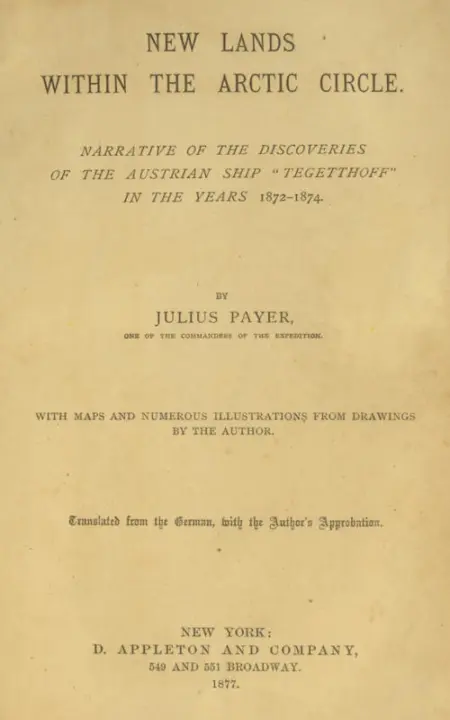
"New Lands Within the Arctic Circle" by Julius Payer is a historical account written in the late 19th century. The narrative chronicles the daring finds and hardships faced during the Austrian ship "Tegetthoff's" expedition from 1872 to 1874 as it navigated uncharted territories within the Arctic. The author provides insights into the crew's experiences, scientific observations, and the formidable natural challenges they encountered, presenting a detailed picture of Arctic exploration. The opening of the narrative establishes the context and significance of the expedition, emphasizing the roles of key figures such as Lieutenant Weyprecht and Dr. Kepes. Payer reflects on the dynamics of leadership and teamwork while setting the stage for the harrowing adventures that lie ahead. The narrative alludes to their struggle against the ice, the challenges of navigation, and the aim of discovering new lands, particularly focusing on the hardships endured during the harsh Arctic winters. These early pages lay the groundwork for the epic and often perilous journey that will unfold, inviting the reader to join in an era of exploration filled with excitement and scientific discovery.
Introduction adapted from the source catalogue; source summaries may be automatically generated.
Free to read · English · 133,616 words · No account needed
MAKE TIME FOR A GOOD BOOK
On by default. Untick to stop anonymous reading totals. Each page counts after 10 seconds in view. How this works.
Anonymous counting is on unless you have switched it off.
+------------+------------------+
| |Mean Direction and|
| | Force. |
| +----------+-------+
| |Direction.| Force.|
+------------+----------+-------+
| | | |
|1872. | | |
| | | |
|July 15 | N53°E | 1·36 |
|August 31 | S56°W | 1·15 |
|September 30| S45°W | 0·54 |
|October 31 | S23°E | 0·43 |
|November 30 | S71°E | 0·26 |
|December 31 | S44°E | 0·64 |
| | | |
|1873. | | |
| | | |
|January 31 | S64°W | 1·24 |
|February 28 | N32°E | 0·26 |
|March 31 | N37°E | 0·63 |
|April 30 | N61°E | 0·53 |
|May 31 | N5°W | 0·53 |
|June 30 | S79°E | 0·97 |
|July 31 | N74°W | 0·82 |
|August 31 | S48°E | 0·31 |
|September 30| S53°E | 0·14 |
|October 31 | N42°E | 1·82 |
|November 30 | N54°E | 1·10 |
|December 31 | N66°E | 1·21 |
| | | |
| 1874. | | |
| | | |
|January 31 | S70°E | 0·93 |
|February 28 | N47°E | 1·16 |
|March 31 | N59°W | 0·83 |
|April 30 | N80°E | 0·94 |
+------------+----------+-------+
[1] Polynia, a Russian term for an open water space.—Glossary in Kane’s Arctic Explorations, vol. i., p. 14.
[2] Ice-fields have been seen there equal to the superficial extent of a German principality, or even to the Duchy of Salzburg.
[3] Geikie’s Great Ice Age, pp. 38, 39.
[4] In the North Atlantic Ocean down to 40° N. L.
[5] Parry’s Journal of a Voyage for the Discovery of a North-West Passage, 1819-20, p. 298. 4to. London, 1821.
[6] Sir J. C. Ross’s Southern Antarctic Voyage, vol. ii., p. 151.
[7] Sir John Ross—Second Voyage of Discovery to the Arctic Ocean, p.
180; 4to. London, 1835.
[8] The nautical mile or “knot,” which is about an ordinary mile and a
sixth, is meant.
[9] Dock, an opening in the ice, artificial or natural, offering protection. Kane’s Glossary of Arctic Terms, vol. i., p. 13.
[10] Mercator was not an Englishman; he was a Dutchman, born 1512, died
1594.
[11] Three centuries ago, Plancius, the Dutch geographer, devised this for the North Pole, while Barros, the Portuguese historiographer, did the same for the South Pole.
[12] As a corrective to this rather extreme statement, see Clement Markham’s Threshold of the Unknown Region, 4th Edition, pp. 383-393.
[13] A decoction prepared by Dr. Kepes, the physician of the Tegetthoff.
[14] Lieutenant Brosch had the entire care of the victualling department, and deserved our heartiest thanks for the skill and self-sacrifice with which he performed his duty.
[15] Formerly Captain in the Austrian Merchant Service.
[16] Our position was then in 76° 22′ N. Lat., 63° 3′ E. Long.
[17] A decoction prepared by Kepes.
[18] Parry mentions, as a fact illustrative of the increase of moisture and its condensation into ice, that about a hundred hundredweights of ice were once removed from the lower quarters of the Hecla, which had accumulated there from the breath, the steam caused by cooking, and the moisture brought down by the clothes of the men.
[19] The noise produced by such collisions cannot be more fittingly
expressed.
[20] Hall’s contemporaneous expedition excepted.
[21] See Appendix.
[22] I take this opportunity of stating that the originals of nearly all the illustrations of this book were drawn on the spot from nature, and that they have been reproduced as they were drawn.
Your reading position is saved on this browser. Take it to another device with a library code. Reading pages adapt to text, rather than matching a printed edition.
BEHIND THE BOOK
This eBook is for the use of anyone anywhere in the United States and most other parts of the world at no cost and with almost no restrictions whatsoever. You may copy it, give it away or re-use it under the terms of the Project Gutenberg License included with this eBook or online at www.gutenberg.org. If you are not located in the United States, you will have to check the laws of the country where you are located before using this eBook. Read the source licence.
The original source file, including credits and licence, is retained by this library. Request an original-format copy at no charge. Please include the book title and Project Gutenberg identifier #60258.
KEEP YOUR CURIOSITY GOING
Wilfrid Scawen Blunt
Wilfrid Scawen Blunt

E. W. (Edgar Watson) Howe
Cécile Tormay

Moritz Busch
John L. Ransom