THE CLASSIC COLLECTION✦My diaries, being a personal narrative of events 1888-1914, Part 2 (1900-1914)CLASSIC FREE BOOKS
My diaries, being a personal narrative of events 1888-1914, Part 2 (1900-1914)
Wilfrid Scawen Blunt
THE CLASSIC COLLECTION · 1876
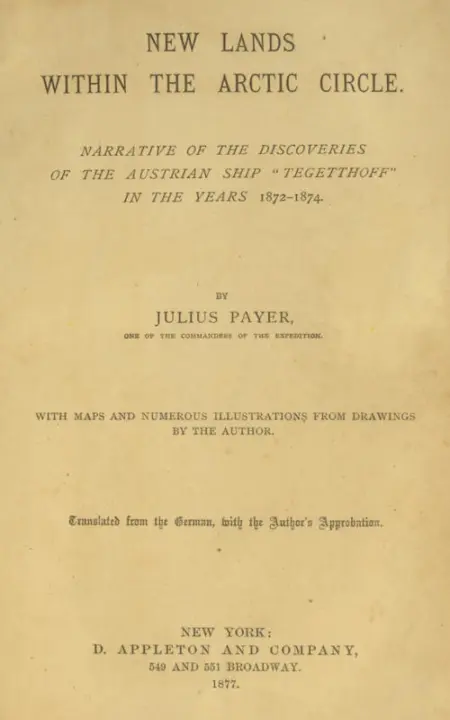
"New Lands Within the Arctic Circle" by Julius Payer is a historical account written in the late 19th century. The narrative chronicles the daring finds and hardships faced during the Austrian ship "Tegetthoff's" expedition from 1872 to 1874 as it navigated uncharted territories within the Arctic. The author provides insights into the crew's experiences, scientific observations, and the formidable natural challenges they encountered, presenting a detailed picture of Arctic exploration. The opening of the narrative establishes the context and significance of the expedition, emphasizing the roles of key figures such as Lieutenant Weyprecht and Dr. Kepes. Payer reflects on the dynamics of leadership and teamwork while setting the stage for the harrowing adventures that lie ahead. The narrative alludes to their struggle against the ice, the challenges of navigation, and the aim of discovering new lands, particularly focusing on the hardships endured during the harsh Arctic winters. These early pages lay the groundwork for the epic and often perilous journey that will unfold, inviting the reader to join in an era of exploration filled with excitement and scientific discovery.
Introduction adapted from the source catalogue; source summaries may be automatically generated.
Free to read · English · 133,616 words · No account needed
MAKE TIME FOR A GOOD BOOK
On by default. Untick to stop anonymous reading totals. Each page counts after 10 seconds in view. How this works.
Anonymous counting is on unless you have switched it off.
5. In more recent times great influence has been attributed to the Gulf Stream as a power influencing all the seas, known and unknown, of the whole Arctic region. Dr. Petermann, however, in a lately published work, endeavours to show that its effects are discernible only on the northern seas of Spitzbergen and Novaya Zemlya. Its action on the coasts of Spitzbergen has been indisputably established by the Swedes, who discovered there certain tropical plants (Entada gigalobium); but the penetration of the warmer waters of this current to the northern coasts of Novaya Zemlya has not been so positively ascertained. In the Austrian Expedition of 1873-4, we discovered no proofs of its existence. We found neither the constant current, nor the water of a higher temperature, which characterizes that renowned stream.
6. For a long time the “ice-holes,” seen by Wrangel and Morton, were regarded as indications of an ice-free Polar Sea. With regard to those seen by Morton in 81° 22′, Richardson very justly remarks: “The open water of the Kennedy Channel is not of greater extent in the month of June than the open spaces which have occasionally been seen in summer on the north of Spitzbergen by whale-fishers.” Wrangel, when he describes the “Polynjii,” which he saw on the east of the New Siberian Islands, accounts for them by the action of a local coast-wind; and yet Wrangel would have been the first to favour the notion of an inner Polar Sea, for he still thought, in opposition to Scoresby, that ice could not be formed on the open sea, because of the absence of land as a support for the ice in its formation.
7. The first practical application of the theory of an open Polar Sea was long ago devised by Plancius; the discovery, namely, of a route in high latitudes to China. But the expeditions to the North Pole, properly so termed, sprang also from this theory, which was held with the greatest pertinacity. The evidence of unsuccessful undertakings was always met and outweighed by the counter-experience of one favourable year in the ice. Thus Barentz, in the exceedingly propitious summer of 1594, advanced without difficulty one degree of latitude beyond the northern extremity of Novaya Zemlya, while his successors frequently encountered insurmountable difficulties at Cape Nassau, and he himself in the following year, 1595, found the state of the ice changed much for the worse. In the years 1871, 1874, Mack, Carlsen, and the two Austro-Hungarian expeditions came upon an open sea in the very places where very few, if any, water-ways were to be seen in 1872 and 1873. In the summers of 1816, 1817, the mighty stream of ice on the coast of East Greenland had decreased to such an extent that Scoresby met with little ice between 74° and 80° N.L., but since then whalers have constantly seen the heaviest ice there, heavier than anywhere else. In 1753 and 1754, the Sea of Kara and the Novaya Zemlya Sea were free from ice. But in subsequent years the whale-fishers knocked in vain at their ice-barred entrances. In 1823 Lütke from a point on the west coast of the Sea of Kara saw that sea without ice; but, in the middle of August, 1833, Pachtussow found the western side of that sea open, while in the previous year he himself could not pass the Karian Gates. Again in 1743 and 1773, the North Spitzbergen Sea held out promises the most inviting, which might possibly have permitted the reaching of a still higher degree of latitude than that which Nordenskjöld and Koldewey attained in 1868. Sir John Ross, in the first year of his second voyage, found all things most favourable for navigation; but in the following year the very reverse; and Sir James C. Ross experienced the same alternation of circumstances in the Southern Polar Sea. In 1850, Penny found the Wellington Channel free from ice, but in 1852, Belcher, although he penetrated far further than Penny, was confronted in the same channel by pack- and drift-ice. Scoresby the younger, to whose profound faculty of observation we owe the most significant hints on the nature of the Polar Sea, although he had navigated the Greenland ice-ocean for twenty years, landed only once on its coast. The Swedish expedition (1861) could approach the north-east of Spitzbergen only in boats; Smith sailed over the sea there (1871) as far as Cape Smith. The walrus-hunter, Matilas, sailed round (1864) the north-east island completely, and Carlsen, an ice navigator, as successful as he was skilful, in 1863 circumnavigated Spitzbergen, and in 1871 Novaya Zemlya, and discovered there the relics of Barentz’s winter quarters. In 1872, King Karl Land was circumnavigated, although both Koldewey and Nordenskjöld (1868) as well as the first Austrian expedition (1871) had in vain attempted to approach it. How greatly also, in the same year, the state of the ice varies in different places, is proved by the fact, that Franklin learnt from the whalers that they never saw the ice so thick and so strong in Davis Straits as at the end of July 1819, while Parry, more to the north by some degrees of latitude, pursued his path of discovery even to Melville Island, and in the following year returned to England without meeting any special obstacles. These examples, to which many more might be added, show how variable are the chances of ice-navigation from one year to another. But however variable the conditions of the ice may be, the impediments, even under the most favourable circumstances, are so very great, that we have never been able to penetrate the innermost Polar regions,—penetrate, that is, to where, according to the views of an earlier time, the open Polar Sea should be found.
Your reading position is saved on this browser. Take it to another device with a library code. Reading pages adapt to text, rather than matching a printed edition.
BEHIND THE BOOK
This eBook is for the use of anyone anywhere in the United States and most other parts of the world at no cost and with almost no restrictions whatsoever. You may copy it, give it away or re-use it under the terms of the Project Gutenberg License included with this eBook or online at www.gutenberg.org. If you are not located in the United States, you will have to check the laws of the country where you are located before using this eBook. Read the source licence.
The original source file, including credits and licence, is retained by this library. Request an original-format copy at no charge. Please include the book title and Project Gutenberg identifier #60258.
KEEP YOUR CURIOSITY GOING
Wilfrid Scawen Blunt
Wilfrid Scawen Blunt

E. W. (Edgar Watson) Howe
Cécile Tormay

Moritz Busch
John L. Ransom