THE CLASSIC COLLECTION✦My diaries, being a personal narrative of events 1888-1914, Part 2 (1900-1914)CLASSIC FREE BOOKS
My diaries, being a personal narrative of events 1888-1914, Part 2 (1900-1914)
Wilfrid Scawen Blunt
THE CLASSIC COLLECTION · 1876
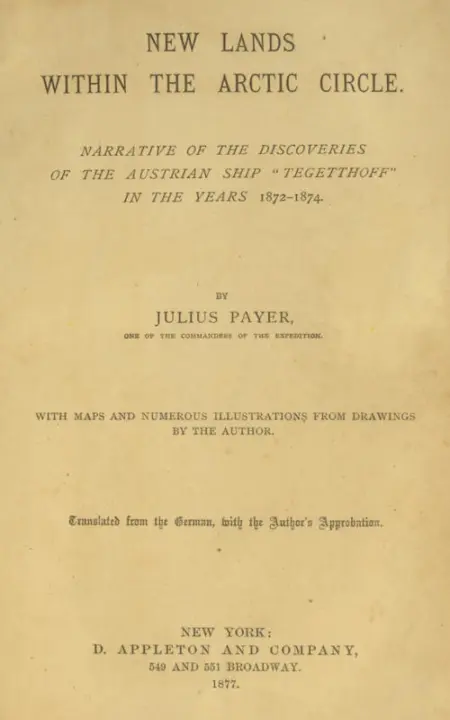
"New Lands Within the Arctic Circle" by Julius Payer is a historical account written in the late 19th century. The narrative chronicles the daring finds and hardships faced during the Austrian ship "Tegetthoff's" expedition from 1872 to 1874 as it navigated uncharted territories within the Arctic. The author provides insights into the crew's experiences, scientific observations, and the formidable natural challenges they encountered, presenting a detailed picture of Arctic exploration. The opening of the narrative establishes the context and significance of the expedition, emphasizing the roles of key figures such as Lieutenant Weyprecht and Dr. Kepes. Payer reflects on the dynamics of leadership and teamwork while setting the stage for the harrowing adventures that lie ahead. The narrative alludes to their struggle against the ice, the challenges of navigation, and the aim of discovering new lands, particularly focusing on the hardships endured during the harsh Arctic winters. These early pages lay the groundwork for the epic and often perilous journey that will unfold, inviting the reader to join in an era of exploration filled with excitement and scientific discovery.
Introduction adapted from the source catalogue; source summaries may be automatically generated.
Free to read · English · 133,616 words · No account needed
MAKE TIME FOR A GOOD BOOK
On by default. Untick to stop anonymous reading totals. Each page counts after 10 seconds in view. How this works.
Anonymous counting is on unless you have switched it off.
Nor can we forbear to direct attention to another statement in the same chapter. Let our readers mark the prophetic spirit of the following passage: “All the changes and phenomena of this mighty network lead us to infer the existence of frozen seas up to the Pole itself; and according to my own experience, gained in three expeditions, I consider that the states of the ice between 82° and 90° N. L. will not essentially differ from those which have been observed south of latitude 82°; I incline rather to the belief that they will be found worse instead of better” (p. 30). And “worse instead of better” they have been found, as we cannot doubt, when we weigh the ominous significance of the designation the “Sea of Ancient Ice.”
History may or may not verify the position which the telegram so briefly resumes—“The Pole impracticable.” Impracticable no doubt it was, if the condition of the ice seen by our expedition in that awful sea be its normal condition. All that it was possible for men to dare and achieve, England will feel that her officers and sailors dared and achieved under the circumstances they encountered. It may be, that later experience will show, that even that Sea may present to future explorers an aspect less tremendous; yea, that in some seasons, which science may yet predict, when her theories of the sun-spots are matured and formulated, open water will be found, as perhaps it was found in the year of the expedition of the Polaris, where the heroic sledging parties from the Alert and Discovery saw nothing and found nothing, but piled-up barriers of ice rising to the height of 150 feet.
It would be idle to predict, in the face of these results, that the Pole shall yet be reached. Any confident prediction in this spirit would, at the present moment, be singularly inopportune, as well as unwise. But despair would be equally unjustifiable, while its influence would be most hurtful and depressing, especially if Arctic exploration and the attainment of the Pole were supposed to be identical propositions. There are two things: reaching the North Pole, and the exploration of the Polar region. If the former appeals more to the imagination, and readily calls forth the emotions which are fed by the love of the marvellous, the latter enlists the sympathies of those who take a broader view of the necessities of Arctic exploration. These have found a powerful representative in one whose services entitle him to speak with authority, in the naval chief of the Tegetthoff expedition. At a meeting of the German Scientific and Medical Association held at Gratz in September of 1875, Weyprecht read a paper on the principles of Arctic exploration, in which, according to the summary of its contents, which appeared in Nature, October 11, 1875, he maintains, that the Polar regions offer, in certain important respects, greater advantages than any other part of the globe for the observation of natural phenomena—Magnetism, the Aurora, Meteorology, Geology, Zoölogy, and Botany. He deplores, that while large sums have been spent and much hardship endured for geographical knowledge, strictly scientific observations have been regarded as holding a secondary place. Though not denying the importance of geographical discovery, he maintains, that the main purpose of future Arctic expeditions should be the extension of our knowledge of the various natural phenomena which may be studied with so great advantage in those regions. He insists in that paper on the following propositions:—“1. Arctic exploration is of the highest importance to a knowledge of the laws of nature. 2. Geographical discovery in those regions is of superior importance only in so far as it extends the field of scientific investigation in its strict sense. 3. Minute Arctic topography is of secondary importance. 4. The geographical Pole has for science no greater significance than any other point in high latitude. 5. Observation stations should be selected without reference to the latitude, but for the advantages they offer for the investigation of the phenomena to be studied. 6. Interrupted series of observations have only a relative value.” The suggestions thrown out by Lieutenant Weyprecht have been taken up by one whose mind seems to rise instinctively to all high aims and objects. Prince Bismarck forthwith appointed a German Commission of Arctic Exploration, consisting of some of the most eminent men of science of whom Germany can boast, who reported to the Bundesrath in a memoir, the recommendations of which were unanimously adopted. From Nature, November 11, 1875, which we have already quoted, we borrow the following résumé of that report:—
Your reading position is saved on this browser. Take it to another device with a library code. Reading pages adapt to text, rather than matching a printed edition.
BEHIND THE BOOK
This eBook is for the use of anyone anywhere in the United States and most other parts of the world at no cost and with almost no restrictions whatsoever. You may copy it, give it away or re-use it under the terms of the Project Gutenberg License included with this eBook or online at www.gutenberg.org. If you are not located in the United States, you will have to check the laws of the country where you are located before using this eBook. Read the source licence.
The original source file, including credits and licence, is retained by this library. Request an original-format copy at no charge. Please include the book title and Project Gutenberg identifier #60258.
KEEP YOUR CURIOSITY GOING
Wilfrid Scawen Blunt
Wilfrid Scawen Blunt

E. W. (Edgar Watson) Howe
Cécile Tormay

Moritz Busch
John L. Ransom