THE CLASSIC COLLECTION✦My diaries, being a personal narrative of events 1888-1914, Part 2 (1900-1914)CLASSIC FREE BOOKS
My diaries, being a personal narrative of events 1888-1914, Part 2 (1900-1914)
Wilfrid Scawen Blunt
THE CLASSIC COLLECTION · 1876
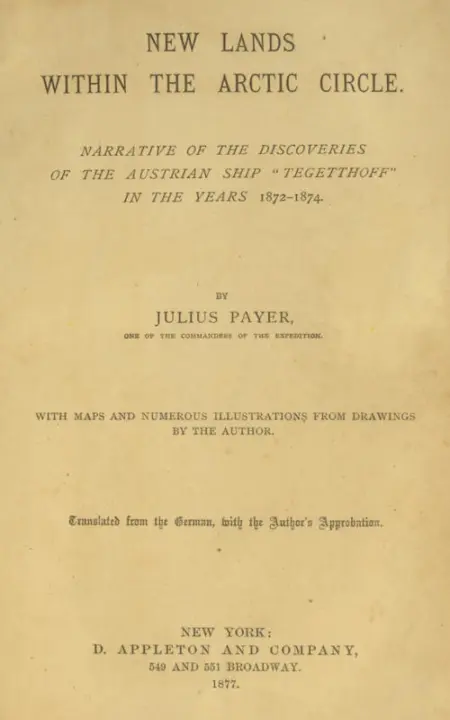
"New Lands Within the Arctic Circle" by Julius Payer is a historical account written in the late 19th century. The narrative chronicles the daring finds and hardships faced during the Austrian ship "Tegetthoff's" expedition from 1872 to 1874 as it navigated uncharted territories within the Arctic. The author provides insights into the crew's experiences, scientific observations, and the formidable natural challenges they encountered, presenting a detailed picture of Arctic exploration. The opening of the narrative establishes the context and significance of the expedition, emphasizing the roles of key figures such as Lieutenant Weyprecht and Dr. Kepes. Payer reflects on the dynamics of leadership and teamwork while setting the stage for the harrowing adventures that lie ahead. The narrative alludes to their struggle against the ice, the challenges of navigation, and the aim of discovering new lands, particularly focusing on the hardships endured during the harsh Arctic winters. These early pages lay the groundwork for the epic and often perilous journey that will unfold, inviting the reader to join in an era of exploration filled with excitement and scientific discovery.
Introduction adapted from the source catalogue; source summaries may be automatically generated.
Free to read · English · 133,616 words · No account needed
MAKE TIME FOR A GOOD BOOK
On by default. Untick to stop anonymous reading totals. Each page counts after 10 seconds in view. How this works.
Anonymous counting is on unless you have switched it off.
29. Though we had been accustomed so long to oscillate between extremes, we now felt that the hour had come, when we might count with certainty on being liberated from the fetters of the ice, and all our hopes gained new life. Yet once more they seemed doomed to be disappointed. On the 7th, before we turned into sleep, the prevailing north wind had gathered so much ice around us that we were fairly shut in. Next day (August 8), after the efforts of many hours to force through the multitude of small floes by which we were jammed in, we discovered that we should be unable to move, unless the wind changed to the south-west. Our exertions on the 9th were equally unsuccessful. It was not dense masses of ice, under whose walls we had so often felt ourselves imprisoned, that now held us captive, but miserable flat floes. Their diameter was from fifty to sixty paces, and though they hardly appeared above water, they were not the less impenetrable hindrances. The movement in the sea, that had so elevated us, was scarcely perceptible, and our faith in the nearness of the ocean was consequently much shaken.
30. Again rain fell in abundance, and we remained in the boats waiting for the breaking-up of the ice. It was scarcely possible to go any distance from them, for the ice of the surrounding floes was so thin, that we could not venture to walk on them lest we should break through. Fissures abounded, but no seals were to be seen in them. This forced abode in our boats was almost unendurable. We could not always sleep, and only a frugal few had any tobacco left to smoke. Some of our party had for a long time smoked dry tea-leaves in the form of cigarettes, or had filled their pipes with match paper. All the tinder had been long used up in this way, and a dreadful trial it had been to the olfactory nerves of those who would not so indulge. Haller went further still, and smoked paper in the close covered boat! besides many leaves of his note-books, he still had a quantity of packing-paper, but, in the interest of the community, I was compelled to interfere against its use in this fashion. He found some compensation in another occupation, which had the merit at least of being inoffensive to others—mixing together his rations of tea, salt, and bread-dust, he converted the mixture into a soup. These days seemed as though they would never end; there was a continual taking off and pulling on of boots; some sat in the boats gaping about vacantly in all directions; some standing on the ice gaped as vacantly; all mental activity was concentrated in two wishes, that the ice would break up, and that the time for the next meal would come round. No one had any private reserve of provision. The days were gone when a stocking filled with bread might be seen hanging from the belt of one, or the ribs of a bear in the hand of another. And yet amidst all the hunger, which we felt the more acutely from our abundant leisure, some among us had actually become as plump as quails, and if we had been found dead on the floes, it would have been thought, that we had died in consequence of over-eating, so stout had most of us become. But dreadful was the solemn lapse of time. August was well advanced; the knowledge that we had provisions for only one month more, and the shortness of the season for action that still remained, failed not to impress upon us all that the crisis of our fate was at hand. For three weeks past the formation of young ice had begun, both on the ice and on the sweet-water lakes on the floes. Even during these summer months, the temperature in the night had frequently fallen two or three degrees below freezing-point, and the cold now began to join the fragments of old floes into formidable obstacles. The caprice of a wind might again carry us off towards the north, as it had done two years ago, but carry us too, to certain inevitable destruction. On the 9th of August we found our latitude 78° 9′—a higher degree than we had expected. But what would a lower degree have availed us, had not the open sea been near us—the open sea, on which hung all our hopes, ever since the word had been uttered? The joy of that day’s discovery was fed and sustained by the low murmur of a distant surf, which either imagination or our senses, rendered acute by the presence of danger, continued to hear in the south.
Your reading position is saved on this browser. Take it to another device with a library code. Reading pages adapt to text, rather than matching a printed edition.
BEHIND THE BOOK
This eBook is for the use of anyone anywhere in the United States and most other parts of the world at no cost and with almost no restrictions whatsoever. You may copy it, give it away or re-use it under the terms of the Project Gutenberg License included with this eBook or online at www.gutenberg.org. If you are not located in the United States, you will have to check the laws of the country where you are located before using this eBook. Read the source licence.
The original source file, including credits and licence, is retained by this library. Request an original-format copy at no charge. Please include the book title and Project Gutenberg identifier #60258.
KEEP YOUR CURIOSITY GOING
Wilfrid Scawen Blunt
Wilfrid Scawen Blunt

E. W. (Edgar Watson) Howe
Cécile Tormay

Moritz Busch
John L. Ransom