THE CLASSIC COLLECTION✦My diaries, being a personal narrative of events 1888-1914, Part 2 (1900-1914)CLASSIC FREE BOOKS
My diaries, being a personal narrative of events 1888-1914, Part 2 (1900-1914)
Wilfrid Scawen Blunt
THE CLASSIC COLLECTION · 1876
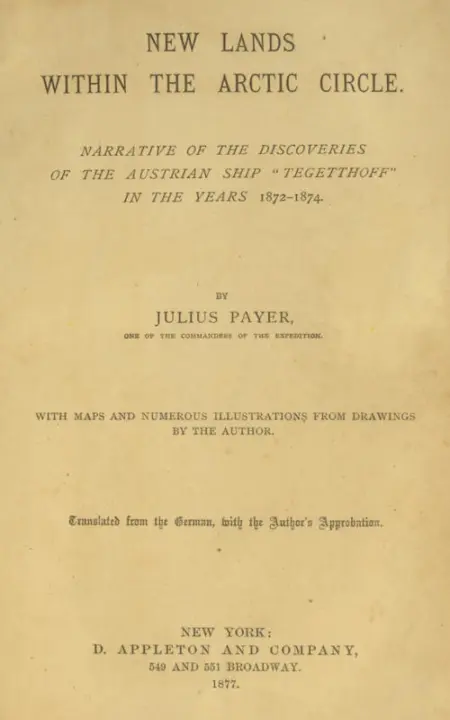
"New Lands Within the Arctic Circle" by Julius Payer is a historical account written in the late 19th century. The narrative chronicles the daring finds and hardships faced during the Austrian ship "Tegetthoff's" expedition from 1872 to 1874 as it navigated uncharted territories within the Arctic. The author provides insights into the crew's experiences, scientific observations, and the formidable natural challenges they encountered, presenting a detailed picture of Arctic exploration. The opening of the narrative establishes the context and significance of the expedition, emphasizing the roles of key figures such as Lieutenant Weyprecht and Dr. Kepes. Payer reflects on the dynamics of leadership and teamwork while setting the stage for the harrowing adventures that lie ahead. The narrative alludes to their struggle against the ice, the challenges of navigation, and the aim of discovering new lands, particularly focusing on the hardships endured during the harsh Arctic winters. These early pages lay the groundwork for the epic and often perilous journey that will unfold, inviting the reader to join in an era of exploration filled with excitement and scientific discovery.
Introduction adapted from the source catalogue; source summaries may be automatically generated.
Free to read · English · 133,616 words · No account needed
MAKE TIME FOR A GOOD BOOK
On by default. Untick to stop anonymous reading totals. Each page counts after 10 seconds in view. How this works.
Anonymous counting is on unless you have switched it off.
15. April 5, after a short rest, we again started about midnight in order to economize our time (the thermometer being at 19° F.). The weather had greatly improved. Klotz, who was the first to step out of the tent, startled us by the information that some high land barred our further progress. But when we followed him into the open air, we found that Klotz had looked to the west instead of to the north, and we discovered the true state of things, that Zichy Land ran on our left in a northerly direction, while Wilczek Land trended towards the north-east. We pursued, therefore, our course on the vast icy wastes, over which hung Cape Easter (81° 1′), and Cape Hellwald shining in the sun, and hoisted the flag on the sledge to celebrate our passage of the eighty-first degree of north latitude, and in commemoration of Easter Sunday.
16. During our march, spying us at a great distance, a bear approached us at a rapid pace, but when he came within forty paces he fell, receiving three bullets in his head. The accompanying illustration shows how we received bears when they attacked us on our journey; it represents also the fine forms of Cape Tyrol in the background. A few hours afterwards, we observed a she-bear about 400 yards from us, apparently diligent in burrowing in the snow; but as soon as she got wind of us she suddenly turned, reared herself on her hind legs, and began to snuff the air. She then came towards us, but as she advanced she rolled herself over with evident pleasure on her back several times, then pushed on with her snout and belly close to the ground, perfectly unconscious of the three rifles which were levelled at her. At fifty paces distance we fired, and brought her down. We immediately examined the place where we had seen her so busy. We did not find poor Sumbu, as we half expected, but a partially-consumed seal, and close to it a hole in the ice, into which the creature no doubt would plunge when danger threatened; but the bear had been sharper and cleverer than the seal, and had probably seized it when asleep on the ice. Bear-flesh now formed our principal food, and the sledge was heavily laden with it. We ate it both raw and cooked, and when the flesh was badly cooked—especially if it were the flesh of an old bear—it was less palatable than when uncooked. It may be tolerable food for sea-gulls, but it is a diet hardly fit even for devils on the fast-days of the infernal regions. Arctic lands certainly do not furnish delicacies to gratify a refined taste; the best things they have to offer are coarse and oily, and if ever they are eaten with relish, it is a relish which comes from hunger alone. The desolate shores of these lands are truly the very home of hunger, and nowhere else are the calculations of travellers so much influenced and determined by the stomach and its needs. Remains or fragments are unknown in Arctic regions. The dead are consumed by the living, and the living find their never-ceasing occupation in the toilsome search for food. In my three Arctic expeditions, I very seldom indeed found the remains of animals, never the remains of a bear or a fox. The man who visits these wastes must do homage to the principle of eating everything, and throwing away nothing. Franklin was unsurpassed in this, but I believe we were little behind him. Franklin and his people found the flesh of a white fox as pleasant to the taste as young geese—a proof how entirely they had forgotten how geese taste. They preferred foxes, too, to lean reindeer; and they considered the flesh of a grey bear exceedingly palatable, though even the Eskimos eat it only in dire necessity. Reindeer marrow, even raw, was to them a great delicacy, and they ate animals in a state of decomposition. Barentz and his crew were very modest in their tastes; they compared whale-flesh to beef, and foxes to rabbits, as articles of diet; bears’ meat they utterly detested. Once only it seems they partook of the liver of a bear, and three of his men became exceedingly ill in consequence, their skin peeling off from head to foot. Kane was prejudiced against bear, notwithstanding the great straits to which he was reduced, and complains of this food as being absolutely uneatable. The testimony of Dunér is more favourable. “If,” says he, “a bear has not been eating walrus or seal in a state of semiputrefaction before he is killed, his flesh, though somewhat coarse, is yet palatable, and not at all prejudicial to health.” Parry thought whale-flesh and walrus-flesh equally distasteful: he makes an exception in favour only of the heart of the walrus; but he speaks of the tenderness and excellence of the flesh of young seals. As for ourselves, we disdained nothing that we could get hold of, after the manner of Sir John Ross, who thought the fox the best of all food, better than the gull (Larus tridactylus).
Your reading position is saved on this browser. Take it to another device with a library code. Reading pages adapt to text, rather than matching a printed edition.
BEHIND THE BOOK
This eBook is for the use of anyone anywhere in the United States and most other parts of the world at no cost and with almost no restrictions whatsoever. You may copy it, give it away or re-use it under the terms of the Project Gutenberg License included with this eBook or online at www.gutenberg.org. If you are not located in the United States, you will have to check the laws of the country where you are located before using this eBook. Read the source licence.
The original source file, including credits and licence, is retained by this library. Request an original-format copy at no charge. Please include the book title and Project Gutenberg identifier #60258.
KEEP YOUR CURIOSITY GOING
Wilfrid Scawen Blunt
Wilfrid Scawen Blunt

E. W. (Edgar Watson) Howe
Cécile Tormay

Moritz Busch
John L. Ransom