THE CLASSIC COLLECTION✦My diaries, being a personal narrative of events 1888-1914, Part 2 (1900-1914)CLASSIC FREE BOOKS
My diaries, being a personal narrative of events 1888-1914, Part 2 (1900-1914)
Wilfrid Scawen Blunt
THE CLASSIC COLLECTION · 1876
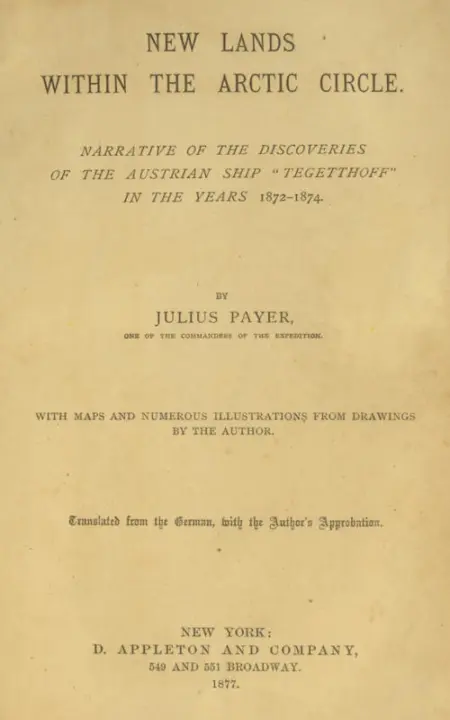
"New Lands Within the Arctic Circle" by Julius Payer is a historical account written in the late 19th century. The narrative chronicles the daring finds and hardships faced during the Austrian ship "Tegetthoff's" expedition from 1872 to 1874 as it navigated uncharted territories within the Arctic. The author provides insights into the crew's experiences, scientific observations, and the formidable natural challenges they encountered, presenting a detailed picture of Arctic exploration. The opening of the narrative establishes the context and significance of the expedition, emphasizing the roles of key figures such as Lieutenant Weyprecht and Dr. Kepes. Payer reflects on the dynamics of leadership and teamwork while setting the stage for the harrowing adventures that lie ahead. The narrative alludes to their struggle against the ice, the challenges of navigation, and the aim of discovering new lands, particularly focusing on the hardships endured during the harsh Arctic winters. These early pages lay the groundwork for the epic and often perilous journey that will unfold, inviting the reader to join in an era of exploration filled with excitement and scientific discovery.
Introduction adapted from the source catalogue; source summaries may be automatically generated.
Free to read · English · 133,616 words · No account needed
MAKE TIME FOR A GOOD BOOK
On by default. Untick to stop anonymous reading totals. Each page counts after 10 seconds in view. How this works.
Anonymous counting is on unless you have switched it off.
10. It is remarkable that great heat as well as great cold should generate the great evil—thirst. It is also remarkable how rapidly the demoralisation produced by thirst extends when any one of the party begins to show signs of suffering from it. Habit, however, enables men to struggle against thirst more successfully than against hunger. Many try to relieve it by using snow; which is especially pernicious when its temperature falls considerably below the point of liquefaction. Inflammation of the mouth and tongue, rheumatic pains in the teeth, diarrhœa, and other mischiefs, are the consequences, whenever a party incautiously yields to the temptation of such a momentary relief. It is in fact a mere delusion, because it is impossible to eat as much snow—say a cubic foot—as would be requisite to furnish an adequate amount of water. Snow of a temperature of 37° to 50° (C.) below zero feels in the mouth like hot iron, and does not quench, but increases thirst, by its inflammatory action on the mucous membranes of the parts it affects. The Eskimos prefer to endure any amount of thirst rather than eat snow, and it is only the Tschuktschees who indulge in it as a relish with their food, which is always eaten cold. Snow-eaters during the march were regarded by us as weaklings, much in the same way as opium-eaters are. Catarrhs of every kind are less frequent in Polar expeditions, and the chills to which we are exposed by passing suddenly from the cold of the land journey to the warmer temperature of the ship, have no evil consequences. It deserves to be investigated whether this arises from the difference of the amount of ozone in the atmosphere of the respective latitudes.—Now let us return to our journey.
11. After crossing over the Sonklar-Glacier and measuring its slight inclination of 1° 6′, we climbed an elevation to ascertain the most promising route for penetrating in a northerly direction; and none seemed better suited than that which lay over its back, which seemed free from crevasses. But we looked in vain for the fancied paradise of the interior, which had existed only in our desire to clothe in glowing colours the Land, from which we had been so long held back. The true character, however, of Kaiser Franz-Josef Land, so far as it could be explored in this and the following sledge expeditions, will be the subject of the next chapter. The accompanying sketch represents a block of snow, about the height of a man, at the foot of the Sonklar-Glacier, to which the winds had given a fanlike shape. In the afternoon, after inspecting the stakes which we had fixed for measuring the motion of the glacier, we came back to the tent and began our return march to Cape Tegetthoff and the ship. A cutting wind compelled us to make constant efforts against frost-bites. With a heavy creaking noise the sledge was dragged over the hard snow, and to our reduced strength it seemed to be laden with a double load. The night is generally the hardest part of such expeditions, and our camping out during the night under the cliffs of Cape Tegetthoff was especially bitter. Happy was he who, exhausted by the labour of dragging, fell asleep at once. As usual, we dug a deep hole in the snow and loosened it as much as possible, so that we might profit by its property of being one of the worst conductors of heat. In a short time the inside of the tent was covered with rime frost, and we ourselves with ice. The tongue only seemed to recover its former mobility with those who bewailed their loss of knives, stockings, gloves—yea, of everything, even their place in the tent. They ate their portion of bear’s flesh much as if they had been chloroformed, and dropping asleep in their stiffened icy coat of mail, they were awoke by its gradual thawing, to reiterate without cessation how cold it was; a fact which no one present was prepared to dispute. The alcohol thermometer stood at -56° F. (-48° on board the ship), and when the warmth produced by the exercise we had taken and by the effects of supper was gone, the feeling of cold was so intense that it seemed far more probable that we should be frozen to death than that we should sleep. The cook therefore received orders to brew some strong grog, and forthwith six spirit-flames burnt under the kettle filled with snow; but to make snow of such extreme coldness boil quickly we should have had to place the kettle over Vesuvius itself in the height of an eruption.
Your reading position is saved on this browser. Take it to another device with a library code. Reading pages adapt to text, rather than matching a printed edition.
BEHIND THE BOOK
This eBook is for the use of anyone anywhere in the United States and most other parts of the world at no cost and with almost no restrictions whatsoever. You may copy it, give it away or re-use it under the terms of the Project Gutenberg License included with this eBook or online at www.gutenberg.org. If you are not located in the United States, you will have to check the laws of the country where you are located before using this eBook. Read the source licence.
The original source file, including credits and licence, is retained by this library. Request an original-format copy at no charge. Please include the book title and Project Gutenberg identifier #60258.
KEEP YOUR CURIOSITY GOING
Wilfrid Scawen Blunt
Wilfrid Scawen Blunt

E. W. (Edgar Watson) Howe
Cécile Tormay

Moritz Busch
John L. Ransom