THE CLASSIC COLLECTION✦My diaries, being a personal narrative of events 1888-1914, Part 2 (1900-1914)CLASSIC FREE BOOKS
My diaries, being a personal narrative of events 1888-1914, Part 2 (1900-1914)
Wilfrid Scawen Blunt
THE CLASSIC COLLECTION · 1876
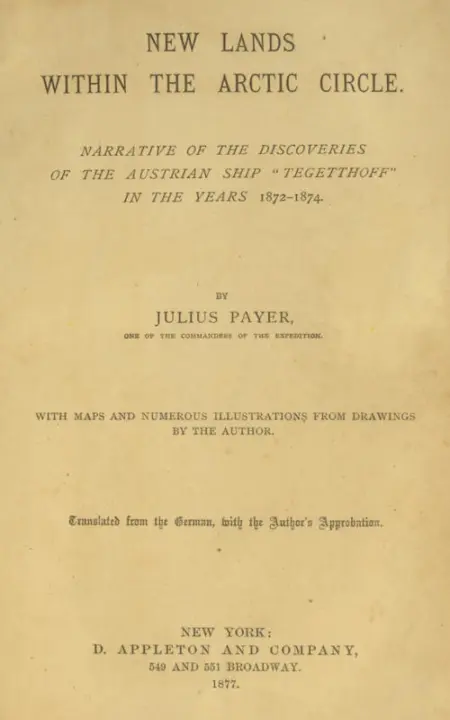
"New Lands Within the Arctic Circle" by Julius Payer is a historical account written in the late 19th century. The narrative chronicles the daring finds and hardships faced during the Austrian ship "Tegetthoff's" expedition from 1872 to 1874 as it navigated uncharted territories within the Arctic. The author provides insights into the crew's experiences, scientific observations, and the formidable natural challenges they encountered, presenting a detailed picture of Arctic exploration. The opening of the narrative establishes the context and significance of the expedition, emphasizing the roles of key figures such as Lieutenant Weyprecht and Dr. Kepes. Payer reflects on the dynamics of leadership and teamwork while setting the stage for the harrowing adventures that lie ahead. The narrative alludes to their struggle against the ice, the challenges of navigation, and the aim of discovering new lands, particularly focusing on the hardships endured during the harsh Arctic winters. These early pages lay the groundwork for the epic and often perilous journey that will unfold, inviting the reader to join in an era of exploration filled with excitement and scientific discovery.
Introduction adapted from the source catalogue; source summaries may be automatically generated.
Free to read · English · 133,616 words · No account needed
MAKE TIME FOR A GOOD BOOK
On by default. Untick to stop anonymous reading totals. Each page counts after 10 seconds in view. How this works.
Anonymous counting is on unless you have switched it off.
11. The number of those afflicted with scurvy decreased with the approach of spring. Their gums recovered their fresh and natural appearance, and the general weakness, the pains in the joints, the leaden weight of the feet, the depression of spirits—symptoms of this terrible malady—abated, and the scorbutic marks disappeared from their bodies. Pachtusow, when he wintered in Novaya Zemlya, so abundant in supplies of drift-wood, caused his people to use the bath once a week in a log house constructed on the land, as a preservative against scurvy, and had their inner clothing washed twice a week, but even these steps were insufficient to avert the malady. In our case baths so added to the moisture that we were obliged to put a stop to them, and our under-garments could be changed only as our stock of them permitted. Hence we could hope to prevent the spread of scurvy only by the improvement of our diet. Several hundred-weight of potatoes and a large supply of preserved meat had been kept in store for the second winter. These now came into use, and were the more welcome as our supply of lemon-juice—the most important preservative against scurvy—was diminishing. By the advice of our physician, Dr. Kepes, we departed from the maxim, so generally adhered to in Arctic expeditions, of avoiding spirituous liquors. From the beginning of October our men daily received rations of brandy. When I compare the sanitary condition of the crew of the Tegetthoff with the better state of that of the Germania, I attribute this to the lesser power of resistance to disease in some of our people on board the Tegetthoff and to the moral depression so easily explained by our disasters in this ship.
12. The Arctic voyager is exposed to no disease so much as to scurvy. Its appearance among a crew exercises a most untoward influence. Its causes are still but little known; the means, however, of combating it are numerous. It is no longer the scourge it was in the days of Barentz, when he and all his men were attacked with it on the short summer excursion of 1595, or when in Munk’s expedition of 1619 all died but two. In Behring’s expedition of 1741, out of seventy-six men, forty-two were attacked and thirty died. In Tschirikoff’s summer expedition during that same year (1741), out of seventy men, twenty died. Rossmyslow, who passed the winter of 1768-69 in “Matoschkin-Schar,” lost seven out of thirteen men. When the disease gains the mastery, the utter incapacity of the expedition for further exploration follows as a necessary consequence. Lassinius, who was sent out to explore Novaya Zemlya in 1819, had to return in the height of summer, all his men having fallen down with the scurvy. This disease has been a frightful enemy to expeditions which have wintered in that region, and carried off numerous victims. All these, it is true, were miserably equipped, and depended on the medicinal virtues of the “Löffel-kraut” of that country for remedies against the disease. In 1832-33 Pachtusow, wintering in the south of the island, out of ten men lost three; in 1834-35, two more died of the same disease. In the expedition of Ziwolka and Mojsejew, 1838-39, the scurvy gained such mastery that at the end of February half of the crew were attacked, and Ziwolka himself with eight men died. Parry regarded damp, especially damp bedding, as the principal cause of the malady. During his wintering at Melville Island he found sorrel an effective remedy or palliative. He attributed the greatest anti-scorbutic effect to beer; and according to him and to most of the English expeditions, beer and wine take the place of brandy. The disease generally has a fatal issue when there has been excessive loss of blood, or when dropsy supervenes. Most of Ross’s second expedition suffered more or less from it, and the experience of that expedition showed that vegetable nourishment alone was not competent to make head against it. Ross regarded the addition of fish or seals to the ordinary diet as an effective preservative, and did not disdain the use of blubber for the same purpose. Lemon-juice, uncooked potatoes, fruit with much acidity, fresh vegetables and fresh meat, wine and yeast, exercise in the open air, and cheerfulness, have always proved sufficient to prevent its appearance, or at any rate to render it improbable. But however valuable these may be as preventives, they almost cease to have any effect when the disease has once broken out. The lime-juice must be fresh, and, like vinegar, be taken in as concentrated a form as possible. It is decomposed and useless by being kept too long, and also by the action of frost. This was the case with the lemon-juice which Sir John Ross found among the stores of the Fury. An anti-scorbutic effect has been attributed also—and with justice—to the chewing of tobacco. It appears that liability to scurvy is very different among different races, and that neither vegetable nor animal food is an absolute preservative. The Eskimos, and even the Lapps, who seldom or never use vegetables, are almost exempt from it, and McClure’s men fell down with it in their second winter, although they had fresh meat three times a week. Steller relates that in Kamschatka scurvy attacks strangers only, but not the natives, who live largely on vegetables; he states also, that the scurvy when it does appear among strangers and visitors there, is cured by a diet of the fresh fish of spring.
Your reading position is saved on this browser. Take it to another device with a library code. Reading pages adapt to text, rather than matching a printed edition.
BEHIND THE BOOK
This eBook is for the use of anyone anywhere in the United States and most other parts of the world at no cost and with almost no restrictions whatsoever. You may copy it, give it away or re-use it under the terms of the Project Gutenberg License included with this eBook or online at www.gutenberg.org. If you are not located in the United States, you will have to check the laws of the country where you are located before using this eBook. Read the source licence.
The original source file, including credits and licence, is retained by this library. Request an original-format copy at no charge. Please include the book title and Project Gutenberg identifier #60258.
KEEP YOUR CURIOSITY GOING
Wilfrid Scawen Blunt
Wilfrid Scawen Blunt

E. W. (Edgar Watson) Howe
Cécile Tormay

Moritz Busch
John L. Ransom