THE CLASSIC COLLECTION✦My diaries, being a personal narrative of events 1888-1914, Part 2 (1900-1914)CLASSIC FREE BOOKS
My diaries, being a personal narrative of events 1888-1914, Part 2 (1900-1914)
Wilfrid Scawen Blunt
THE CLASSIC COLLECTION · 1876
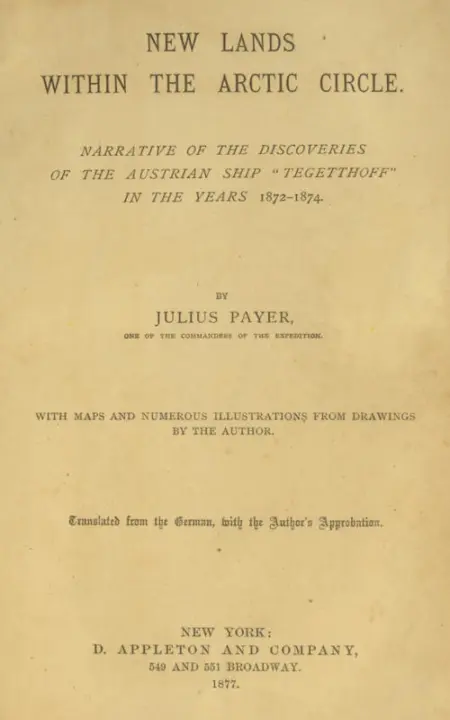
"New Lands Within the Arctic Circle" by Julius Payer is a historical account written in the late 19th century. The narrative chronicles the daring finds and hardships faced during the Austrian ship "Tegetthoff's" expedition from 1872 to 1874 as it navigated uncharted territories within the Arctic. The author provides insights into the crew's experiences, scientific observations, and the formidable natural challenges they encountered, presenting a detailed picture of Arctic exploration. The opening of the narrative establishes the context and significance of the expedition, emphasizing the roles of key figures such as Lieutenant Weyprecht and Dr. Kepes. Payer reflects on the dynamics of leadership and teamwork while setting the stage for the harrowing adventures that lie ahead. The narrative alludes to their struggle against the ice, the challenges of navigation, and the aim of discovering new lands, particularly focusing on the hardships endured during the harsh Arctic winters. These early pages lay the groundwork for the epic and often perilous journey that will unfold, inviting the reader to join in an era of exploration filled with excitement and scientific discovery.
Introduction adapted from the source catalogue; source summaries may be automatically generated.
Free to read · English · 133,616 words · No account needed
MAKE TIME FOR A GOOD BOOK
On by default. Untick to stop anonymous reading totals. Each page counts after 10 seconds in view. How this works.
Anonymous counting is on unless you have switched it off.
7. With December a new era began for the dogs. A large snow house was built for them outside the ship, in which were placed their kennels, well filled with straw. The name of each dog was written on his house. And here let me remark, that the winter quarters of the dogs should always be on the ice. To keep them under the deck-tent is unhealthy and inconvenient, and would be an impossibility if their numbers were great. Every morning Haller opened the door of the snow house, and out rushed the dogs, with their tails in the air, to begin forthwith a general fight. No shouts, no blows, not even the discharge of a rifle could separate the combatants. Pouring water over them at a temperature of -35° F., though a somewhat barbarous way of producing peace, was successful only with the younger dogs. When the fight was over, the next object was to find out their special patron, and the instant they recognised him they rushed upon him, tugged at his clothes, and thrust their noses inquiringly into his pockets. Each then made his morning round, visiting the places where he had hid in the snow a piece of bread or covered up a bit of seal. When they had satisfied their appetite, it was curious to observe how they would make it smooth over the hole in which they deposited their treasure, all the time cunningly turning their eyes right and left to see whether they were observed.
8. Their violence and eagerness having somewhat abated, we may observe the members of our pack one by one. The red giant there, who offers his paw as huge as a bear’s, is named after a god of the heathen days of Lapland, “Jubinal;” and not a few legends surrounded the accounts of his early life. A Siberian Israelite, so it was said, brought him from the north of Asia over the Ural. He was the victor in all fights, the leader of the sledge team, and could drag four men on a hard level path without any effort. The day before we sailed from Bremerhaven he tore a sheep to pieces. Every summer when he changed his coat, the sailors clad him in a canvas dress. Bop was his inferior in strength, but his superior in wisdom; Matoschkin surpassed him in gravity. The latter used to sit for hours in a moody manner on a pile of chests looking at the ice world. Bop and Matoschkin were Newfoundlands; the first died of cold in our first winter, the latter, as our readers may remember, was carried off by a bear and torn to pieces. We had also two Newfoundland bitches, who were called respectively “Novaya” and “Zemlya;” the former died in the first year, the latter, though she was of little use in sledging from her laziness, may claim indisputably the merit of being the mother of her hopeful son, “Torossy,” who grew to a considerable size, and was the pride of the whole crew. He knew no other world than the frozen ocean, and no other destiny than to draw a sledge; and to this work he had devoted himself zealously since the commencement of winter. In the happy courage of ignorance he wagged his tail all day on deck; wagged his tail as he followed us on the ice; wagged it, even when Sumbu stole his dinner; wagged it, even before the jaws of a bear. Gillis, the fifth Newfoundland, was incessantly quarrelling, and was the irreconcilable enemy of Jubinal; he was a favourite with no one, chiefly because he had killed the two cats which we brought from Tromsoe as pets for the dogs. His body was covered with scars, and half his time was spent under the medical treatment of the Tyrolese. He was not wanting in docility, but he was essentially an eye-pleaser; all his efforts in the sledge were mere sham. Pekel, the Lapp, was the smallest of all the dogs. In his early days he had tended the reindeer at the North Cape and on the plains of Tana Elf, and his ways did not fit him for life amid the ice, but for the brown herd which roamed at the foot of Kilpis. Hence he was quarrelsome, and showed special enmity to Sumbu, the mere sight of whom was enough to stir up the most hostile feelings. He was therefore banished with his house to a high ice-cliff, but the thaw destroying its supports, house and dog fell plump into an ice-lake. Among all the dogs there was no such desperate hypocrite as Sumbu, the most demonstrative in his friendship, but withal the most greedy and dissatisfied. He was the first to slink away with tail between his legs and find out the most secluded nook, when he saw the other dogs being harnessed in the sledges; and, when pulled out and put in a team, at once laid himself down on the sledge, not to draw, but to be drawn. When at last he was set in motion, he was no longer the same dog. He was then full of action, unsurpassed in speed and agility, and his sportiveness was as great as his cunning. From the carpenter he would carry off a hoop, or a bag of nails from the stoker, or he lay flat on his belly and thrust out his long nose in the snow. His agility stood him in good stead, for it enabled him to catch all the mice that ventured on deck. Neither the stores of provisions for the dogs nor the depôt of food for the crew were safe from his depredations. He hated bears so fiercely, that he began to howl like a wolf when we turned out to hunt them. Boldly he followed up their trail, even when at a distance from the hunters and close to the heels of the bear. The dogs were fed once a day with bear’s flesh or blubber, or dried horse-flesh, as long as it lasted.[24] They well knew the hour of feeding, and gathered together before it arrived. At night they were shut up in their house, and when the snow drifted they all lay huddled in a heap before the door. The dog-house was about eight feet high, but after a few weeks we could scarcely discern it from the accumulation of snow-drifts. For some time we kept up communication with it by means of a shaft dug in the snow; but one day in February a fissure in the ice was formed right across where the house stood, which compelled us to remove it.
Your reading position is saved on this browser. Take it to another device with a library code. Reading pages adapt to text, rather than matching a printed edition.
BEHIND THE BOOK
This eBook is for the use of anyone anywhere in the United States and most other parts of the world at no cost and with almost no restrictions whatsoever. You may copy it, give it away or re-use it under the terms of the Project Gutenberg License included with this eBook or online at www.gutenberg.org. If you are not located in the United States, you will have to check the laws of the country where you are located before using this eBook. Read the source licence.
The original source file, including credits and licence, is retained by this library. Request an original-format copy at no charge. Please include the book title and Project Gutenberg identifier #60258.
KEEP YOUR CURIOSITY GOING
Wilfrid Scawen Blunt
Wilfrid Scawen Blunt

E. W. (Edgar Watson) Howe
Cécile Tormay

Moritz Busch
John L. Ransom