THE CLASSIC COLLECTION✦My diaries, being a personal narrative of events 1888-1914, Part 2 (1900-1914)CLASSIC FREE BOOKS
My diaries, being a personal narrative of events 1888-1914, Part 2 (1900-1914)
Wilfrid Scawen Blunt
THE CLASSIC COLLECTION · 1876
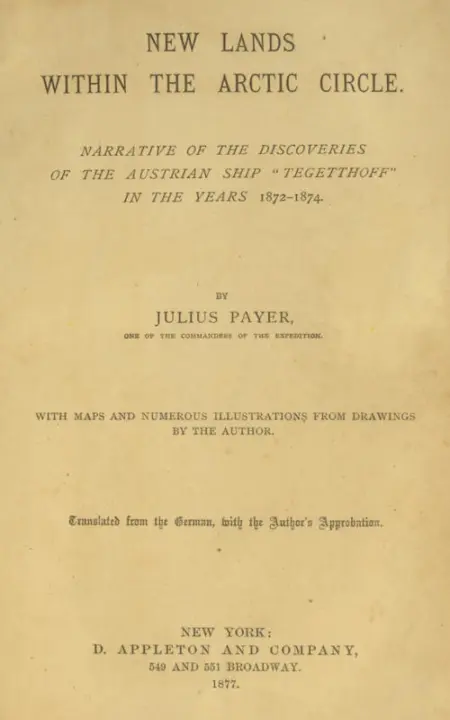
"New Lands Within the Arctic Circle" by Julius Payer is a historical account written in the late 19th century. The narrative chronicles the daring finds and hardships faced during the Austrian ship "Tegetthoff's" expedition from 1872 to 1874 as it navigated uncharted territories within the Arctic. The author provides insights into the crew's experiences, scientific observations, and the formidable natural challenges they encountered, presenting a detailed picture of Arctic exploration. The opening of the narrative establishes the context and significance of the expedition, emphasizing the roles of key figures such as Lieutenant Weyprecht and Dr. Kepes. Payer reflects on the dynamics of leadership and teamwork while setting the stage for the harrowing adventures that lie ahead. The narrative alludes to their struggle against the ice, the challenges of navigation, and the aim of discovering new lands, particularly focusing on the hardships endured during the harsh Arctic winters. These early pages lay the groundwork for the epic and often perilous journey that will unfold, inviting the reader to join in an era of exploration filled with excitement and scientific discovery.
Introduction adapted from the source catalogue; source summaries may be automatically generated.
Free to read · English · 133,616 words · No account needed
MAKE TIME FOR A GOOD BOOK
On by default. Untick to stop anonymous reading totals. Each page counts after 10 seconds in view. How this works.
Anonymous counting is on unless you have switched it off.
15. The use of the bath tends greatly to promote health, for without it the skin of the body has no other stimulant; but the insecurity of our position rendered bathing sometimes a somewhat doubtful enjoyment. I remember many cases, when some of us, while bathing in the cold dark washing place in lukewarm water an inch deep, were alarmed by a sudden pressure of ice. Ultimately we gave up this practice, finding that it produced a troublesome amount of damp.
16. To a stranger, who should have visited us during this winter, nothing in the ship would have been so surprising and interesting as a visit to the quarters of the crew. Except for an hour, from five to six o’clock in the evening, when they were encouraged to take exercise in the open air, the rest of their time was spent in school, or in the duties of the watch, or in the work of the ship. Our supply of Slavonic books was unfortunately not very ample, and besides, not all the crew were able to read; the greater therefore was their tendency, like men of southern climes, to harmless noise, and I believe that some of our people, during the whole expedition, never ceased to speak. Here I beg to insert some passages from my journal:—“Passing by the steaming kitchen, we enter their messroom. Here in a narrow space we find the toilers of the sea and the mountains—eighteen in number. A little band of Dalmatians who for the first time encounter darkness and cold, the horrors of which are increased tenfold to men born and bred in the sunny South. Truly it could be no little thing to such men to be torn from sleep almost every night by the movement of the ice, to sit day after day in the long night of winter without any real intellectual occupation, and yet not to become demoralized, but remain calm and composed, and ever ready to obey and oblige. Can anything higher be said in their praise? Those men slept, each by himself, in a double row of berths; only Lusina the boatswain, and Carlsen the harpooner, who had circumnavigated Spitzbergen and Novaya Zemlya, occupied a separate partition. The clatter of the tongues of so many vehement Southerners was like the sound made by the smaller wheels of a machine, while the naive simplicity of the grave Tyrolese came in between times, like the steady beat of a great cog-wheel. It was a miniature reproduction of the confusion of tongues of Babel. Lusina speaks Italian to the occupants of the officers’ cabin, English with Carlsen, French with Dr. Kepes, and Slavonic with the crew. Carlsen had adopted for the ‘Slavonians,’ as he called our people, a kind of speech compounded of Norwegian, English, German, Italian, and Slavonic. The crew, with the exception of the two Italians, speak Slavonic among themselves. The head of the little German colony is the cook, a Styrian; his heart is better than his culinary skill, for only too readily he leaves his work to be done by the stove. There is also among them a Moravian, Pospischill, the Vulcan of the ship; but we must return to the predominant race—the Slavonic. There is Lukinovich, a very Harpagon, always collecting, finding treasures in nails, empty bottles, lamp wicks, and searching even under the snow for articles wherewith to fill his sack—the sack which he was one day to leave behind him, much against the grain, when we abandoned the ship. There is Marola, the steward, and Fallesich, who had worked at the Suez Canal; these are our great singers. Then Palmich with his lance, the man whose zeal never bated, and whose very glance transfixed everything; Vecerina, the Job of the party, and the merry Titans, Sussich and Catarinich; Latkovich and Lettis, ‘the philosophers;’ Stiglich, the immovable confessor of passive obedience and the unlawfulness of resistance; Zaninovich, the ‘pearl;’ Haller the herdsman and Klotz the prophet. Five of these men had run away from their wives. Klotz the prophet was under all circumstances, not indeed the most useful, but the most interesting person of this little community. A lofty calm worthy of an Evangelist graced his outer man; of still greater stature than Andreas Höfer, he wore, like him, a large black beard. As a hunter, a guide, a collector of stones, and a lonely enthusiast, he had moved about the mountains of his home, leading a life of visions. At home he was regarded as an incomparably bold mountaineer, and the ropes of the ship were to him so many convenient foot-paths. His reputation as a physician in his native land was great, and on board ship he failed not with his good offices. Haller, his fellow-countryman, shared with Klotz the office of armourer, and the duties of hunter and driver of the sledge-dogs; and when we began our sledge journeys, both of them were ready to relieve others in dragging. Both had served in the army, Klotz on the Tonale, Haller on the Stelvio, and in 1868 the latter had been my useful companion when I was engaged in the survey of the Ortler and Adamello Alps. ‘The philosophers’ of our party, Latkovich and Lettis, had drawn a fine distinction between the different layers of ice, according as they contained a greater or less amount of saline matter: Ghiaccio della prima and Ghiaccio della seconda qualità.”
Your reading position is saved on this browser. Take it to another device with a library code. Reading pages adapt to text, rather than matching a printed edition.
BEHIND THE BOOK
This eBook is for the use of anyone anywhere in the United States and most other parts of the world at no cost and with almost no restrictions whatsoever. You may copy it, give it away or re-use it under the terms of the Project Gutenberg License included with this eBook or online at www.gutenberg.org. If you are not located in the United States, you will have to check the laws of the country where you are located before using this eBook. Read the source licence.
The original source file, including credits and licence, is retained by this library. Request an original-format copy at no charge. Please include the book title and Project Gutenberg identifier #60258.
KEEP YOUR CURIOSITY GOING
Wilfrid Scawen Blunt
Wilfrid Scawen Blunt

E. W. (Edgar Watson) Howe
Cécile Tormay

Moritz Busch
John L. Ransom