THE CLASSIC COLLECTION✦My diaries, being a personal narrative of events 1888-1914, Part 2 (1900-1914)CLASSIC FREE BOOKS
My diaries, being a personal narrative of events 1888-1914, Part 2 (1900-1914)
Wilfrid Scawen Blunt
THE CLASSIC COLLECTION · 1876
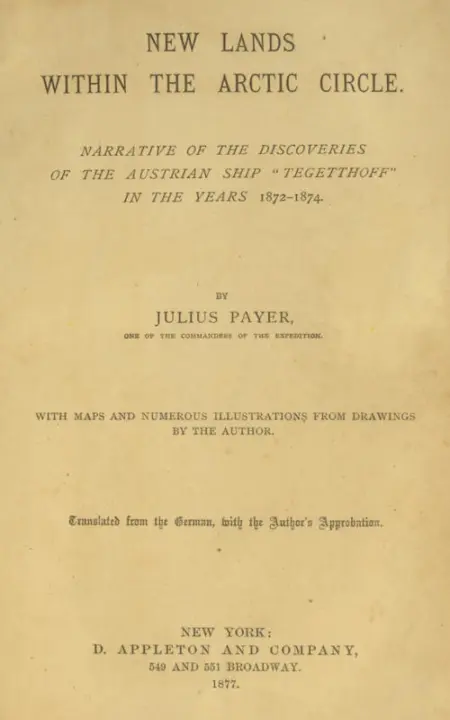
"New Lands Within the Arctic Circle" by Julius Payer is a historical account written in the late 19th century. The narrative chronicles the daring finds and hardships faced during the Austrian ship "Tegetthoff's" expedition from 1872 to 1874 as it navigated uncharted territories within the Arctic. The author provides insights into the crew's experiences, scientific observations, and the formidable natural challenges they encountered, presenting a detailed picture of Arctic exploration. The opening of the narrative establishes the context and significance of the expedition, emphasizing the roles of key figures such as Lieutenant Weyprecht and Dr. Kepes. Payer reflects on the dynamics of leadership and teamwork while setting the stage for the harrowing adventures that lie ahead. The narrative alludes to their struggle against the ice, the challenges of navigation, and the aim of discovering new lands, particularly focusing on the hardships endured during the harsh Arctic winters. These early pages lay the groundwork for the epic and often perilous journey that will unfold, inviting the reader to join in an era of exploration filled with excitement and scientific discovery.
Introduction adapted from the source catalogue; source summaries may be automatically generated.
Free to read · English · 133,616 words · No account needed
MAKE TIME FOR A GOOD BOOK
On by default. Untick to stop anonymous reading totals. Each page counts after 10 seconds in view. How this works.
Anonymous counting is on unless you have switched it off.
6. We had sailed over one “ice-hole,” and again a dense barrier of ice frowned on us; as we forced our way into it, the ice closed in all round us—we were “beset.” The ship was made fast to a floe, the steam blown off, its hot breath rushing with a loud noise through the cold mist; every open mesh in the net of water-ways was closed by the ice, which soon lay in such thick masses around us, that any one provided with a plank might have wandered for miles in any direction he liked. July 30, the Tegetthoff remained fast in her prison; no current of water, nor any movement among the floes lying close to us was discernible; a dead calm prevailed, and mist hung on every side. On the following day we made vain efforts to break through a floe which lay on our bows. The calm still prevailed, Aug. 1 (74° 39′ N. L. 53° E. L.), and no change was to be seen in the ice. Aug. 2, the crew began with hearty good-will the toilsome work of warping, but with no success, the smallness of the floes hardly admitting of this manœuvre. In the evening of the same day it seemed as if a fresh breeze would set us free; but after we had gone on for a few cable-lengths, a great floe once more barred the route, while at the same time the wind fell. At length, when the ice became somewhat looser, we got up the engine fires, and in the following night broke through, under steam, a broad barrier of ice, which separated us from the open coast-water of Novaya Zemlya. In the morning of Aug. 3, we forced our way into coast-water, twenty miles broad, to the north of Matotschkin Schar, and steered due north, the mountainous coasts still in sight. A belt of ice 105 miles broad lay behind us. The country greatly resembled Spitzbergen, and we observed with pleasure its picturesque glaciers and mountains rising to the height of nearly 3,000 feet, though inconsiderable compared with the mountains of Greenland. Far and wide not a fragment of ice was to be seen; there was a heavy swell on, the air was unusually warm (41° F.), in the evening rain fell, and on Aug. 4 we had dense mists and driving snow-storms, which forced us to keep to the west of Admiralty Peninsula. During the night of Aug. 6, the snow-storms were heavier than before, and the deck was quite covered. Towards the north and west very close ice was seen, and since the temperature of the air, even with the winds in the south-west, remained constantly below zero, it was evident that the ice must stretch far in that direction also. Aug. 7, we ran on the white barriers to the west of Admiralty Peninsula, and far to the north, beyond a broad field of ice, refraction indicated open water and showed the forms of “Tschorny Nos” floating in the air. In the afternoon of Aug. 8 the ice in 75° 22′ N. L. became so thick around us that we were compelled to have recourse to steam-power; but the Tegetthoff, even with this auxiliary was unable against a head-wind to penetrate a broad strip of close ice, and banking up our fires, we determined to wait its breaking up. Close under the coast open water was again observed, and in it—a Schooner! Every one now hastened to write letters to his friends and relations, but the schooner, to which we meant to give our letters and despatches, by running into the heart of Gwosdarew Bay escaped the duty we had in store for it. About half-past ten P.M. the wind had fallen and the ice began to open out, and we were able to continue our voyage under steam in a north-westerly direction. The sun lay before us, the clear mirror of distant “leads” glowed with a glorious carmine, the barriers of ice which lay between these “leads” appeared as stripes of violet, and only our immediate neighbourhood was pale and cold. The Tegetthoff laboured through the dense accumulation of floes and about midnight reached open water, and the steam was again blown off. Aug. 9, we sailed in coast-water perfectly free from ice, excepting the icebergs we encountered, some about forty feet high. These, generally, were so numerous and so small in size, that they were at once seen to be offshoots from the small glaciers of Novaya Zemlya as they plunge into the sea. Their surface was frequently covered with débris. Loose drift-ice showed itself, Aug. 10, but the ship continued to steer between the floes towards the north. In the forenoon of that day we were again nearly “beset,” but happily escaped that fate after four hours’ warping. Aug. 11, our course was continued without impediment in a northerly direction through the loose drift-ice. The land, from which we had hitherto remained distant about eight or twelve nautical miles, now declined in height from three thousand to fifteen hundred or a thousand feet, and quickly lost its picturesque character. On the noon of August 12, on account of a thick mist, we made fast to a great floe, and were able to commence on it the training of the dogs to drag the sledges.
Your reading position is saved on this browser. Take it to another device with a library code. Reading pages adapt to text, rather than matching a printed edition.
BEHIND THE BOOK
This eBook is for the use of anyone anywhere in the United States and most other parts of the world at no cost and with almost no restrictions whatsoever. You may copy it, give it away or re-use it under the terms of the Project Gutenberg License included with this eBook or online at www.gutenberg.org. If you are not located in the United States, you will have to check the laws of the country where you are located before using this eBook. Read the source licence.
The original source file, including credits and licence, is retained by this library. Request an original-format copy at no charge. Please include the book title and Project Gutenberg identifier #60258.
KEEP YOUR CURIOSITY GOING
Wilfrid Scawen Blunt
Wilfrid Scawen Blunt

E. W. (Edgar Watson) Howe
Cécile Tormay

Moritz Busch
John L. Ransom