
The Writing of News A Handbook with Chapters on Newspaper Correspondence and Copy Reading
Charles G. (Charles Griffith) Ross
THE CLASSIC COLLECTION · 1901
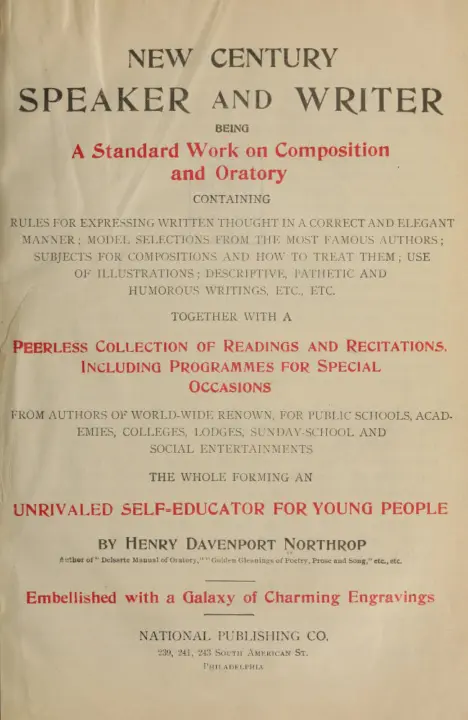
"New Century Speaker and Writer: Being a Standard Work on Composition and Oratory" by Henry Davenport Northrup is an instructional guide focused on the art of writing and public speaking, likely written in the early 20th century. The text serves as a comprehensive resource for young students and aspiring orators, intending to enhance their writing skills while providing a collection of readings and recitations from renowned authors. Central themes include mastering composition, developing an elegant style, and effective techniques for public oratory. The opening of this guide outlines the necessity for clarity and elegance in written communication, emphasizing that expressing thoughts skillfully is an essential skill for students. Northrup discusses the challenges faced by learners, such as the common fear of composition assignments, and offers encouragement by sharing that even great writers faced similar struggles. He introduces practical advice on writing, including selecting suitable subjects, developing a personal style, and the importance of reading widely to improve both language and thought. The aim is to inspire confidence and equip readers with useful tools for enhancing their writing and speaking abilities.
Introduction adapted from the source catalogue; source summaries may be automatically generated.
Free to read · English · 237,347 words · No account needed
MAKE TIME FOR A GOOD BOOK
On by default. Untick to stop anonymous reading totals. Each page counts after 10 seconds in view. How this works.
Anonymous counting is on unless you have switched it off.
It hardly needs description. A background of dark brown gauze, very faintly lighted at the upper right-hand corner; a dress of black serge or stuff, with black veil and white coif; a crucifix and rosary—these are the very simple materials needed. Let the light fall from the left-hand upper corner in front. Choose your nun for the beauty of her eyes, the regularity and refinement of feature, and the elegance of her hands.
Characters.
POET.—A young man with long hair and wide linen collar turned down over
coat collar.
STATUE.—Personated by a young woman in white, with arms bare.
(The Poet speaks.)
Thou holdest me, thou holdest me,
O marble presence, cold and fair.
I cannot draw my feet past thee
Within thy niche above the stair.
I found thee in a mossy cave—
The entrance to a buried shrine;
The rocks around a shudder gave
As thence I bore my prize divine.
What master wrought thee long ago—
Who but Pygmalion’s scholar apt?
The rose upon thy cheek of snow
Ofttimes he saw in vision rapt.
The day upspringing in thine eye
He fancied now, and now it seemed
A hovering smile, a gradual sigh,
Thy lips from silence dead redeemed;
But, dying ere the moment ripe
When thou should’st gather vital fire,
He left thee, a half-conscious type
Of Love and Love’s unvoiced desire.
Thou holdest me, thou holdest me,
O marble presence, cold and fair!
Now let thy prisoned soul be free,
Thy breast its long-sealed fate declare.
(The Statue speaks.)
Thou troublest me, thou troublest me!
A thousand years unused to speech,
Why should the charm dissolve for thee,
Or why to thee my secret teach?
Not Paros, nor Pentelicus,
E’er held me in its quarried hill;
Nor master’s chisel carved me thus,
With lofty thought and patient skill.
Ah, surely, not Pygmalion’s hand
Unprisoned me, through loving art—
I, who in marble moveless stand,
Once held quick veins and pulsing heart;
Love, changed to hate, wrought this cold change
I froze beneath his bitter eye;
Love, changed to Hate—transformer strange—
Forbade me live, forbade me die!
Thou troublest me, thou troublest me;
No further question; go thy way!
He, only, who could set me free,
Hath long since crumbled back to clay!
Thy soul in peace if thou would’st save,
And give forgetfulness to mine,
Restore me to that mossy cave,
The entrance to a buried shrine!
(This beautiful tableau may be represented in three or four scenes, with
fine dress effect.)
Your reading position is saved on this browser. Take it to another device with a library code. Reading pages adapt to text, rather than matching a printed edition.
BEHIND THE BOOK
This eBook is for the use of anyone anywhere in the United States and most other parts of the world at no cost and with almost no restrictions whatsoever. You may copy it, give it away or re-use it under the terms of the Project Gutenberg License included with this eBook or online at www.gutenberg.org. If you are not located in the United States, you will have to check the laws of the country where you are located before using this eBook. Read the source licence.
The original source file, including credits and licence, is retained by this library. Request an original-format copy at no charge. Please include the book title and Project Gutenberg identifier #66982.
KEEP YOUR CURIOSITY GOING
Charles G. (Charles Griffith) Ross
Hannah Webster Foster

Emily Lawless
Edwin Hamlin Carr

Charles De Lano Hine
Andrew Ure