
The Writing of News A Handbook with Chapters on Newspaper Correspondence and Copy Reading
Charles G. (Charles Griffith) Ross
THE CLASSIC COLLECTION · 1901
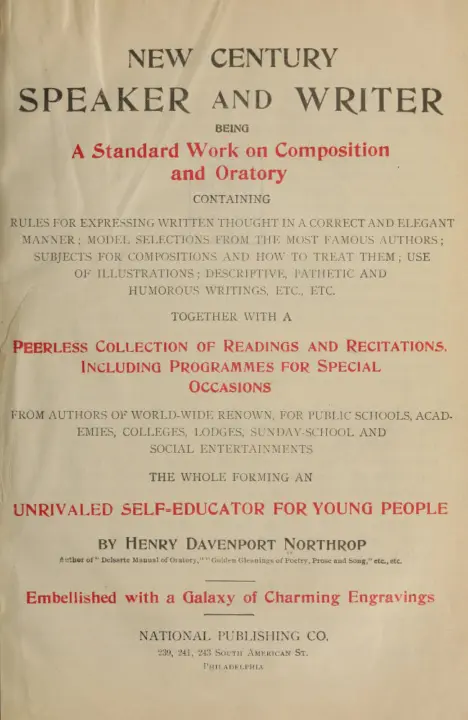
"New Century Speaker and Writer: Being a Standard Work on Composition and Oratory" by Henry Davenport Northrup is an instructional guide focused on the art of writing and public speaking, likely written in the early 20th century. The text serves as a comprehensive resource for young students and aspiring orators, intending to enhance their writing skills while providing a collection of readings and recitations from renowned authors. Central themes include mastering composition, developing an elegant style, and effective techniques for public oratory. The opening of this guide outlines the necessity for clarity and elegance in written communication, emphasizing that expressing thoughts skillfully is an essential skill for students. Northrup discusses the challenges faced by learners, such as the common fear of composition assignments, and offers encouragement by sharing that even great writers faced similar struggles. He introduces practical advice on writing, including selecting suitable subjects, developing a personal style, and the importance of reading widely to improve both language and thought. The aim is to inspire confidence and equip readers with useful tools for enhancing their writing and speaking abilities.
Introduction adapted from the source catalogue; source summaries may be automatically generated.
Free to read · English · 237,347 words · No account needed
MAKE TIME FOR A GOOD BOOK
On by default. Untick to stop anonymous reading totals. Each page counts after 10 seconds in view. How this works.
Anonymous counting is on unless you have switched it off.
Now, stay right still and listen, kitty-cat, and I’ll tell you a
story.
Once there was a girl.
She was a pretty good little girl, and minded her papa ’n’ mamma everything they said, only sometimes she didn’t, and then she was naughty; but she was always sorry, and said she wouldn’t do so any more, and her mamma’d forgive her.
She was going to hang up her stocking.
“You’ll have to be pretty good, ’lest ’twon’t be filled,” said
her mamma.
“’Less maybe there’ll be a big bunch of sticks in it,” said her
papa.
Do you think that’s a nice way to talk, kitty-cat? I don’t.
So the little girl was good as she could be, ’less she was bigger, and didn’t cry and slap her little sister hardly any at all, and always minded her mamma when she came where the chimney was, ’specially much.
So she hung up her stocking.
And in the night she got awake, and wanted it to come morning; but in the morning she didn’t get awake till ’twas all sunshiny out doors.
Then she ran quick as she could to look at her stocking where she’d hung it; and true’s you live, kitty-cat, there wasn’t the leastest thing in it—not the leastest bit of a scrimp!
Oh, the little girl felt dreadfully! How’d you feel, s’pose it
had been you, kitty-cat?
She ’menced to cry, the little girl did, and she kept going harder ’n harder, till by’mby she screeched orfly, and her mamma came running to see what the matter was.
“Mercy me!” said her mamma. “Look over by the window ’fore you do that any more, Kathie.”
That little girl’s name was Kathie too, kitty-cat, just the
same’s mine.
So she looked over by the window, the way her mamma said, and—oh! there was the loveliest dolly’s house you ever saw in all your born life.
It had curtains to pull to the sides when you wanted to play, and pull in front when you didn’t.
There was a bed-room, kitty-cat, and a dinner-room, and a kitchen, and a parlor, and they all had carpets on.
And there was the sweetest dolly in the parlor, all dressed up in blue silk! Oh, dear! And a penano, to play real little tunes on, and a rocking-chair, and—O kitty-cat! I can’t begin to tell you half about it.
I can’t about the bed-room, either, and the dinner-room.
Your reading position is saved on this browser. Take it to another device with a library code. Reading pages adapt to text, rather than matching a printed edition.
BEHIND THE BOOK
This eBook is for the use of anyone anywhere in the United States and most other parts of the world at no cost and with almost no restrictions whatsoever. You may copy it, give it away or re-use it under the terms of the Project Gutenberg License included with this eBook or online at www.gutenberg.org. If you are not located in the United States, you will have to check the laws of the country where you are located before using this eBook. Read the source licence.
The original source file, including credits and licence, is retained by this library. Request an original-format copy at no charge. Please include the book title and Project Gutenberg identifier #66982.
KEEP YOUR CURIOSITY GOING
Charles G. (Charles Griffith) Ross
Hannah Webster Foster

Emily Lawless
Edwin Hamlin Carr

Charles De Lano Hine
Andrew Ure