
The Writing of News A Handbook with Chapters on Newspaper Correspondence and Copy Reading
Charles G. (Charles Griffith) Ross
THE CLASSIC COLLECTION · 1901
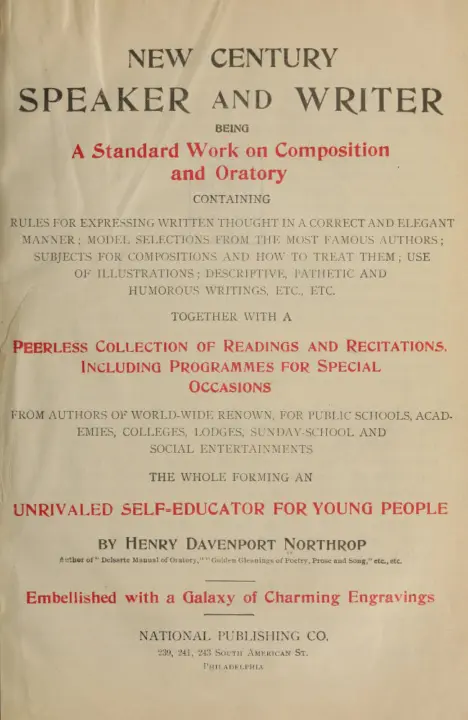
"New Century Speaker and Writer: Being a Standard Work on Composition and Oratory" by Henry Davenport Northrup is an instructional guide focused on the art of writing and public speaking, likely written in the early 20th century. The text serves as a comprehensive resource for young students and aspiring orators, intending to enhance their writing skills while providing a collection of readings and recitations from renowned authors. Central themes include mastering composition, developing an elegant style, and effective techniques for public oratory. The opening of this guide outlines the necessity for clarity and elegance in written communication, emphasizing that expressing thoughts skillfully is an essential skill for students. Northrup discusses the challenges faced by learners, such as the common fear of composition assignments, and offers encouragement by sharing that even great writers faced similar struggles. He introduces practical advice on writing, including selecting suitable subjects, developing a personal style, and the importance of reading widely to improve both language and thought. The aim is to inspire confidence and equip readers with useful tools for enhancing their writing and speaking abilities.
Introduction adapted from the source catalogue; source summaries may be automatically generated.
Free to read · English · 237,347 words · No account needed
MAKE TIME FOR A GOOD BOOK
On by default. Untick to stop anonymous reading totals. Each page counts after 10 seconds in view. How this works.
Anonymous counting is on unless you have switched it off.
Out spake the victor then,
As he hailed them o’er the wave,
Ye are brothers! ye are men!
And we conquer but to save.
EXAMPLES:—“Oh! Charley, this is too absurd,” ejaculated Mrs. Beckett. “Why, Mr. Paton must be going mad,” exclaimed Mrs. Beckett. “Hearts of oak!” our captains cried.
“Shoot, if you must, this old gray head,
But spare your country’s flag,” she said.
He woke to hear his sentries shriek,
“To arms! They come! The Greek! The Greek!”
The student should write out all of the above sentences and place the quotation marks where they belong. You have enough examples to guide you.
Sometimes, in the course of a quotation, words are inserted which form no part of the quotation; thus,
“Out with those boats and let us haste away,” Cried one, “ere yet yon sea the bark devours.”
In such cases every separate part of the quotation is marked off by inverted commas. A capital letter is placed only at the beginning of the quotation, or after a full stop.
Exercise 41.
Place all direct quotations within inverted commas.
I cannot tell you that replied the young man; it would not be fair to others. It was not answered the other; your house has always seemed like home. But, surely, argued the widow it must be a comfort to feel that. In the meantime said Edgar I will write to you. A common rose, said Uncle Ralph, like common sense and common honesty, is not so very common. Poor faithful old doggie! murmured Mrs. Currie, he thought Tacks was a burglar. Capital house dog! murmured the colonel; I shall never forget how he made poor Heavisides run. Cloudy, sir, said the colonel, cloudy; rain before morning, I think. I don’t see the dog I began; I suppose you found him all right, the other evening. Oh, uncle, pleaded Lilian; don’t talk like that.
Little kitten, I say,
Just an hour you may stay.
Agreed, said Ching, but let us try it soon:
Suppose we say to-morrow afternoon.
They’re there, said Chang, if I see anything
As clear as day-light.
May Heaven look down, the old man cries
Upon my son and on his ship.
Nay, Solomon replied,
The wise and strong should seek
The welfare of the weak.
Oh king! she said; henceforth
The secret of thy worth
And wisdom well I know.
EXAMPLES:—“I cannot tell you that,” replied the young man; “it would not be fair to others.” “It was not,” answered the other; “your house has always seemed like home.”
“Little kitten,” I say,
“Just an hour you may stay.”
Your reading position is saved on this browser. Take it to another device with a library code. Reading pages adapt to text, rather than matching a printed edition.
BEHIND THE BOOK
This eBook is for the use of anyone anywhere in the United States and most other parts of the world at no cost and with almost no restrictions whatsoever. You may copy it, give it away or re-use it under the terms of the Project Gutenberg License included with this eBook or online at www.gutenberg.org. If you are not located in the United States, you will have to check the laws of the country where you are located before using this eBook. Read the source licence.
The original source file, including credits and licence, is retained by this library. Request an original-format copy at no charge. Please include the book title and Project Gutenberg identifier #66982.
KEEP YOUR CURIOSITY GOING
Charles G. (Charles Griffith) Ross
Hannah Webster Foster

Emily Lawless
Edwin Hamlin Carr

Charles De Lano Hine
Andrew Ure