
The Writing of News A Handbook with Chapters on Newspaper Correspondence and Copy Reading
Charles G. (Charles Griffith) Ross
THE CLASSIC COLLECTION · 1901
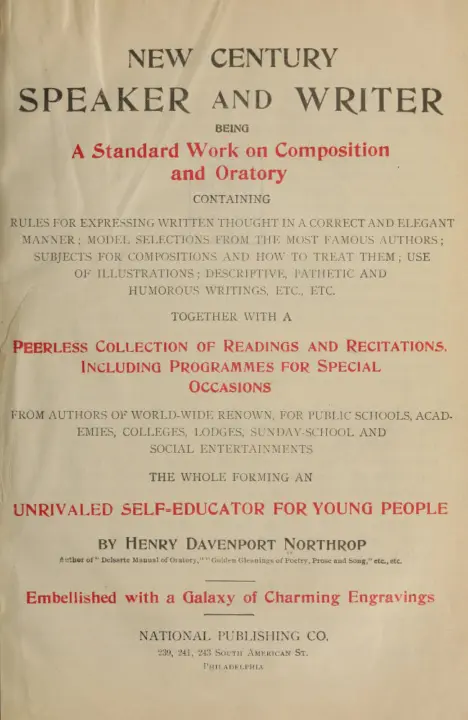
"New Century Speaker and Writer: Being a Standard Work on Composition and Oratory" by Henry Davenport Northrup is an instructional guide focused on the art of writing and public speaking, likely written in the early 20th century. The text serves as a comprehensive resource for young students and aspiring orators, intending to enhance their writing skills while providing a collection of readings and recitations from renowned authors. Central themes include mastering composition, developing an elegant style, and effective techniques for public oratory. The opening of this guide outlines the necessity for clarity and elegance in written communication, emphasizing that expressing thoughts skillfully is an essential skill for students. Northrup discusses the challenges faced by learners, such as the common fear of composition assignments, and offers encouragement by sharing that even great writers faced similar struggles. He introduces practical advice on writing, including selecting suitable subjects, developing a personal style, and the importance of reading widely to improve both language and thought. The aim is to inspire confidence and equip readers with useful tools for enhancing their writing and speaking abilities.
Introduction adapted from the source catalogue; source summaries may be automatically generated.
Free to read · English · 237,347 words · No account needed
MAKE TIME FOR A GOOD BOOK
On by default. Untick to stop anonymous reading totals. Each page counts after 10 seconds in view. How this works.
Anonymous counting is on unless you have switched it off.
Dr. Sir, you are not obliged to me:—put up your money, sir. Do you think I’ll take a fee for telling you what you know as well as myself? Though you’re no physician, sir, you are not altogether a fool. Go home, sir, and reform, or, take my word for it, your life is not worth half a year’s purchase.
Pa. Thank you, doctor, thank you. Good-day, doctor.
(Exit on right, followed by DOCTOR.)
Mr. Cross. Why do you keep me knocking all day at the door?
John. I was at work, sir, in the garden. As soon as I heard your knock, I ran to open the door with such haste that I fell down and hurt myself.
Mr. C. Why didn’t you leave the door open?
John. Why, sir, you scolded me yesterday because I did so. When the door is open, you scold; when it is shut, you scold. I should like to know what to do?
Mr. C. What to do? What to do, did you say?
John. I said it. Shall I leave the door open?
Mr. C. No. I tell you, no!
John. Shall I keep the door shut?
Mr. C. Shall you keep the door shut? No, I say.
John. But, sir, a door must be either open or——
Mr. C. Don’t presume to argue with me, fellow!
John. But doesn’t it hold to reason that a door——
Mr. C. Silence, I say. Hold your tongue!
John. And I say that a door must be either open or shut. Now, how will
you have it?
Mr. C. I have told you a thousand times, you provoking fellow—I have told you that I wished it—— But what do you mean by cross-questioning me, sir? Have you trimmed the grape-vine, as I ordered you?
John. I did that three days ago, sir.
Mr. C. Have you washed the carriage? Eh?
John. I washed it before breakfast, sir, as usual.
Mr. C. You haven’t watered the horses to-day!
John. Go and see, sir, if you can make them drink any more. They have
had their fill.
Mr. C. Have you given them their oats?
John. Ask William; he saw me do it.
Mr. C. But you have forgotten to take the mare to be shod. Ah! I have
you now!
John. I have the blacksmith’s bill here.
Mr. C. My letters!—Did you take them to the post-office? Ha! You
forgot, did you?
John. I forgot nothing, sir. The letters were in the mail ten minutes after you handed them to me.
Your reading position is saved on this browser. Take it to another device with a library code. Reading pages adapt to text, rather than matching a printed edition.
BEHIND THE BOOK
This eBook is for the use of anyone anywhere in the United States and most other parts of the world at no cost and with almost no restrictions whatsoever. You may copy it, give it away or re-use it under the terms of the Project Gutenberg License included with this eBook or online at www.gutenberg.org. If you are not located in the United States, you will have to check the laws of the country where you are located before using this eBook. Read the source licence.
The original source file, including credits and licence, is retained by this library. Request an original-format copy at no charge. Please include the book title and Project Gutenberg identifier #66982.
KEEP YOUR CURIOSITY GOING
Charles G. (Charles Griffith) Ross
Hannah Webster Foster

Emily Lawless
Edwin Hamlin Carr

Charles De Lano Hine
Andrew Ure