
The Writing of News A Handbook with Chapters on Newspaper Correspondence and Copy Reading
Charles G. (Charles Griffith) Ross
THE CLASSIC COLLECTION · 1901
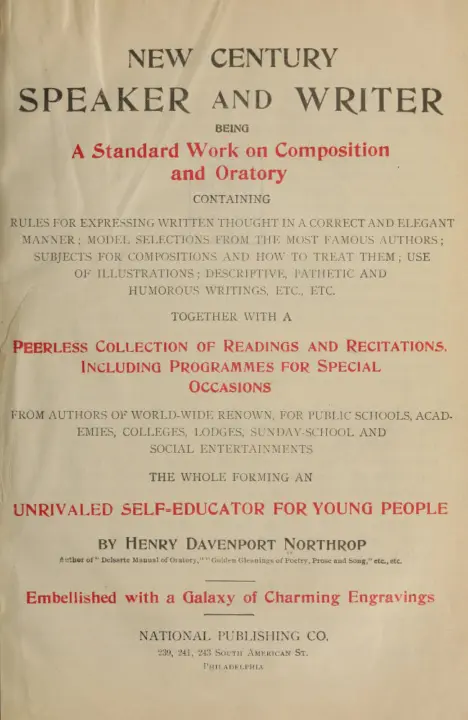
"New Century Speaker and Writer: Being a Standard Work on Composition and Oratory" by Henry Davenport Northrup is an instructional guide focused on the art of writing and public speaking, likely written in the early 20th century. The text serves as a comprehensive resource for young students and aspiring orators, intending to enhance their writing skills while providing a collection of readings and recitations from renowned authors. Central themes include mastering composition, developing an elegant style, and effective techniques for public oratory. The opening of this guide outlines the necessity for clarity and elegance in written communication, emphasizing that expressing thoughts skillfully is an essential skill for students. Northrup discusses the challenges faced by learners, such as the common fear of composition assignments, and offers encouragement by sharing that even great writers faced similar struggles. He introduces practical advice on writing, including selecting suitable subjects, developing a personal style, and the importance of reading widely to improve both language and thought. The aim is to inspire confidence and equip readers with useful tools for enhancing their writing and speaking abilities.
Introduction adapted from the source catalogue; source summaries may be automatically generated.
Free to read · English · 237,347 words · No account needed
MAKE TIME FOR A GOOD BOOK
On by default. Untick to stop anonymous reading totals. Each page counts after 10 seconds in view. How this works.
Anonymous counting is on unless you have switched it off.
Pyg. (aside). I doubt it much.
Gal. Is she within?
Pyg. No, she is not within.
Gal. But she’ll come back?
Pyg. Oh! yes, she will come back.
Gal. How pleased she’ll be to know when she returns, That there was someone here to fill her place.
Pyg. (dryly). Yes, I should say she’d be extremely pleased.
(Rises.)
Gal. Why, there is something in thy voice which says
That thou art jesting. Is it possible
To say one thing and mean another?
Pyg. Yes,
It’s sometimes done.
Gal. How very wonderful!
So clever!
Pyg. And so very useful.
Gal. Yes.
Teach me the art.
Pyg. The art will come in time. My wife will not be pleased; there—that’s the truth.
Gal., I do not think that I shall like thy wife.
Tell me more of her.
Pyg. Well—
Gal. What did she say
When she last left thee?
Pyg. Humph! Well, let me see:
Oh! true, she gave thee to me as my wife—
Her solitary representative;
(Tenderly) She feared I should be lonely till she came,
And counselled me, if thoughts of love should come,
To speak those thoughts to thee, as I am wont
To speak to her.
Gal. That’s right.
Pyg. (releasing her). But when she spoke
Thou wast a stone, now thou art flesh and blood,
Which makes a difference.
Gal. It’s a strange world;
A woman loves her husband very much,
And cannot brook that I should love him too;
She fears he will be lonely till she comes,
And will not let me cheer his loneliness:
She bids him breathe his love to senseless stone,
And when that stone is brought to life—be dumb!
It’s a strange world, I cannot fathom it.
(Crosses, R.)
Pyg. (aside). Let me be brave, and put an end to this.
(Aloud.) Come, Galatea—till my wife returns,
My sister shall provide thee with a home;
Her house is close at hand.
Gal. (astonished and alarmed). Send me not hence,
Pygmalion—let me stay.
Pyg. It may not be.
Come, Galatea, we shall meet again.
Gal. (resignedly). Do with me as thou wilt, Pygmalion! But we shall meet again?—and very soon?
Pyg. Yes, very soon.
Gal. And when thy wife returns,
She’ll let me stay with thee?
Pyg. I do not know.
(Aside.) Why should I hide the truth from her?
(Aloud.) Alas!
I may not see thee then.
Gal. Pygmalion,
What fearful words are these?
Pyg. The bitter truth.
I may not love thee; I must send thee hence.
Your reading position is saved on this browser. Take it to another device with a library code. Reading pages adapt to text, rather than matching a printed edition.
BEHIND THE BOOK
This eBook is for the use of anyone anywhere in the United States and most other parts of the world at no cost and with almost no restrictions whatsoever. You may copy it, give it away or re-use it under the terms of the Project Gutenberg License included with this eBook or online at www.gutenberg.org. If you are not located in the United States, you will have to check the laws of the country where you are located before using this eBook. Read the source licence.
The original source file, including credits and licence, is retained by this library. Request an original-format copy at no charge. Please include the book title and Project Gutenberg identifier #66982.
KEEP YOUR CURIOSITY GOING
Charles G. (Charles Griffith) Ross
Hannah Webster Foster

Emily Lawless
Edwin Hamlin Carr

Charles De Lano Hine
Andrew Ure