
The Writing of News A Handbook with Chapters on Newspaper Correspondence and Copy Reading
Charles G. (Charles Griffith) Ross
THE CLASSIC COLLECTION · 1901
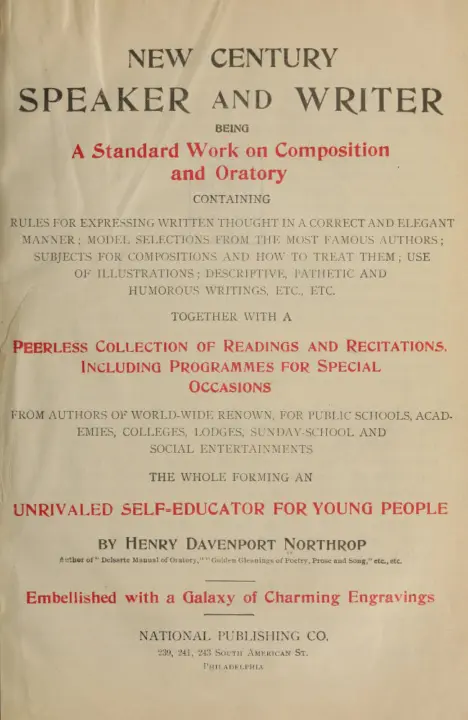
"New Century Speaker and Writer: Being a Standard Work on Composition and Oratory" by Henry Davenport Northrup is an instructional guide focused on the art of writing and public speaking, likely written in the early 20th century. The text serves as a comprehensive resource for young students and aspiring orators, intending to enhance their writing skills while providing a collection of readings and recitations from renowned authors. Central themes include mastering composition, developing an elegant style, and effective techniques for public oratory. The opening of this guide outlines the necessity for clarity and elegance in written communication, emphasizing that expressing thoughts skillfully is an essential skill for students. Northrup discusses the challenges faced by learners, such as the common fear of composition assignments, and offers encouragement by sharing that even great writers faced similar struggles. He introduces practical advice on writing, including selecting suitable subjects, developing a personal style, and the importance of reading widely to improve both language and thought. The aim is to inspire confidence and equip readers with useful tools for enhancing their writing and speaking abilities.
Introduction adapted from the source catalogue; source summaries may be automatically generated.
Free to read · English · 237,347 words · No account needed
MAKE TIME FOR A GOOD BOOK
On by default. Untick to stop anonymous reading totals. Each page counts after 10 seconds in view. How this works.
Anonymous counting is on unless you have switched it off.
Jov. Brave General,—for, though a rogue and bondman, As you have said, I’ll still allow you General, As he that beats a consul surely is.
Spart. Say two—two consuls; and to that e’en add A proconsul, three prætors, and some generals.
Jov. Why, this is no more than true. Are you a Thracian?
Spart. Ay.
Jov. There is something in the air of Thrace
Breeds valor up as rank as grass. ’Tis pity.
You are a barbarian.
Spart. Wherefore?
Jov. Had you been born
A Roman, you had won by this a triumph.
Spart. I thank the gods I am barbarian;
For I can better teach the grace-begot
And heaven-supported masters of the earth
How a mere dweller of a desert rock
Can bow their crowned heads to his chariot-wheels,
Their regal necks to be his stepping-blocks.
But come, what is thy message?
Jov. Julia, niece
Of the prætor, is thy captive.
Spart. Ay.
Jov. For whom
Is offered in exchange thy wife, Senona,
And thy young boy.
Spart. Tell thou the prætor, Roman,
The Thracian’s wife is ransomed.
Jov. How is that?
Spart. Ransomed, and by the steel, from out the camp Of slaughtered Gellius! (Pointing off.) Behold them, Roman!
Jov. (Looking as SPART. points.) This is sorcery! But name a ransom for the general’s niece.
Spart. Have I not now the prætor on the hip?
He would, in his extremity, have made
My wife his buckler of defence; perhaps
Have doomed her to the scourge! But this is Roman.
Now the barbarian is instructed. Look!
I hold the prætor by the heart; and he
Shall feel how tightly grip barbarian fingers.
Jov. Men do not war on women. Name her ransom.
Spart. Men do not war on women! Look you:
One day I climbed up to the ridgy top
Of the cloud-piercing Hæmus, where, among
The eagles and the thunders, from that height,
I looked upon the world, as far as where,
Wrestling with storms, the gloomy Euxine chafed
On his recoiling shores; and where dim Adria
In her blue bosom quenched the fiery sphere.
Between those surges lay a land, might once
Have matched Elysium; but Rome had made it
A Tartarus. In my green youth I looked
From the same frosty peak where now I stood,
And then beheld the glory of those lands,
Where Peace was tinkling on the shepherd’s bell
And singing with the reapers.
Since that glad day, Rome’s conquerors had passed
With withering armies there, and all was changed.
Peace had departed; howling War was there,
Cheered on by Roman hunters. Then, methought
E’en as I looked upon the altered scene,
Groans echoed through the valleys, through which ran
Rivers of blood, like smoking Phlegethons;
Fires flashed from burning villages, and Famine
Shrieked in the empty cornfields! Women and children,
Robbed of their sires and husbands, left to starve—
These were the dwellers of the land! Say’st thou
Rome wars not, then, on women?
Your reading position is saved on this browser. Take it to another device with a library code. Reading pages adapt to text, rather than matching a printed edition.
BEHIND THE BOOK
This eBook is for the use of anyone anywhere in the United States and most other parts of the world at no cost and with almost no restrictions whatsoever. You may copy it, give it away or re-use it under the terms of the Project Gutenberg License included with this eBook or online at www.gutenberg.org. If you are not located in the United States, you will have to check the laws of the country where you are located before using this eBook. Read the source licence.
The original source file, including credits and licence, is retained by this library. Request an original-format copy at no charge. Please include the book title and Project Gutenberg identifier #66982.
KEEP YOUR CURIOSITY GOING
Charles G. (Charles Griffith) Ross
Hannah Webster Foster

Emily Lawless
Edwin Hamlin Carr

Charles De Lano Hine
Andrew Ure