
The Writing of News A Handbook with Chapters on Newspaper Correspondence and Copy Reading
Charles G. (Charles Griffith) Ross
THE CLASSIC COLLECTION · 1901
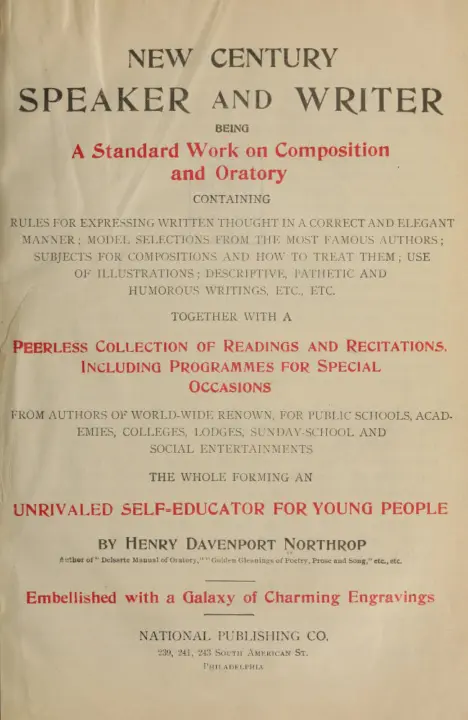
"New Century Speaker and Writer: Being a Standard Work on Composition and Oratory" by Henry Davenport Northrup is an instructional guide focused on the art of writing and public speaking, likely written in the early 20th century. The text serves as a comprehensive resource for young students and aspiring orators, intending to enhance their writing skills while providing a collection of readings and recitations from renowned authors. Central themes include mastering composition, developing an elegant style, and effective techniques for public oratory. The opening of this guide outlines the necessity for clarity and elegance in written communication, emphasizing that expressing thoughts skillfully is an essential skill for students. Northrup discusses the challenges faced by learners, such as the common fear of composition assignments, and offers encouragement by sharing that even great writers faced similar struggles. He introduces practical advice on writing, including selecting suitable subjects, developing a personal style, and the importance of reading widely to improve both language and thought. The aim is to inspire confidence and equip readers with useful tools for enhancing their writing and speaking abilities.
Introduction adapted from the source catalogue; source summaries may be automatically generated.
Free to read · English · 237,347 words · No account needed
MAKE TIME FOR A GOOD BOOK
On by default. Untick to stop anonymous reading totals. Each page counts after 10 seconds in view. How this works.
Anonymous counting is on unless you have switched it off.
N. Well, dat’s ze same man. Our Jacob he ain’t dot no ozzer name, either: des Jacob, old Jacob.
A. This good old man had twelve sons.
N. Any little girls?
A. Only one.
N. Huh! I dess she was mighty sorry wiz such a houseful of boys an’ no
little sister.
A. Well, Jacob loved this son very much—
N. How much?
A. Oh, ever so much; more than he could tell.
N. Ten hundred thousand bushels?
A. Yes, and more than that. He bought him a new coat—
N. May Crawford’s dot a new dress, dray and blue, an’ pearl buttons on it, an’ a new parasol, and I’m doing to have some new button shoes as twick as I can kick zese ones out.
A. His father bought him a new coat, a beautiful coat of many colors—
N. Oh, ho! des like a bed quilt.
A. And Joseph was very proud of this pretty coat—
N. Huh! I bet you ze boys frowed stones an’ hollered at him if he wored
it to school!
A. But his brothers, all of his older brothers, who—
N. Did he wear it to school, Aunt Dora?
A. No, I don’t think he did.
N. I dess he was afraid, and kept it for a Sunday coat. Did he wear it
to Sunday school?
A. He didn’t go to one.
N. Den he was a heathen.
A. No, Joseph wasn’t a heathen.
N. Den he was a bad boy.
A. No, indeed; Joseph was a good boy—
N. Den why didn’t he go to Sunday-school?
A. No matter. But all his brothers hated him because his father loved
him the best and—
N. I spect he always dot the biggest piece of pie.
A. And so they wanted to get rid of him, because—
N. Den why didn’t zey send him out in the kitchen to talk with Jenny? Dat’s what my ma’am does.
A. And they hated him all the more because one night, Joseph had a
dream—
N. Oo-oo! I dreamed dot ze big Bible on ze parlor had five long legs and a mouf full of sharp teeth, an’ it climbed onto my bed and drowled at me ’cause I bit ze wax apple an’ tied gran’pa’s wig onto Carlo’s head last Sunday! Oh, I was so scared an’ I hollered an’ ma’am said she dessed I had ze nightmare.
A. Well, one day Joseph’s father sent him away to see how his brothers
were getting along—
N. Why didn’t he write ’em a letter?
Your reading position is saved on this browser. Take it to another device with a library code. Reading pages adapt to text, rather than matching a printed edition.
BEHIND THE BOOK
This eBook is for the use of anyone anywhere in the United States and most other parts of the world at no cost and with almost no restrictions whatsoever. You may copy it, give it away or re-use it under the terms of the Project Gutenberg License included with this eBook or online at www.gutenberg.org. If you are not located in the United States, you will have to check the laws of the country where you are located before using this eBook. Read the source licence.
The original source file, including credits and licence, is retained by this library. Request an original-format copy at no charge. Please include the book title and Project Gutenberg identifier #66982.
KEEP YOUR CURIOSITY GOING
Charles G. (Charles Griffith) Ross
Hannah Webster Foster

Emily Lawless
Edwin Hamlin Carr

Charles De Lano Hine
Andrew Ure