
The Writing of News A Handbook with Chapters on Newspaper Correspondence and Copy Reading
Charles G. (Charles Griffith) Ross
THE CLASSIC COLLECTION · 1901
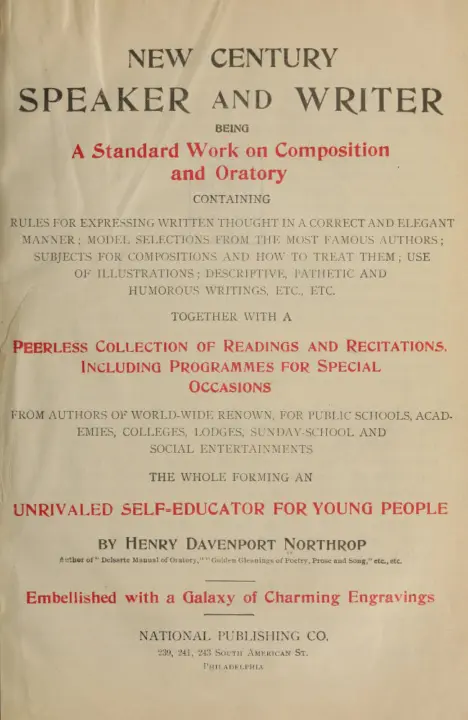
"New Century Speaker and Writer: Being a Standard Work on Composition and Oratory" by Henry Davenport Northrup is an instructional guide focused on the art of writing and public speaking, likely written in the early 20th century. The text serves as a comprehensive resource for young students and aspiring orators, intending to enhance their writing skills while providing a collection of readings and recitations from renowned authors. Central themes include mastering composition, developing an elegant style, and effective techniques for public oratory. The opening of this guide outlines the necessity for clarity and elegance in written communication, emphasizing that expressing thoughts skillfully is an essential skill for students. Northrup discusses the challenges faced by learners, such as the common fear of composition assignments, and offers encouragement by sharing that even great writers faced similar struggles. He introduces practical advice on writing, including selecting suitable subjects, developing a personal style, and the importance of reading widely to improve both language and thought. The aim is to inspire confidence and equip readers with useful tools for enhancing their writing and speaking abilities.
Introduction adapted from the source catalogue; source summaries may be automatically generated.
Free to read · English · 237,347 words · No account needed
MAKE TIME FOR A GOOD BOOK
On by default. Untick to stop anonymous reading totals. Each page counts after 10 seconds in view. How this works.
Anonymous counting is on unless you have switched it off.
The harebell shivered, and cried, “Oh! oh!
I am faint, so faint! Come, dear wind, blow.”
The wind blew softly, and did not speak.
She thanked him kindly, but grew more weak.
“Sun, dear sun, I am cold,” she said.
He rose; but lower she drooped her head.
“O rain! I am withering; all the blue
Is fading out of me;—come, please do.”
The rain came down as fast as it could,
But for all its will it did her no good.
She shuddered and shriveled, and moaning said; “Thank you all kindly;” and then she was dead.
Let us hope, let us hope, when she comes next year, She’ll be simple and sweet. But I fear, I fear.
(To be answered by a class or the whole school.)
What is the favorite flower of the poets?
Ans. The daisy.
What English poet so loved the daisy that he lay all one day in the field to see it open in the morning and close at night?
Ans. Chaucer.
What violet, so called, really belongs to the lily family?
Ans. The dog-tooth violet.
What flower was named by the Greeks after one of their gods?
Ans. The pansy, after Pan.
About what flower was Emerson’s finest poem written?
Ans. The rhodora.
Which of the buttercups are foreigners?
Ans. The tall buttercup and the common buttercup with bulbous base.
Name some other imported flowers.
Ans. Dandelion and ox-eyed daisy.
Name two distinctly American blossoms.
Ans. Indian pipe and blood-root.
What queen adopted the daisy as her flower?
Ans. Queen Margherita of Italy.
Name one of the most brilliant of August flowers.
Ans. The cardinal flower.
What is one of the most difficult wild flowers to cultivate?
Ans. Trailing arbutus, which grows all over the United States.
What floral poem of Wordsworth’s is famous?
Ans. Daffodils.
What is the most beautiful plant of Autumn?
Ans. The golden rod.
RECITATION—Pansies.
We had climbed to the top of the old Gray Peak,
And viewed the valley o’er;
And we started off on our homeward tramp,
A good three miles or more.
The road lay curved like a ribbon of gold,
Around the base of the hill,
And the brook gleamed out with a silver sheen,
From thickets near the mill.
But the sun shone warm on the dusty road,
Until by heat oppressed,
We wearily stopped at a cottage gate;
The matron bade us rest.
How cool was the shade of the trumpet-vine,
A spring ran fresh and clear?
The flash and whirr of a jeweled thing,
A humming-bird was near.
Your reading position is saved on this browser. Take it to another device with a library code. Reading pages adapt to text, rather than matching a printed edition.
BEHIND THE BOOK
This eBook is for the use of anyone anywhere in the United States and most other parts of the world at no cost and with almost no restrictions whatsoever. You may copy it, give it away or re-use it under the terms of the Project Gutenberg License included with this eBook or online at www.gutenberg.org. If you are not located in the United States, you will have to check the laws of the country where you are located before using this eBook. Read the source licence.
The original source file, including credits and licence, is retained by this library. Request an original-format copy at no charge. Please include the book title and Project Gutenberg identifier #66982.
KEEP YOUR CURIOSITY GOING
Charles G. (Charles Griffith) Ross
Hannah Webster Foster

Emily Lawless
Edwin Hamlin Carr

Charles De Lano Hine
Andrew Ure