
The Writing of News A Handbook with Chapters on Newspaper Correspondence and Copy Reading
Charles G. (Charles Griffith) Ross
THE CLASSIC COLLECTION · 1901
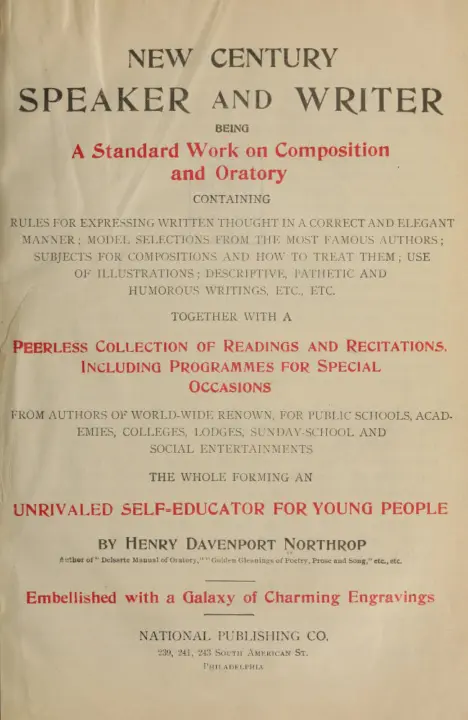
"New Century Speaker and Writer: Being a Standard Work on Composition and Oratory" by Henry Davenport Northrup is an instructional guide focused on the art of writing and public speaking, likely written in the early 20th century. The text serves as a comprehensive resource for young students and aspiring orators, intending to enhance their writing skills while providing a collection of readings and recitations from renowned authors. Central themes include mastering composition, developing an elegant style, and effective techniques for public oratory. The opening of this guide outlines the necessity for clarity and elegance in written communication, emphasizing that expressing thoughts skillfully is an essential skill for students. Northrup discusses the challenges faced by learners, such as the common fear of composition assignments, and offers encouragement by sharing that even great writers faced similar struggles. He introduces practical advice on writing, including selecting suitable subjects, developing a personal style, and the importance of reading widely to improve both language and thought. The aim is to inspire confidence and equip readers with useful tools for enhancing their writing and speaking abilities.
Introduction adapted from the source catalogue; source summaries may be automatically generated.
Free to read · English · 237,347 words · No account needed
MAKE TIME FOR A GOOD BOOK
On by default. Untick to stop anonymous reading totals. Each page counts after 10 seconds in view. How this works.
Anonymous counting is on unless you have switched it off.
The days of the week once talking together
About their housekeeping, their friends and the weather,
Agreed in their talk it would be a nice thing
For all to march, and dance, and sing;
So they all stood up in a very straight row,
And this is the way they decided to go:
(Let seven children stand up, and as day of week is called, take places, each one equipped with the things the speaker mentions.)
First came little Sunday, so sweet and good,
With a book in her hand, at the head she stood.
Monday skipped in with soap and a tub,
Scrubbing away with a rub-a-dub-dub;
With board and iron comes Tuesday bright,
Talking to Monday in great delight.
Then Wednesday—the dear little cook—came in,
Riding cock horse on his rolling-pin.
Thursday followed, with broom and brush,
Her hair in a towel, and she in a rush.
Friday appeared, gayly tripping along;
He scoured the knives and then he was gone.
Saturday last, with a great big tub,
Into which we all jump for a very good rub.
(The children march and sing to the tune of “Good Morning,
Merry Sunshine.”)
Children of the week are we,
Happy, busy, full of glee.
Often do we come this way,
And you meet us every day.
Hand in hand we trip along,
Singing, as we go, a song.
Each one may a duty bring,
Though it be a little thing.
(All bow, and, taking up the articles, retire from the stage
in order, Sunday, Monday etc.)
And there they sat, a popping corn,
John Styles and Susan Cutter—
John Styles as fat as any ox
And Susan fat as butter.
And there they sat and shelled the corn,
And raked and stirred the fire,
And talked of different kinds of care
And hitched their chairs up nigher.
Then Susan she the popper shook,
Then John he shook the popper,
Till both their faces grew as red
As saucepans made of copper.
And then they shelled, and popped and ate,
All kinds of fun a-poking,
While he haw-hawed at her remarks,
And she laughed at his joking.
And still they popped, and still they ate—
John’s mouth was like a hopper—
And stirred the fire and sprinkled salt,
And shook and shook the popper.
The clock struck nine—the clock struck ten,
And still the corn kept popping;
It struck eleven, and then struck twelve,
And still no signs of stopping.
And John he ate, and Sue she thought—
The corn did pop and patter—
Till John cried out, “The corn’s afire!
Why, Susan, what’s the matter?”
Your reading position is saved on this browser. Take it to another device with a library code. Reading pages adapt to text, rather than matching a printed edition.
BEHIND THE BOOK
This eBook is for the use of anyone anywhere in the United States and most other parts of the world at no cost and with almost no restrictions whatsoever. You may copy it, give it away or re-use it under the terms of the Project Gutenberg License included with this eBook or online at www.gutenberg.org. If you are not located in the United States, you will have to check the laws of the country where you are located before using this eBook. Read the source licence.
The original source file, including credits and licence, is retained by this library. Request an original-format copy at no charge. Please include the book title and Project Gutenberg identifier #66982.
KEEP YOUR CURIOSITY GOING
Charles G. (Charles Griffith) Ross
Hannah Webster Foster

Emily Lawless
Edwin Hamlin Carr

Charles De Lano Hine
Andrew Ure