
The Writing of News A Handbook with Chapters on Newspaper Correspondence and Copy Reading
Charles G. (Charles Griffith) Ross
THE CLASSIC COLLECTION · 1901
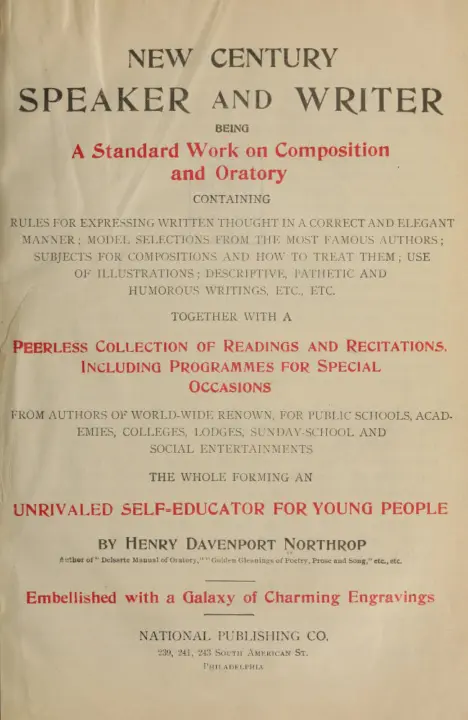
"New Century Speaker and Writer: Being a Standard Work on Composition and Oratory" by Henry Davenport Northrup is an instructional guide focused on the art of writing and public speaking, likely written in the early 20th century. The text serves as a comprehensive resource for young students and aspiring orators, intending to enhance their writing skills while providing a collection of readings and recitations from renowned authors. Central themes include mastering composition, developing an elegant style, and effective techniques for public oratory. The opening of this guide outlines the necessity for clarity and elegance in written communication, emphasizing that expressing thoughts skillfully is an essential skill for students. Northrup discusses the challenges faced by learners, such as the common fear of composition assignments, and offers encouragement by sharing that even great writers faced similar struggles. He introduces practical advice on writing, including selecting suitable subjects, developing a personal style, and the importance of reading widely to improve both language and thought. The aim is to inspire confidence and equip readers with useful tools for enhancing their writing and speaking abilities.
Introduction adapted from the source catalogue; source summaries may be automatically generated.
Free to read · English · 237,347 words · No account needed
MAKE TIME FOR A GOOD BOOK
On by default. Untick to stop anonymous reading totals. Each page counts after 10 seconds in view. How this works.
Anonymous counting is on unless you have switched it off.
Only a bird! and the tiny throat
With quaver and trill and whistle of flute,
Bruised and bleeding and silent lies
There at his feet. Its chords are mute.
And the boy, with a loud and boisterous laugh,
Proud of his prowess and brutal skill,
Throws it aside with a careless toss—
“Only a bird! it was made to kill.”
Only a bird! yet far away
Little ones clamor and cry for food—
Clamor and cry, and the chill of night
Settles over the orphan brood.
Weaker and fainter the moaning call
For a brooding breast that shall never come.
Morning breaks o’er a lonely nest,
Songless and lifeless; mute and dumb.
Teach the child to make all the gestures and facial expressions. This is a captivating recital for any “little tot” who can do it well, and this will require patient practice.
I’ll tell you how I speak a piece:
First, I make my bow;
Then I bring my words out clear
And plain as I know how.
Next, I throw my hands up—so!
Then I lift my eyes:
That’s to let my hearers know
Something doth surprise.
Next, I grin and show my teeth,
Nearly every one,
Shake my shoulders, hold my sides:
That’s the sign of fun.
Next, I start, and knit my brows,
Hold my head erect:
Something’s wrong, you see, and I
Decidedly object.
Then I wabble at my knees,
Clutch at shadows near,
Tremble well from top to toe:
That’s the sign of fear.
Now I start, and with a leap,
Seize an airy dagger.
“Wretch!” I cry: that’s tragedy
Every soul to stagger.
Then I let my voice grow faint,
Gasp, and hold my breath,
Tumble down and plunge about:
That’s a villain’s death.
Quickly then I come to life,
Perfectly restored;
With a bow my speech is done.
Now you’ll please applaud.
For five little children and one older, a girl, who takes the part of the mother. They stand in a row and each steps forward and recites the verse.
Said the first little chicken,
With a queer little squirm,
“I wish I could find
A fat little worm.”
Said the next little chicken,
With an odd little shrug,
“I wish I could find
A fat little bug,”
Said the third little chicken,
With a sharp little squeal,
“I wish I could find
Some nice yellow meal.”
Said the fourth little chicken,
With a small sigh of grief,
“I wish I could find
A green little leaf.”
Your reading position is saved on this browser. Take it to another device with a library code. Reading pages adapt to text, rather than matching a printed edition.
BEHIND THE BOOK
This eBook is for the use of anyone anywhere in the United States and most other parts of the world at no cost and with almost no restrictions whatsoever. You may copy it, give it away or re-use it under the terms of the Project Gutenberg License included with this eBook or online at www.gutenberg.org. If you are not located in the United States, you will have to check the laws of the country where you are located before using this eBook. Read the source licence.
The original source file, including credits and licence, is retained by this library. Request an original-format copy at no charge. Please include the book title and Project Gutenberg identifier #66982.
KEEP YOUR CURIOSITY GOING
Charles G. (Charles Griffith) Ross
Hannah Webster Foster

Emily Lawless
Edwin Hamlin Carr

Charles De Lano Hine
Andrew Ure