
The Writing of News A Handbook with Chapters on Newspaper Correspondence and Copy Reading
Charles G. (Charles Griffith) Ross
THE CLASSIC COLLECTION · 1901
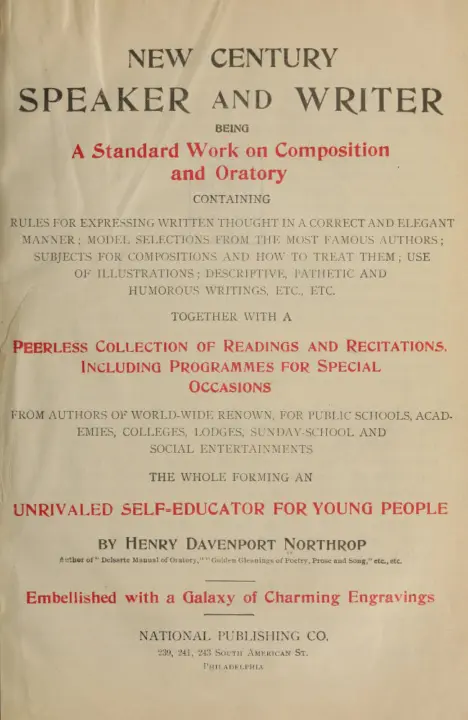
"New Century Speaker and Writer: Being a Standard Work on Composition and Oratory" by Henry Davenport Northrup is an instructional guide focused on the art of writing and public speaking, likely written in the early 20th century. The text serves as a comprehensive resource for young students and aspiring orators, intending to enhance their writing skills while providing a collection of readings and recitations from renowned authors. Central themes include mastering composition, developing an elegant style, and effective techniques for public oratory. The opening of this guide outlines the necessity for clarity and elegance in written communication, emphasizing that expressing thoughts skillfully is an essential skill for students. Northrup discusses the challenges faced by learners, such as the common fear of composition assignments, and offers encouragement by sharing that even great writers faced similar struggles. He introduces practical advice on writing, including selecting suitable subjects, developing a personal style, and the importance of reading widely to improve both language and thought. The aim is to inspire confidence and equip readers with useful tools for enhancing their writing and speaking abilities.
Introduction adapted from the source catalogue; source summaries may be automatically generated.
Free to read · English · 237,347 words · No account needed
MAKE TIME FOR A GOOD BOOK
On by default. Untick to stop anonymous reading totals. Each page counts after 10 seconds in view. How this works.
Anonymous counting is on unless you have switched it off.
’Twas a stylish congregation, that of Theophrastus Brown, And its organ was the finest and the biggest in the town, And the chorus, all the papers favorably commented on it, For ’twas said each female member had a forty—dollar bonnet.
Now in the “amen corner” of the church sat Brother Eyer, Who persisted every Sabbath-day in singing with the choir; He was poor, but genteel-looking, and his heart as snow was white, And his old face beamed with sweetness when he sang with all his might.
His voice was cracked and broken, age had touched his vocal chords, And nearly every Sunday he would mispronounce the words Of the hymns, and ’twas no wonder, he was old and nearly blind, And the choir rattling onward always left him far behind.
Then the pastor called together in the lecture-room one day Seven influential members who subscribe more than they pay, And having asked God’s guidance in a printed prayer or two, They put their heads together to determine what to do.
They debated, thought, suggested, till at last “dear Brother York,” Who last winter made a million on a sudden rise in pork, Rose and moved that a committee wait at once on Brother Eyer, And proceed to rake him lively for “disturbin’ of the choir.”
Of course the motion carried, and one day a coach and four, With the latest style of driver, rattled up to Eyer’s door; And the sleek, well-dressed committee, Brothers Sharkey, York, and Lamb, As they crossed the humble portal took good care to miss the jam.
They found the choir’s great trouble sitting in his old arm-chair, And the summer’s golden sunbeams lay upon his thin white hair; He was singing “Rock of Ages” in a voice both cracked and low, But the angels understood him, ’twas all he cared to know.
Said York: “We’re here, dear brother, with the vestry’s approbation, To discuss a little matter that affects the congregation;” “And the choir, too,” said Sharkey, giving Brother York a nudge, “And the choir, too!” he echoed with the graveness of a judge.
“It was the understanding when we bargained for the chorus That it was to relieve us, that is, do the singing for us; If we rupture the agreement, it is very plain, dear brother, It will leave our congregation and be gobbled by another.
“We don’t want any singing except that what we’ve bought! The latest tunes are all the rage; the old ones stand for naught; And so we have decided—are you listening, Brother Eyer?— That you’ll have to stop your singin’, for it flurrytates the choir.”
Your reading position is saved on this browser. Take it to another device with a library code. Reading pages adapt to text, rather than matching a printed edition.
BEHIND THE BOOK
This eBook is for the use of anyone anywhere in the United States and most other parts of the world at no cost and with almost no restrictions whatsoever. You may copy it, give it away or re-use it under the terms of the Project Gutenberg License included with this eBook or online at www.gutenberg.org. If you are not located in the United States, you will have to check the laws of the country where you are located before using this eBook. Read the source licence.
The original source file, including credits and licence, is retained by this library. Request an original-format copy at no charge. Please include the book title and Project Gutenberg identifier #66982.
KEEP YOUR CURIOSITY GOING
Charles G. (Charles Griffith) Ross
Hannah Webster Foster

Emily Lawless
Edwin Hamlin Carr

Charles De Lano Hine
Andrew Ure