
The Writing of News A Handbook with Chapters on Newspaper Correspondence and Copy Reading
Charles G. (Charles Griffith) Ross
THE CLASSIC COLLECTION · 1901
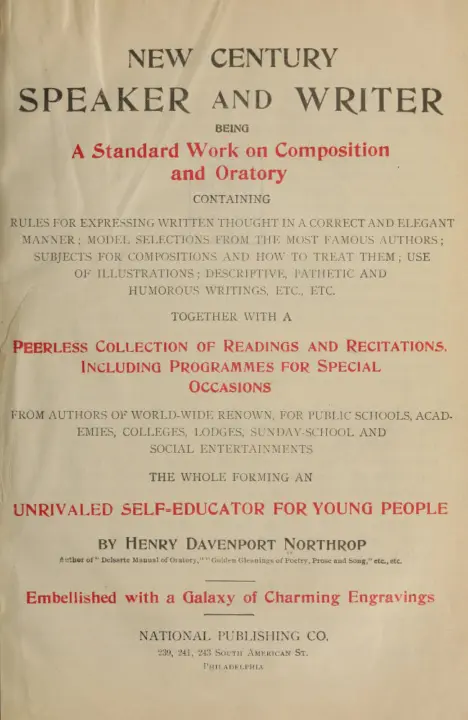
"New Century Speaker and Writer: Being a Standard Work on Composition and Oratory" by Henry Davenport Northrup is an instructional guide focused on the art of writing and public speaking, likely written in the early 20th century. The text serves as a comprehensive resource for young students and aspiring orators, intending to enhance their writing skills while providing a collection of readings and recitations from renowned authors. Central themes include mastering composition, developing an elegant style, and effective techniques for public oratory. The opening of this guide outlines the necessity for clarity and elegance in written communication, emphasizing that expressing thoughts skillfully is an essential skill for students. Northrup discusses the challenges faced by learners, such as the common fear of composition assignments, and offers encouragement by sharing that even great writers faced similar struggles. He introduces practical advice on writing, including selecting suitable subjects, developing a personal style, and the importance of reading widely to improve both language and thought. The aim is to inspire confidence and equip readers with useful tools for enhancing their writing and speaking abilities.
Introduction adapted from the source catalogue; source summaries may be automatically generated.
Free to read · English · 237,347 words · No account needed
MAKE TIME FOR A GOOD BOOK
On by default. Untick to stop anonymous reading totals. Each page counts after 10 seconds in view. How this works.
Anonymous counting is on unless you have switched it off.
And as beside the fire he sat and piped his meerschaum well, We asked, to pass the time away, that he a tale should tell. He paused a moment, then he laid his good old pipe aside, And said, “I’ll tell you boys, to-night, how Stonewall Jackson died.
“We were retreating from the foe, for Fredericksburg was lost, And on our flank, still threatening, appeared the Union host; Down by the Rappahannock, in our dismal tents we lay, And the lightest heart was heavy with our grave defeat that day.
“For ’tis better for a soldier like Montgomery to die, Than live to see his comrades from a hated foeman fly; But reverses often come upon defenders of the right, And justice seldom conquers, boys, when nations go to fight.
“With heavy hearts we laid us down, but, mind you, not to sleep, Nor did we turn aside to sing, or turn aside to weep, But as we pondered o’er our griefs, a sudden moan was heard, Far louder than the willow’s moan, when by the wind ’tis stirred.
“It woke the camp from reverie, it woke the camp to fear; And louder, louder grew the wail, most dreadful then to hear. And nearer came the weeping crowd, and something stiff and still Was borne, we knew not what it was, but followed with a will.
“At last within our Gen’ral’s tent the precious load was laid, And then a pallid soldier turned unto us all, and said: ‘We thought it hard, my comrades brave, to lose the field to-day; But harder will our struggle be, to labor in the fray; For he is gone, our gallant chief, who could our hopes restore, And rout and ruin is our fate, since Stonewall is no more.’
“I cannot tell you how we felt, or how we acted then, For words are weak to tell a tale when grief has mastered men; But this I know, I pulled the cloth from off brave Jackson’s face, And almost jumped with joy to see him gaze around the place.
“But, boys, it was a fleeting dream, a vacant stare he cast; He did not see the canvas shaken by the sudden blast; He did not see us weeping as we staunched the flowing blood, But again in battle fighting, he was where the foemen stood.
“‘Order Gen’ral Hill to action!’ loud he cried, as he was wont; And then he quickly added: ‘Bring the infantry to front!’ As he saw the corps pass by him—as it were—in duty’s call, Suddenly he shouted: ‘Drive them! charge upon them, one and all!’
Your reading position is saved on this browser. Take it to another device with a library code. Reading pages adapt to text, rather than matching a printed edition.
BEHIND THE BOOK
This eBook is for the use of anyone anywhere in the United States and most other parts of the world at no cost and with almost no restrictions whatsoever. You may copy it, give it away or re-use it under the terms of the Project Gutenberg License included with this eBook or online at www.gutenberg.org. If you are not located in the United States, you will have to check the laws of the country where you are located before using this eBook. Read the source licence.
The original source file, including credits and licence, is retained by this library. Request an original-format copy at no charge. Please include the book title and Project Gutenberg identifier #66982.
KEEP YOUR CURIOSITY GOING
Charles G. (Charles Griffith) Ross
Hannah Webster Foster

Emily Lawless
Edwin Hamlin Carr

Charles De Lano Hine
Andrew Ure