
The Writing of News A Handbook with Chapters on Newspaper Correspondence and Copy Reading
Charles G. (Charles Griffith) Ross
THE CLASSIC COLLECTION · 1901
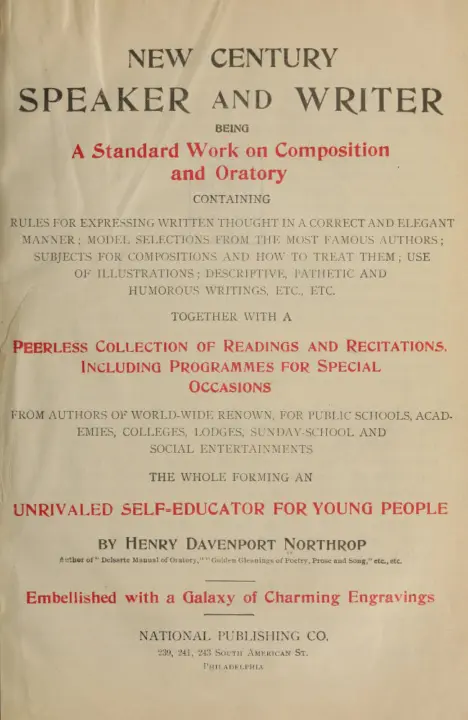
"New Century Speaker and Writer: Being a Standard Work on Composition and Oratory" by Henry Davenport Northrup is an instructional guide focused on the art of writing and public speaking, likely written in the early 20th century. The text serves as a comprehensive resource for young students and aspiring orators, intending to enhance their writing skills while providing a collection of readings and recitations from renowned authors. Central themes include mastering composition, developing an elegant style, and effective techniques for public oratory. The opening of this guide outlines the necessity for clarity and elegance in written communication, emphasizing that expressing thoughts skillfully is an essential skill for students. Northrup discusses the challenges faced by learners, such as the common fear of composition assignments, and offers encouragement by sharing that even great writers faced similar struggles. He introduces practical advice on writing, including selecting suitable subjects, developing a personal style, and the importance of reading widely to improve both language and thought. The aim is to inspire confidence and equip readers with useful tools for enhancing their writing and speaking abilities.
Introduction adapted from the source catalogue; source summaries may be automatically generated.
Free to read · English · 237,347 words · No account needed
MAKE TIME FOR A GOOD BOOK
On by default. Untick to stop anonymous reading totals. Each page counts after 10 seconds in view. How this works.
Anonymous counting is on unless you have switched it off.
“Whoever told you that did not speak the truth,” she haughtily uttered. “James died naturally.”
“Yes,” continued the minister, in a perplexed tone. “He kicked the side of the barn down in his last agonies, didn’t he?”
“No, sir; he did not.”
“Well, I have been misinformed, I suppose. How old was he?”
“Thirty-five.”
“He did not do much active work. Perhaps you are better without him, for you can easily supply his place with a better one.”
“Never! sir, will I find such a good one as he.”
“Oh, yes you will; he had the heaves bad, you know.”
“Nothing of the kind, sir.”
“Why, I recollect I saw him one day, with you on his back, and I distinctly recollect that he had the heaves, and walked as if he had the spring-halt.”
Mrs. H.’s eyes snapped fire, and she stared at the reverend visitor as if she imagined he was crazy.
“He could not have had the spring-halt, for he had a cork-leg,”
she replied.
“A cork-leg—remarkable; but really, didn’t he have a dangerous trick of suddenly stopping and kicking the wagon all to pieces?”
“Never, sir; he was not mad.”
“Probably not. But there were some good points about him.”
“I should think so.”
“The way in which he carried his ears, for example.”
“Nobody ever noticed that particular merit,” said the widow, with much asperity, “he was warm-hearted, generous and frank.”
“Good qualities,” answered the minister. “How long did it take
him to go a mile?”
“About fifteen minutes.”
“Not much of a goer. Wasn’t his hair apt to fly?”
“He didn’t have any hair, he was bald-headed.”
“Quite a curiosity.”
“No, sir; no more of a curiosity than you are.”
The minister shifted uneasily, and got red in the face; but he
returned to the attack.
“Did you use the whip much on him?”
“Never, sir.”
“Went right along without it, eh?”
“Yes.”
“He must have been a good sort of a brute!”
The widow sat down and cried.
“The idea of your coming here and insulting me,” she sobbed. “If my husband had lived you would not have done it. Your remarks in reference to the poor dead man have been a series of insults, and I won’t stand it.”
He colored, and looked dumfounded.
“Ain’t you Mrs. Blinkers?” at last he stammered, “and has not your gray horse just died?”
“No! no!” she cried. “I never owned a horse, but my husband died
a week ago.”
Ten minutes later that minister came out of that house with the reddest face ever seen on mortal man.
Your reading position is saved on this browser. Take it to another device with a library code. Reading pages adapt to text, rather than matching a printed edition.
BEHIND THE BOOK
This eBook is for the use of anyone anywhere in the United States and most other parts of the world at no cost and with almost no restrictions whatsoever. You may copy it, give it away or re-use it under the terms of the Project Gutenberg License included with this eBook or online at www.gutenberg.org. If you are not located in the United States, you will have to check the laws of the country where you are located before using this eBook. Read the source licence.
The original source file, including credits and licence, is retained by this library. Request an original-format copy at no charge. Please include the book title and Project Gutenberg identifier #66982.
KEEP YOUR CURIOSITY GOING
Charles G. (Charles Griffith) Ross
Hannah Webster Foster

Emily Lawless
Edwin Hamlin Carr

Charles De Lano Hine
Andrew Ure