
The Writing of News A Handbook with Chapters on Newspaper Correspondence and Copy Reading
Charles G. (Charles Griffith) Ross
THE CLASSIC COLLECTION · 1901
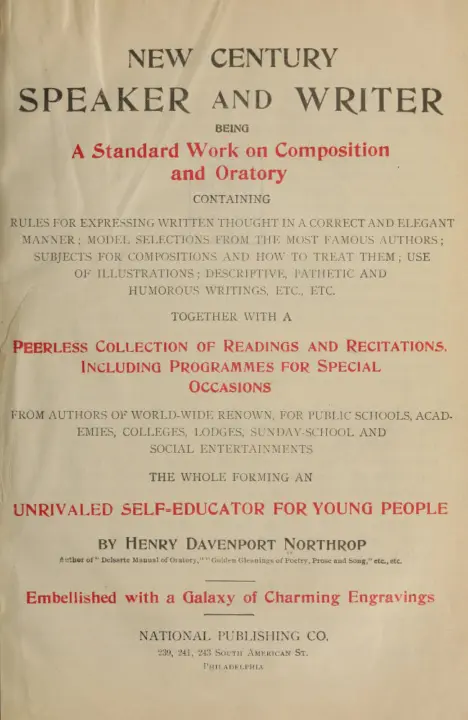
"New Century Speaker and Writer: Being a Standard Work on Composition and Oratory" by Henry Davenport Northrup is an instructional guide focused on the art of writing and public speaking, likely written in the early 20th century. The text serves as a comprehensive resource for young students and aspiring orators, intending to enhance their writing skills while providing a collection of readings and recitations from renowned authors. Central themes include mastering composition, developing an elegant style, and effective techniques for public oratory. The opening of this guide outlines the necessity for clarity and elegance in written communication, emphasizing that expressing thoughts skillfully is an essential skill for students. Northrup discusses the challenges faced by learners, such as the common fear of composition assignments, and offers encouragement by sharing that even great writers faced similar struggles. He introduces practical advice on writing, including selecting suitable subjects, developing a personal style, and the importance of reading widely to improve both language and thought. The aim is to inspire confidence and equip readers with useful tools for enhancing their writing and speaking abilities.
Introduction adapted from the source catalogue; source summaries may be automatically generated.
Free to read · English · 237,347 words · No account needed
MAKE TIME FOR A GOOD BOOK
On by default. Untick to stop anonymous reading totals. Each page counts after 10 seconds in view. How this works.
Anonymous counting is on unless you have switched it off.
More Haste, Less Speed.
Necessity is the Mother of Invention.
What Can’t be Cured must be Endured.
Well Begun is Half Done.
All that Glitters is not Gold.
Evil Communications Corrupt Good Manners.
Honesty is the Best Policy.
A Stitch in Time Saves Nine.
Prevention is Better than Cure.
A Rolling Stone Gathers no Moss.
Make Hay while the Sun Shines.
Birds of a Feather Flock Together.
Knowledge is Power.
Take Care of the Pennies and the Dollars will take Care of Themselves.
A Bird in the Hand is Worth Two in the Bush.
The Longest Way Around is the Shortest Way Home.
The Proof of the Pudding is in the Eating.
If you would Shoot High you must Aim High.
Marry in Haste and Repent at Leisure.
People who Live in Glass Houses should not Throw Stones.
Be Sure you are Right, then Go Ahead.
It is an Ill Wind that Blows Good to no One.
Every Crow Thinks her own Little Crows the Blackest.
You Cannot Make a Silk Purse out of a Sow’s Ear.
The Least Said, the Soonest Mended.
Speech is Silver, Silence is Golden.
Manners Make the Man.
Benefits of Industry.
Evils of Idleness.
Summer Sports in the Country.
Winter Amusements in Cities.
Shop Windows at Christmas Time.
Habits of Economy.
Advantages of Travel.
Temptations of Riches.
Dangers of Trades Unions.
Benefits of Application.
Advantages of Muscular Exercise.
Physical and Moral Perils of Muscular Exercise.
Effects of Machinery upon Manual Labor.
Pleasures of Literature.
Sources of National Wealth.
Benefits of Self-Control.
Modern Methods of Benevolence.
Responsibilities of Scholars.
Causes of Commercial Decline.
Advantages of a National Bankrupt Law.
Peculiarities of the New England Poets.
The Character of Wilkins Micawber.
Claims of the Indians to Government Protection.
Evils of Immigration.
Characteristics of the English Novel.
Incentives to Literary Exertion.
Reforms Suggested in “Oliver Twist.”
American Tendencies to Extravagance.
Uses of Gold.
Uses of Public Libraries.
Infirmities of Genius.
Excellencies of the Puritan Character.
Miseries of Authorship.
Blessings of Liberty.
Pleasures in Contemplating Nature.
Dangers that Threaten our Republic.
Advantages of Method.
Distinctions in Society.
Rewards of Literary Labor.
Struggles for Civil Freedom.
Advantages of Competition.
Uses of Adversity.
Advantages of Self-Reliance.
Evils of Prejudice.
The Colonial Period of Our History.
Uses of Art.
Self-Made Men.
Dickens’ Caricatures of English Schools.
Irving’s Portraitures of the Dutch Settlers.
Injuries of Stimulants.
Evils of Centralization.
Advantages of Modern Inventions.
Uses of Coal.
Sources of Corruption in Civil Offices.
Elements of Success in Life.
Dangers of the French Republic.
Changes of Fashion.
Social Dangers from Anarchists.
Longfellow’s “Hiawatha.”
Longfellow’s “Evangeline.”
Oliver Wendell Holmes’s Humor.
Character of Eugene Field’s Poetry.
Characteristics of American Humor.
Hardships of the New England Settlers.
Persecution of the Jews.
Causes of Nihilism in Russia.
English Ideas of America.
Methods of Reform in the Civil Service.
Benefits of Mechanical Exhibitions.
Strikes and Arbitrations.
Time: its Use and Abuse.
Employers and Men: their Rights and Relations.
The Study of Modern Languages.
The Study of Ancient Languages.
Industry and Energy.
The Duty of Cleanliness.
Punctuality.
Courage.
Fortitude.
Cruelty to Animals.
The Law of Supply and Demand.
“Right before Might.”
The Telescope and Microscope.
Manhood Suffrage.
“The New Woman.”
Uses and Abuses of Money.
The Cultivation of Music.
Amusements for Young People.
The Great Discoverers of Queen Elizabeth’s Reign.
Pleasures of the Imagination.
Natural History as a Study.
Your Favorite Female Character.
The Cultivation of Memory.
Mental Discipline from the Study of Mathematics.
Knowledge the Best Kind of Wealth.
The Position and Prospects of the United States.
The Influence of Scenery on Character.
Sketch of the Plot of Any One of Shakespeare’s Plays.
How to Best Help the Poor.
Influence of Works of Fiction.
Description of Any One of Sir Walter Scott’s Poems and Novels.
Changes Caused by the Invention of the Typewriter.
The Saloon in Modern Politics.
The Evils of Great Trusts.
Utility of Shorthand.
Great Poets of England.
Dante’s Inferno.
The Alhambra.
The Catacombs of Rome.
The Style of John Bunyan.
The Consolations of Age.
The Dangers Arising from Great Trusts.
The Coast Guard Service.
The Wrongs of Ireland.
Plot of any one of Bret Harte’s Novels.
The Lives of the Poor in Large Cities.
On Making Music a Profession.
The Novel Entitled “Lorna Doone.”
The Duty of Cheerfulness.
Cervantes, the Soldier and the Writer.
Our American Humorists.
Martin Luther’s Moral Courage.
Truth the Standard of Excellence.
The Evils of Prejudice.
The Power of Ridicule.
The Power of Early Impressions.
The Exiles of Siberia.
Politics as a Profession.
Your reading position is saved on this browser. Take it to another device with a library code. Reading pages adapt to text, rather than matching a printed edition.
BEHIND THE BOOK
This eBook is for the use of anyone anywhere in the United States and most other parts of the world at no cost and with almost no restrictions whatsoever. You may copy it, give it away or re-use it under the terms of the Project Gutenberg License included with this eBook or online at www.gutenberg.org. If you are not located in the United States, you will have to check the laws of the country where you are located before using this eBook. Read the source licence.
The original source file, including credits and licence, is retained by this library. Request an original-format copy at no charge. Please include the book title and Project Gutenberg identifier #66982.
KEEP YOUR CURIOSITY GOING
Charles G. (Charles Griffith) Ross
Hannah Webster Foster

Emily Lawless
Edwin Hamlin Carr

Charles De Lano Hine
Andrew Ure