
The Writing of News A Handbook with Chapters on Newspaper Correspondence and Copy Reading
Charles G. (Charles Griffith) Ross
THE CLASSIC COLLECTION · 1901
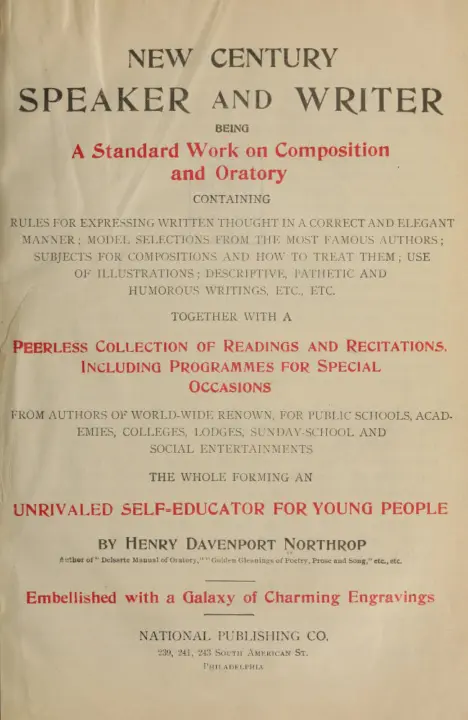
"New Century Speaker and Writer: Being a Standard Work on Composition and Oratory" by Henry Davenport Northrup is an instructional guide focused on the art of writing and public speaking, likely written in the early 20th century. The text serves as a comprehensive resource for young students and aspiring orators, intending to enhance their writing skills while providing a collection of readings and recitations from renowned authors. Central themes include mastering composition, developing an elegant style, and effective techniques for public oratory. The opening of this guide outlines the necessity for clarity and elegance in written communication, emphasizing that expressing thoughts skillfully is an essential skill for students. Northrup discusses the challenges faced by learners, such as the common fear of composition assignments, and offers encouragement by sharing that even great writers faced similar struggles. He introduces practical advice on writing, including selecting suitable subjects, developing a personal style, and the importance of reading widely to improve both language and thought. The aim is to inspire confidence and equip readers with useful tools for enhancing their writing and speaking abilities.
Introduction adapted from the source catalogue; source summaries may be automatically generated.
Free to read · English · 237,347 words · No account needed
MAKE TIME FOR A GOOD BOOK
On by default. Untick to stop anonymous reading totals. Each page counts after 10 seconds in view. How this works.
Anonymous counting is on unless you have switched it off.
This is always placed towards the left of the page, and varies according to the relations between the sender and the receiver of the letter. Writing to an intimate friend, one may say, “My dear Tom,” or (a little less familiarly) “My dear Brown.” Writing to a friend who is also a superior in age or position, one would say, “My dear Mr. Brown.” “Dear Sir” is formal, but claims some small degree of acquaintance or regard. “Sir” is purely formal. Similarly we may have, “My dear Annie,” “My dear Mrs. Brown,” “Dear Madam,” and “Madam.” In writing to Miss Jones, a stranger, you may not wish to say, “Dear Miss.” It would be better in this instance to address her as “Miss Jones.”
After the form of address comes the =Letter=.
A friendly letter should be easy and pleasant in style—it should be, in fact, a talk on paper. In a business letter, on the other hand, the style is brief and concise. The first aim of the writer is to make himself understood, the next to be brief.
After the letter comes the =Subscription=, as,
Sincerely yours,
ALEXANDER ARGYLE.
Or,
Respectfully yours,
NEW ENGLAND COAL CO.
Or in more formal style,
I am, dear sir,
Your obedient servant,
THOMAS LANCASTER.
The subscription is arranged like the address, but begins further
to the left. The form of subscription varies with the form of
address.
A business letter ends with the =Address of the Person to whom it is
Sent=.
This is written in the left corner. A friendly letter generally
ends with the subscription.
Application for a Situation.
345 Lancaster Street,
15th February, 189-.
Seeing by your advertisement in this morning’s “Standard” that you are in need of an office boy, I beg leave to apply for the position. I have been for six years a pupil in the Commercial School, Old Bridge Street. My teacher permits me to refer you to him for an account of my conduct and abilities. I have therefore only to add that if I am fortunate enough to enter your employ, it shall be my aim to serve you diligently and faithfully.
I am, sir,
Your obedient servant,
THOMAS WATSON.
J. W. CHAMBERS, ESQ.,
97 Dearborn Street.
Letters of Invitation.
NEWARK, September 11.
Myself, and a half dozen other good fellows, are going to devote a few hours on Tuesday evening to the enjoyment of refreshments, chit-chat, and so on. I hope you will make one, as we have not enjoyed the “feast of reason and flow of soul” in each other’s company for some time past.
Believe me, dear Joe, Yours ever, HARRY.
Your reading position is saved on this browser. Take it to another device with a library code. Reading pages adapt to text, rather than matching a printed edition.
BEHIND THE BOOK
This eBook is for the use of anyone anywhere in the United States and most other parts of the world at no cost and with almost no restrictions whatsoever. You may copy it, give it away or re-use it under the terms of the Project Gutenberg License included with this eBook or online at www.gutenberg.org. If you are not located in the United States, you will have to check the laws of the country where you are located before using this eBook. Read the source licence.
The original source file, including credits and licence, is retained by this library. Request an original-format copy at no charge. Please include the book title and Project Gutenberg identifier #66982.
KEEP YOUR CURIOSITY GOING
Charles G. (Charles Griffith) Ross
Hannah Webster Foster

Emily Lawless
Edwin Hamlin Carr

Charles De Lano Hine
Andrew Ure