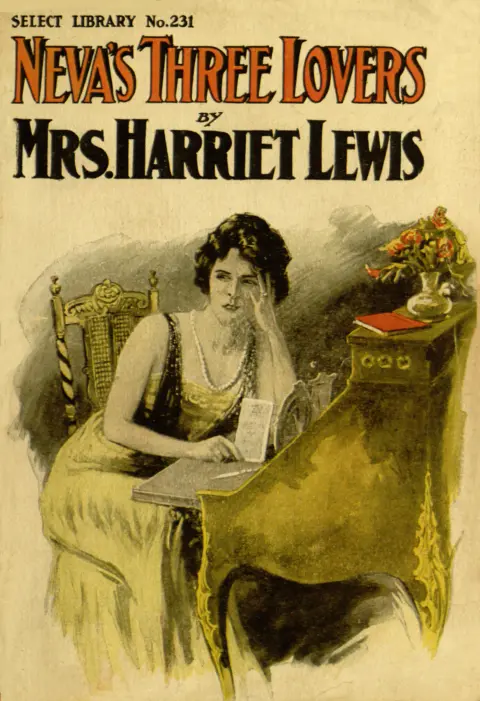
Neva’s three lovers: a novel
Harriet Lewis
THE CLASSIC COLLECTION · 1871
"Neva's Choice" by Harriet Lewis is a novel written in the late 19th century. The story serves as a sequel to "Neva's Three Lovers" and explores themes of love, betrayal, and choice as it follows Neva Wynde, the daughter of a wealthy baronet, who finds herself entangled in a web of familial intrigue and romantic obligation. As she navigates her feelings for potential suitors, including Rufus Black and Lord Towyn, Neva must confront the manipulations of her new stepmother and others who threaten her autonomy and well-being. The opening of this tale sets the stage for a dramatic conflict surrounding Neva's situation. We are introduced to her complex relationships—particularly with her stepmother, Mrs. Craven Black, and her enemies, who conspire to ensure she marries Rufus Black. Through conversations filled with tension and emotional undercurrents, Neva expresses her final rejection of Rufus and her growing discomfort with the intentions of the Blacks. As she embarks on a journey with them under the guise of visiting Wynde Heights, Neva begins to realize that she may be falling victim to an insidious plot, which is marked by her mounting unease and suspicion about the authenticity of a letter from her deceased father that purportedly dictates her future choices.
Introduction adapted from the source catalogue; source summaries may be automatically generated.
Free to read · English · 75,777 words · No account needed
MAKE TIME FOR A GOOD BOOK
On by default. Untick to stop anonymous reading totals. Each page counts after 10 seconds in view. How this works.
Anonymous counting is on unless you have switched it off.
“No, sir,” said the woman still more grimly. “If you have a spark of manliness, you will let the young lady alone. She hates you now. I assure you she does. She’s only a governess, and you’ll lose her her place if you hang around her. I tell you again she hates you.”
Rufus uttered a low moan, and sat down abruptly upon a shop bench. Mrs. Peters glided out and entered the carriage, giving the order to return home.
“I told him a lie, God forgive me!” she muttered, as she looked at Lally, who lay back upon the cushions, faint and white. “I told him that you were a governess, Miss Lally. Let him once get wind of your good fortune, and he’ll abandon his heiress and come back to you. Let us start for the north to-night, dear Miss Lally, and you will not see him if he comes to Mount street. We can take the night express, and sleep comfortably with our lap robes, and to-morrow night we will sleep at Edinburgh.”
“We will do as you say, Peters,” said Lally wearily. “Only don’t speak
to me now.”
She buried her face in the cushions, and was silent with a stillness
like death.
Meanwhile Rufus Black sat for some minutes in a sort of stupor, but at last raised his haggard eyes and said to the shopkeeper:
“The--the lady who passed out, Benson, was my wife. I had heard she was dead. Can you give me her address?”
The shopman was all sympathy and kindness. He knew Rufus Black had come of a good family, and he suspected, from the scene he had just witnessed, that he had experienced trouble through his marriage. He picked up the mourning card Lally had laid down and read the address aloud.
“‘Miss Wroat, Mount street, Grosvenor Square,’” repeated Rufus. “My wife is governess in that family. Thanks, Benson. I will go to Mount street.”
He went out with staggering steps, hailed a hansom cab, gave the order, and was driven to the Wroat mansion in Mount street. The boy called Buttons waited upon the door in Toppen’s absence. He was a shrewd lad, and had received private instructions from Peters, who had just come in with her young mistress.
“I want to see Miss Bird,” said Rufus abruptly, making a movement to
enter the hall.
The boy blocked his path.
“No such lady here, sir,” he replied.
“Mrs. Black perhaps?” suggested Rufus.
“No such lady,” persisted the boy.
Rufus offered him a bright coin, and said desperately:
“I want to see the governess--”
Your reading position is saved on this browser. Take it to another device with a library code. Reading pages adapt to text, rather than matching a printed edition.
Harriet Lewis
BEHIND THE BOOK
This eBook is for the use of anyone anywhere in the United States and most other parts of the world at no cost and with almost no restrictions whatsoever. You may copy it, give it away or re-use it under the terms of the Project Gutenberg License included with this eBook or online at www.gutenberg.org. If you are not located in the United States, you will have to check the laws of the country where you are located before using this eBook. Read the source licence.
The original source file, including credits and licence, is retained by this library. Request an original-format copy at no charge. Please include the book title and Project Gutenberg identifier #68439.
KEEP YOUR CURIOSITY GOING
Coulson Kernahan

Maurice Baring
Frances Wright
Cécile Tormay

Frederic Jesup Stimson

W. H. P. (William Henry Pope) Jarvis