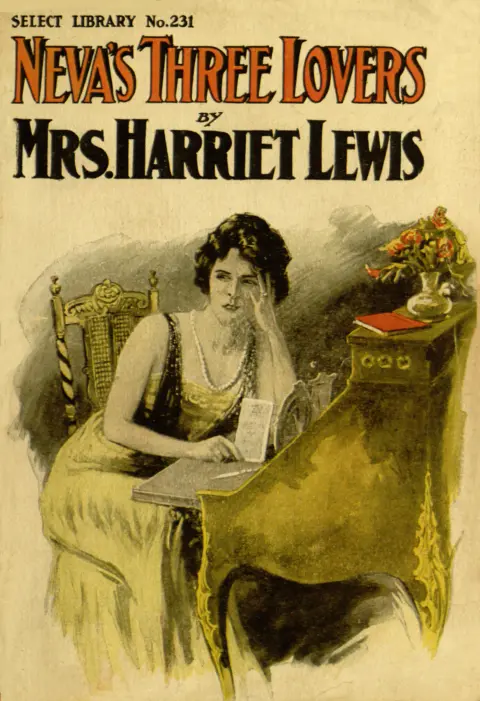
Neva’s three lovers: a novel
Harriet Lewis
THE CLASSIC COLLECTION · 1871
"Neva's Choice" by Harriet Lewis is a novel written in the late 19th century. The story serves as a sequel to "Neva's Three Lovers" and explores themes of love, betrayal, and choice as it follows Neva Wynde, the daughter of a wealthy baronet, who finds herself entangled in a web of familial intrigue and romantic obligation. As she navigates her feelings for potential suitors, including Rufus Black and Lord Towyn, Neva must confront the manipulations of her new stepmother and others who threaten her autonomy and well-being. The opening of this tale sets the stage for a dramatic conflict surrounding Neva's situation. We are introduced to her complex relationships—particularly with her stepmother, Mrs. Craven Black, and her enemies, who conspire to ensure she marries Rufus Black. Through conversations filled with tension and emotional undercurrents, Neva expresses her final rejection of Rufus and her growing discomfort with the intentions of the Blacks. As she embarks on a journey with them under the guise of visiting Wynde Heights, Neva begins to realize that she may be falling victim to an insidious plot, which is marked by her mounting unease and suspicion about the authenticity of a letter from her deceased father that purportedly dictates her future choices.
Introduction adapted from the source catalogue; source summaries may be automatically generated.
Free to read · English · 75,777 words · No account needed
MAKE TIME FOR A GOOD BOOK
On by default. Untick to stop anonymous reading totals. Each page counts after 10 seconds in view. How this works.
Anonymous counting is on unless you have switched it off.
He saw the dark and slender figure perched on the peaks while yet afar off. Something in its droop reminded him of Lally, and he came on at a swinging pace, his eager gaze never swerving from her; and as he came nearer and yet nearer, the conviction stole upon him that it was Lally at whom he looked.
“She must have come out with Miss Wroat,” he thought. “Rich ladies never walk without an attendant. She has dropped behind, being tired. It is Lally! it is--it is!”
He came up swiftly, the damp soil deadening the sound of his footsteps. He gained the rocks, and began to climb them to Lally’s side, but the girl did not stir, nor notice his approach.
A sudden sound at her side at last startled her. With a quick exclamation, she turned her head--and beheld him!
She did not speak, but her great black eyes grew larger, and her face grew suddenly so deathly white that he thought she must be fainting.
“Lally! O Lally!” he cried to her, in an anguished, broken voice. “Thank God! I have found you! Oh, my darling, my little wife, whom I have mourned as dead!”
He knelt down before her, in the shadow of a projecting rock, the tears streaming over his face, and his eyes regarding her in wild imploring. So a devotee might have knelt to his patron saint, feeling unworthy to approach her, but longing and praying with his whole soul for forgiveness and mercy.
Lally felt her soul melt within her.
“Oh, Rufus!” she gasped, in a choking whisper.
He put up his arms to enfold her. She shrank back, not with loathing, but with a sudden dignity, a sort of majesty, that awed him.
“You must not touch me, Rufus,” she commanded. “I am not your wife--”
“You are! You are! Before God, I declare that you are my wife--”
“Hush, Rufus! You wrote to me that I was not your wife. Don’t you remember? You said that our marriage was ‘null and void.’”
“I thought it was. My father told me so!” cried Rufus. “O Lally, I have been a poor, weak-souled wretch. I am not worthy of your love. I should have stood by you, instead of basely deserting you through my own personal cowardice. My father threatened to have me indicted for perjury, in swearing that we were of age at the time of our marriage, and I--I was afraid. You can never respect me, Lally, nor love me again, I know, but if you knew how I have suffered you would pity me.”
“I have always pitied you,” she murmured.
Your reading position is saved on this browser. Take it to another device with a library code. Reading pages adapt to text, rather than matching a printed edition.
Harriet Lewis
BEHIND THE BOOK
This eBook is for the use of anyone anywhere in the United States and most other parts of the world at no cost and with almost no restrictions whatsoever. You may copy it, give it away or re-use it under the terms of the Project Gutenberg License included with this eBook or online at www.gutenberg.org. If you are not located in the United States, you will have to check the laws of the country where you are located before using this eBook. Read the source licence.
The original source file, including credits and licence, is retained by this library. Request an original-format copy at no charge. Please include the book title and Project Gutenberg identifier #68439.
KEEP YOUR CURIOSITY GOING
Coulson Kernahan

Maurice Baring
Frances Wright
Cécile Tormay

Frederic Jesup Stimson

W. H. P. (William Henry Pope) Jarvis