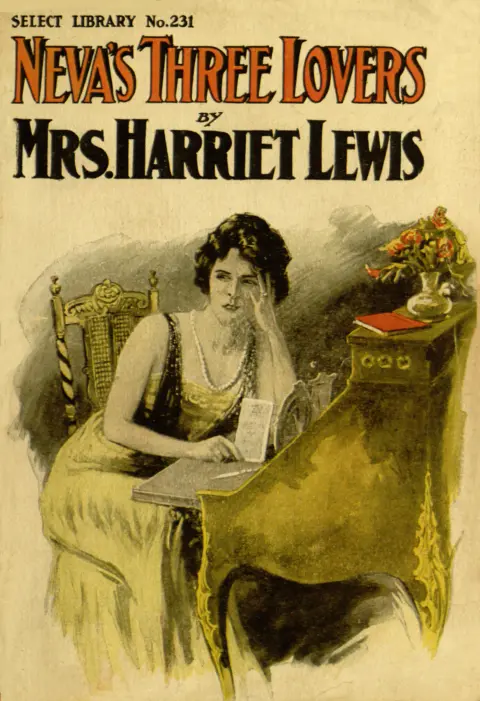
Neva’s three lovers: a novel
Harriet Lewis
THE CLASSIC COLLECTION · 1871
"Neva's Choice" by Harriet Lewis is a novel written in the late 19th century. The story serves as a sequel to "Neva's Three Lovers" and explores themes of love, betrayal, and choice as it follows Neva Wynde, the daughter of a wealthy baronet, who finds herself entangled in a web of familial intrigue and romantic obligation. As she navigates her feelings for potential suitors, including Rufus Black and Lord Towyn, Neva must confront the manipulations of her new stepmother and others who threaten her autonomy and well-being. The opening of this tale sets the stage for a dramatic conflict surrounding Neva's situation. We are introduced to her complex relationships—particularly with her stepmother, Mrs. Craven Black, and her enemies, who conspire to ensure she marries Rufus Black. Through conversations filled with tension and emotional undercurrents, Neva expresses her final rejection of Rufus and her growing discomfort with the intentions of the Blacks. As she embarks on a journey with them under the guise of visiting Wynde Heights, Neva begins to realize that she may be falling victim to an insidious plot, which is marked by her mounting unease and suspicion about the authenticity of a letter from her deceased father that purportedly dictates her future choices.
Introduction adapted from the source catalogue; source summaries may be automatically generated.
Free to read · English · 75,777 words · No account needed
MAKE TIME FOR A GOOD BOOK
On by default. Untick to stop anonymous reading totals. Each page counts after 10 seconds in view. How this works.
Anonymous counting is on unless you have switched it off.
The stranger took off his hat, revealing the upper portion of a noble head, crowned with grizzled hair. Then slowly he turned down his greatcoat collar, and stood before Atkins without disguise, displaying a grandly noble face, with keen blue eyes, a pale bronzed countenance, and sternly set lips above a gray military beard.
Atkins’ hand dropped to his side. With a wild and stifled shriek, he staggered to a chair, his eyes glaring wildly at the stranger.
“My God!” he cried, with white lips. “Sir Harold Wynde!”
Sir Harold--for it was indeed he, returned that day to England, after a prolonged journey from India--smiled his old warm smile, and held out his hand.
“Sir Harold Wynde!” repeated Atkins, not taking the hand--“who--who
died--”
“I can give you the best of proofs, Atkins, that I did not die in India,” said the baronet, with a cheery little laugh. “You look at me as at a ghost, but I’m no ghost. Feel my hand. Is not that real flesh and blood? Atkins, you are giving me a sorry welcome, my old friend.”
Atkins still stared with a wild incredulity at his old friend and employer. He could not yet comprehend the glad truth.
“I--I must be dreaming,” he muttered. “I felt queer to-night. I--”
Sir Harold advanced and, pulling off his glove, laid his hand on that of Atkins. Its touch was chill, but unmistakably human.
“What!” cried the baronet. “Do you believe in ghosts, my friend? I wouldn’t have believed a bona-fide wraith could have so startled the hard-headed Atkins I once knew. I was not eaten by the tiger, Atkins, but I have been kept a prisoner in the hands of human tigers until I managed to escape last month. You know me now, and that I am no ghost?”
Atkins rose up, pale and trembling still, but with an unutterable joy
on his face.
“It is Sir Harold alive, and in the flesh!” he ejaculated. “Sir Harold whom we mourned as dead! This is a miracle!”
He clasped the baronet’s hand, and laughed and cried in a breath. He seemed overflowing with his great joy.
The baronet held the trembling hand of his friend in a strong, restful pressure for some minutes, during which not a word was spoken between them. Their hearts were full.
“I am not myself to-night, Sir Harold,” said Atkins brokenly, after a little. “I have been upset lately.”
He drew Sir Harold toward the fire, helped him off with his greatcoat, and ensconced him in the lounging chair before the fender. Then he drew a chair close beside the baronet’s, and asked tremulously:
Your reading position is saved on this browser. Take it to another device with a library code. Reading pages adapt to text, rather than matching a printed edition.
Harriet Lewis
BEHIND THE BOOK
This eBook is for the use of anyone anywhere in the United States and most other parts of the world at no cost and with almost no restrictions whatsoever. You may copy it, give it away or re-use it under the terms of the Project Gutenberg License included with this eBook or online at www.gutenberg.org. If you are not located in the United States, you will have to check the laws of the country where you are located before using this eBook. Read the source licence.
The original source file, including credits and licence, is retained by this library. Request an original-format copy at no charge. Please include the book title and Project Gutenberg identifier #68439.
KEEP YOUR CURIOSITY GOING
Coulson Kernahan

Maurice Baring
Frances Wright
Cécile Tormay

Frederic Jesup Stimson

W. H. P. (William Henry Pope) Jarvis