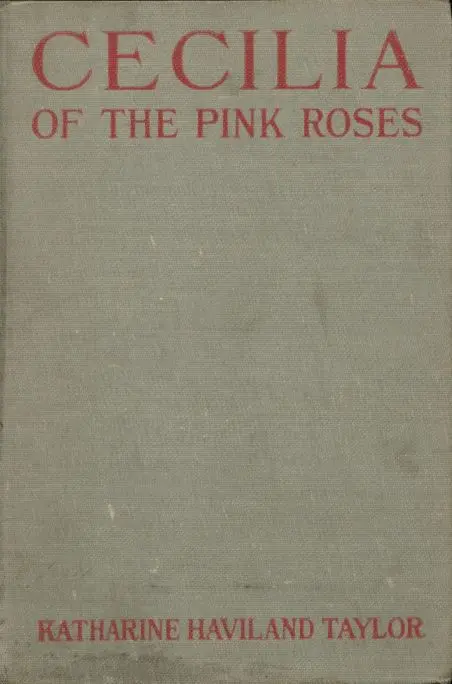
Cecilia of the Pink Roses
Katharine Haviland-Taylor

THE CLASSIC COLLECTION · 1921
"Natalie Page" by Katharine Haviland-Taylor is a novel written in the early 20th century. The story follows Natalie Page, a spirited and tomboyish sixteen-year-old girl, as she navigates the complexities of life after moving from her small hometown to live with her relatives in New York City. The narrative explores themes of family, identity, and the struggle between personal desires and societal expectations, particularly for young women during that time. The opening of the story introduces Natalie in a reflective mood as she recalls poignant moments from her childhood, particularly surrounding the loss of her mother. As she transfers to her uncle Frank Randolph's home, it is clear she possesses a free-spirited nature that leads her into trouble, such as when she decides to bicycle down courthouse steps. As the first chapter unfolds, we find her wrestling with impending changes and the pressure of conformity symbolized by her family's expectations for her future. Natalie's internal conflict is compounded by her aunt’s intentions to polish her rough edges and prepare her for a more refined life, setting the stage for the adventures and challenges she will face in her new urban environment.
Introduction adapted from the source catalogue; source summaries may be automatically generated.
Free to read · English · 67,690 words · No account needed
MAKE TIME FOR A GOOD BOOK
On by default. Untick to stop anonymous reading totals. Each page counts after 10 seconds in view. How this works.
Anonymous counting is on unless you have switched it off.
I said I would go, and we turned toward Riverside Drive, which was lovelier than ever with the snow weighting down the boughs of the trees, and the banks of the Hudson glittering like white mountains across the way. Little tots, many of whom wore red coats, made bright spots in the snow, and their nurses added the black lines that have to be to make a perfect poster. I loved it and so did S. K.
Huge motors, with beautiful women in them, rolled softly with and by us, and some of the windows of the houses and apartments were beginning to be bright with early lights. We were quiet because it made you feel that way.
“I love this,” I whispered.
“My dear,” S. K. answered, “I do too.” Then he looked down at me, and I was warmed by the feeling that he liked me a great deal. He had begun, even at that time, to be quite as much a part of my life as Uncle Frank, who, in his funny, forgetting way, has been both mother and father to me ever since I can remember.
“Next summer,” said S. K., “I am going to Southampton when your aunt does, and I shall return to town when she does.”
“Uncle Archie may be jealous,” I answered, smiling.
S. K. started to speak, then stopped, rubbed his hands together, looked away from me, and frowned. I looked at the beautiful houses, the crowds, and the passing cars. The little stretch of park, the wonderful apartments, and the well-dressed people, made a picture, a picture of happiest, smoothest-living New York. It was pleasant to look on.
“Suppose,” suggested S. K., “we go in up here and have tea? I imagine you’ve had it once, but I also suppose that hasn’t dimmed your bright young appetite.”
I giggled, for it hadn’t. And after we had driven some distance more, we turned in a big house that is set high on a lot of ground where you can get very good tea and wonderful things to eat between drinks. We had scones, and marmalade, and little cakes that were about as big as big candies and which, like those, came in cases. I ate quite a lot. S. K. telephoned aunt about where I was, and we lingered.
I grew confidential after I ate, and told S. K. about Evelyn and Mr. Apthorpe. I hoped he would think it was all right, and he did. He said he wished someone would Cook Tour his affairs like that, and something honestly hurt under my left ribs.
“Yours?” I said, before I knew that I was going to speak.
Your reading position is saved on this browser. Take it to another device with a library code. Reading pages adapt to text, rather than matching a printed edition.
Katharine Haviland-Taylor
BEHIND THE BOOK
This eBook is for the use of anyone anywhere in the United States and most other parts of the world at no cost and with almost no restrictions whatsoever. You may copy it, give it away or re-use it under the terms of the Project Gutenberg License included with this eBook or online at www.gutenberg.org. If you are not located in the United States, you will have to check the laws of the country where you are located before using this eBook. Read the source licence.
The original source file, including credits and licence, is retained by this library. Request an original-format copy at no charge. Please include the book title and Project Gutenberg identifier #59902.
KEEP YOUR CURIOSITY GOING
Coulson Kernahan

Maurice Baring
Frances Wright
Cécile Tormay

Frederic Jesup Stimson

W. H. P. (William Henry Pope) Jarvis