THE CLASSIC COLLECTION✦An outlaw’s diary: the CommuneCLASSIC FREE BOOKS
An outlaw’s diary: the Commune
Cécile Tormay
THE CLASSIC COLLECTION · 1904
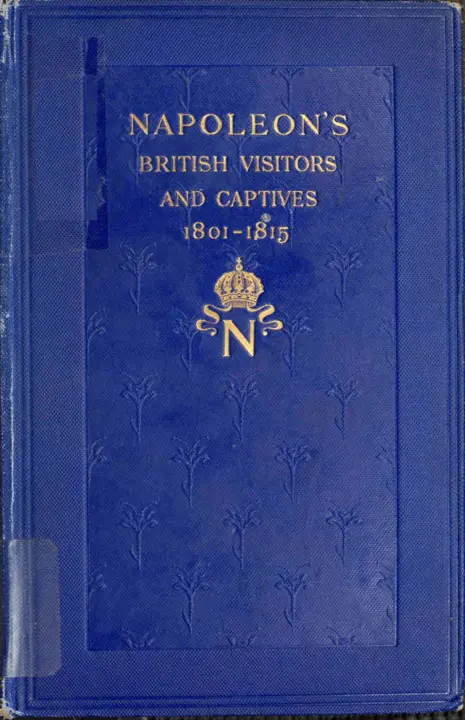
"Napoleon's British Visitors and Captives, 1801-1815" by John Goldworth Alger is a historical account written in the early 20th century. The book explores the interactions and experiences of British visitors and captives in France during the tumultuous period of Napoleon's rise and reign. Alger delves into the social dynamics, political undertones, and personal stories that emerged as Englishmen navigated their relationships with French citizens amid shifting allegiances and changing circumstances. The opening of the work sets the stage for a comprehensive examination of the vast impact of the French Revolution, highlighting the notable dislocation of individuals across Europe, particularly among the French nobility and other political figures. Alger outlines how the Peace of Amiens in 1802 marked a significant uptick in British travel to France after a decade of hostilities, with numerous English visitors eager to witness the transformative atmosphere of post-revolutionary France. The introductory chapter establishes a backdrop of historical context, emphasizing the social and political exchanges that occurred not only between British visitors and French society but also amidst the hardships faced by those who found themselves unexpectedly detained under Napoleon's regime.
Introduction adapted from the source catalogue; source summaries may be automatically generated.
Free to read · English · 89,397 words · No account needed
MAKE TIME FOR A GOOD BOOK
On by default. Untick to stop anonymous reading totals. Each page counts after 10 seconds in view. How this works.
Anonymous counting is on unless you have switched it off.
The only precedents for this detention were the arrest in 1746, without any apparent reason, of all the English in Paris on the return of the Young Pretender, and that of all Englishmen in France in 1793 as hostages for Toulon. Thomas Moore heard Lord Holland in 1819 justify Napoleon, but Mackintosh maintained that the seizure of vessels was warranted by international law, and a French jurist, Miot de Mélito, describes the detention as a ‘violent measure unusual even in the bitterest wars,’ while Henri Martin, the French historian, charges both Governments with having violated international law. The truth is that Napoleon acted in a passion, and as in the case of the Duc d’Enghien was too proud ever to acknowledge a mistake. As to an embargo, he himself as early as the 13th May had despatched orders for the seizure of British vessels in Holland, Genoa, and Tuscany. If, moreover, we are to believe Madame Junot, Napoleon’s decree was due to his having been informed that Colonel James Green had in a café threatened in his cups to assassinate him, and though Junot, being acquainted with Green, vouched for his having left Paris prior to the date of the alleged threat, Napoleon refused to cancel the decree. So swiftly was it enforced that the Prince of Wales packet and the cutter Nancy, which had made their usual passage from Dover to Calais, were seized and their crews detained. When a few weeks afterwards Napoleon visited Calais, Captain Sutton, of the Prince of Wales, petitioned him for release, but he met with a peremptory refusal, and Napoleon, on the two vessels being pointed out to him in the harbour, said, ‘You have plenty of mud there; let them lie and rot.’
The aggregate number of the British captives, represented by the French as seven thousand five hundred, was really only seven hundred, four hundred of them, according to Sturt, being small tradesmen. Napoleon, according to Maclean, was much disappointed at the smallness of the haul. Everything indeed had been done to induce the visitors to stay. The Argus had on the 10th May remonstrated against any fear of detention as in 1793, France, it said, being no longer under a Robespierre, and provincial authorities had given assurances that expulsion with reasonable notice was the worst that could befall. It was unfair, however, to accuse Napoleon of having ‘enticed’ the English to remain. His assurances of safety were probably sincere at the time, but his moral sense did not impress upon him the sacredness of such a virtual pledge. He had no scruples as to suddenly changing his mind to the detriment of persons who had trusted him. Most of the visitors, however, had deemed it prudent to return home while the issue was still uncertain. As late indeed as May arrivals in Paris had continued. From May 10th to 19th there were 48, and from the 20th to the 29th there were 38, but in the next ten days the number fell to 17 and in the following ten days to 6. Most of these visitors, moreover, must have come up from the provinces on their way home, while others came to fetch relatives. There were some narrow escapes. Sir William Call was just in time to leave Geneva, and Miss Berry and Mrs. Damer, warned by Lord John Campbell, hurried away from that city, forgetting or possibly not thinking it safe to pass on the warning to others. The Duke of Bedford, the Duchess of Gordon and her daughter, and Sir Harry Featherstonehaugh left Paris four days after Whitworth. The son of Sir G. Burrell and a companion escaped by making their valet pass for an American and themselves for his servants. Young Edgeworth, on the other hand, received his father’s letter of warning just too late, and was detained till 1814, though his companions, Roget as a Swiss and the Philips boys as below the age, obtained exemption. Yet not only had men been detained when over sixty, but some youths of ten or twelve, and therefore well under the limit of sixteen, had been stopped on the plea of their producing no certificates of birth. Augustine Sayer, aged thirteen, whom his parents had apparently placed in a school, was not allowed to return home, but was forced to maintain himself by tuition. He was eventually physician to the Duke of Kent and to the Lock Hospital, dying in 1861. He may have been one of the English boys sent to Dubufe’s school, for Dubufe, a member of the London Society of Arts, contradicting a statement that Protestants were refused admission to French schools, mentioned that he had received such pupils. John Charles Tarver, the future educationist and teacher of French at Eton, might surely, however, have been sent to his parents in London between 1794 and 1802, even if this was impossible after 1803. Farel, the engineer, in whose care he had been left by them on their release from captivity at Dieppe after the Terror, had virtually adopted him. Born at Dieppe in 1790, he had practically been naturalised, and Farel in 1805 got him into the French civil service. He remained in it till March 1814, when, obtaining leave of absence, he went to London and found his mother, brothers, and sisters still living; but he returned to France during the Hundred Days, intending apparently to resume his official post. Disappointed in this hope, he recrossed the Channel and found a more distinguished career open to him.
Your reading position is saved on this browser. Take it to another device with a library code. Reading pages adapt to text, rather than matching a printed edition.
BEHIND THE BOOK
This eBook is for the use of anyone anywhere in the United States and most other parts of the world at no cost and with almost no restrictions whatsoever. You may copy it, give it away or re-use it under the terms of the Project Gutenberg License included with this eBook or online at www.gutenberg.org. If you are not located in the United States, you will have to check the laws of the country where you are located before using this eBook. Read the source licence.
The original source file, including credits and licence, is retained by this library. Request an original-format copy at no charge. Please include the book title and Project Gutenberg identifier #70408.
KEEP YOUR CURIOSITY GOING
Cécile Tormay

Moritz Busch
John L. Ransom
Frances Wright
Cécile Tormay

Mabel Potter Daggett