THE CLASSIC COLLECTION✦An outlaw’s diary: the CommuneCLASSIC FREE BOOKS
An outlaw’s diary: the Commune
Cécile Tormay
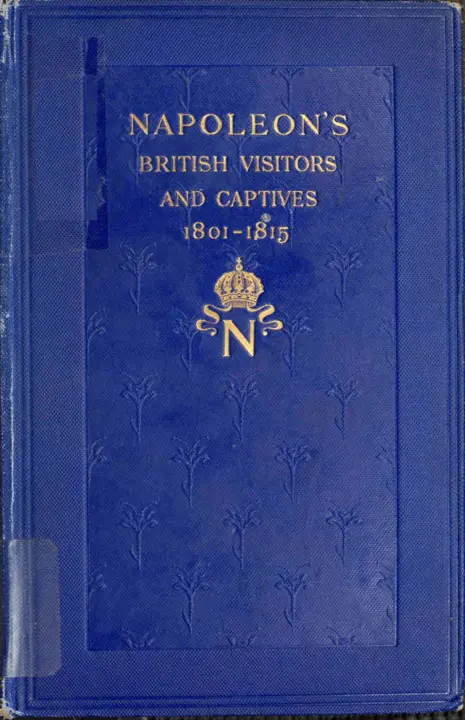
THE CLASSIC COLLECTION · 1904
"Napoleon's British Visitors and Captives, 1801-1815" by John Goldworth Alger is a historical account written in the early 20th century. The book explores the interactions and experiences of British visitors and captives in France during the tumultuous period of Napoleon's rise and reign. Alger delves into the social dynamics, political undertones, and personal stories that emerged as Englishmen navigated their relationships with French citizens amid shifting allegiances and changing circumstances. The opening of the work sets the stage for a comprehensive examination of the vast impact of the French Revolution, highlighting the notable dislocation of individuals across Europe, particularly among the French nobility and other political figures. Alger outlines how the Peace of Amiens in 1802 marked a significant uptick in British travel to France after a decade of hostilities, with numerous English visitors eager to witness the transformative atmosphere of post-revolutionary France. The introductory chapter establishes a backdrop of historical context, emphasizing the social and political exchanges that occurred not only between British visitors and French society but also amidst the hardships faced by those who found themselves unexpectedly detained under Napoleon's regime.
Introduction adapted from the source catalogue; source summaries may be automatically generated.
Free to read · English · 89,397 words · No account needed
MAKE TIME FOR A GOOD BOOK
On by default. Untick to stop anonymous reading totals. Each page counts after 10 seconds in view. How this works.
Anonymous counting is on unless you have switched it off.
Next to Paine in celebrity comes Helen Maria Williams, an eyewitness of the Revolution, whose reminiscences of Madame Roland must have been interesting. She was visited by Sharpe, Rogers, Lord Holland, Kemble, Poole, and Mrs. Cosway, though some English held aloof or even sneered at her. Her attire and manners were certainly open to ridicule,[126] and her cohabitation with John Hurford Stone, the refugee printer, even assuming a secret marriage, exposed her to misconstruction. Stone’s brother William, ruined by twenty-one months’ imprisonment and arrested for debt on his acquittal for treason, had also gone to France, where he became overseer of a paper-hanging factory. We shall hear of him again. There was the widow of Sir Robert Smyth, who remained in Paris after her husband’s death. She and her young children had been painted by Reynolds, and one of those children now married Lambton Este, a son of Charles Este, by turns actor, clergyman, and journalist. Smyth’s old partner, James Millingen, son of a Dutch merchant settled in London, had remained in Paris after the Revolution, though his brother John Gideon had become an English naval official. He was afterwards an eminent archæologist, and his son Michael, archæologist and physician, attended Byron on his deathbed. Anastasia Howard, Baroness Stafford, an ex-nun, had likewise stayed in Paris after her release at the end of the Terror,[127] though her fellow-nuns had in 1800 found a retreat in England. She died in 1807 at the age of eighty-four. Her nephew Charles Jerningham called on her, but though in good health, senility scarcely allowed her to recognise him. This reminds us of her co-religionists at the Austin convent. They, too, had survived the Revolution, and the Superior, Frances Lancaster, must have had much to tell Sir John Carr of how the nunnery was turned into a crowded political prison. Arabella Williams, daughter of David Mallet, author of Northern Antiquities, had had more recent troubles. She had spent most of her life in Paris, but visits to London to obtain her share of her mother, Lucy Estob’s, property brought on her the suspicion of the police and she was arrested. The banker Perregaux and others had to exonerate her from the charge of espionage.[128] Another but more recent resident, representing the demi-monde, though that term had not yet been invented, was Mrs. Lindsay, the Ellenore of Benjamin Constant’s Adolphe, that romance of the Werther and Corinne school, in which the heroine, depicted as a Pole who deserts her old paramour and her children by him, clings to a man anxious to discard her. We do not even know her Christian name, unless she was the ‘Lady Florence Lindsay’ whom Lady Morgan met at Florence in 1819. She is said to have been Irish on the father’s and French on the mother’s side; handsome and sprightly, she had been brought up in good society. She had lived in Paris from 1786 to 1792, and her confiscated tradesmen’s bills, still in the Archives,[129] indicate that she was then the mistress of Comte de Melfort, a man of Scottish Jacobite ancestry. Another of her lovers was Vicomte Chrétien de Lamoignon, who, the last of his family, was wounded at Quiberon, and after the Restoration was created a peer. She left France in 1792, and in 1795 Chateaubriand made her acquaintance in London, where she was on visiting terms with the French aristocratic exiles. He styles her la dernière des Ninon. On his going to France in disguise in 1800 she, having meanwhile returned to Paris, met him at Calais, escorted him, and hired temporary lodgings for him near her own house. She paid half the rent and another friend the remainder. Constant met her in 1804, and after passing an agreeable evening with her, received a letter in which she said that they strikingly resembled each other, but ‘this is perhaps one reason the less against our suiting each other. It is because men resemble each other that Heaven created women, who do not resemble them.’[130] Constant would have married her, however, but for her age and for her two illegitimate children. Charles Constant, Benjamin’s cousin, describes her as intelligent but devoid of culture. In 1801 she translated into French Cornelia Knight’s Life of the Romans. It is commonly stated that she died at Angoulême in 1820; but if so it was under an assumed name, for I have ascertained that there is no Lindsay on the register. Then there was Mrs. Harvey, née Elizabeth Hill, naturalised in Tuscany, who in 1805 was arrested on an unfounded charge of complicity in Georges’ plot. Her daughter Henrietta, a miniature painter, petitioned for her release and the restitution of her papers, the petition being backed by Denon, curator of the Louvre. Scipio du Roure, son of the Marquis de Grisac and grandson of the Countess of Catherlough, Bolingbroke’s sister, may almost be regarded as an Englishman, for he had been educated at Oxford. He eloped with a Mrs. Sandon, who fired at her pursuing husband, whereupon du Roure was prosecuted as the delinquent. A flaw in the indictment secured his acquittal, but he had to take refuge in France. He arrived in the middle of the Revolution and was a member of the Paris Jacobin Commune, but was imprisoned in the Terror. He was now studying jurisprudence and translating Cobbett’s Grammar. He went back to London to claim his mother’s property and that of a half-brother named Knight, and died there in 1822.
Your reading position is saved on this browser. Take it to another device with a library code. Reading pages adapt to text, rather than matching a printed edition.
BEHIND THE BOOK
This eBook is for the use of anyone anywhere in the United States and most other parts of the world at no cost and with almost no restrictions whatsoever. You may copy it, give it away or re-use it under the terms of the Project Gutenberg License included with this eBook or online at www.gutenberg.org. If you are not located in the United States, you will have to check the laws of the country where you are located before using this eBook. Read the source licence.
The original source file, including credits and licence, is retained by this library. Request an original-format copy at no charge. Please include the book title and Project Gutenberg identifier #70408.
KEEP YOUR CURIOSITY GOING
Cécile Tormay

Moritz Busch
John L. Ransom
Frances Wright
Cécile Tormay

Mabel Potter Daggett