THE CLASSIC COLLECTION✦An outlaw’s diary: the CommuneCLASSIC FREE BOOKS
An outlaw’s diary: the Commune
Cécile Tormay
THE CLASSIC COLLECTION · 1904
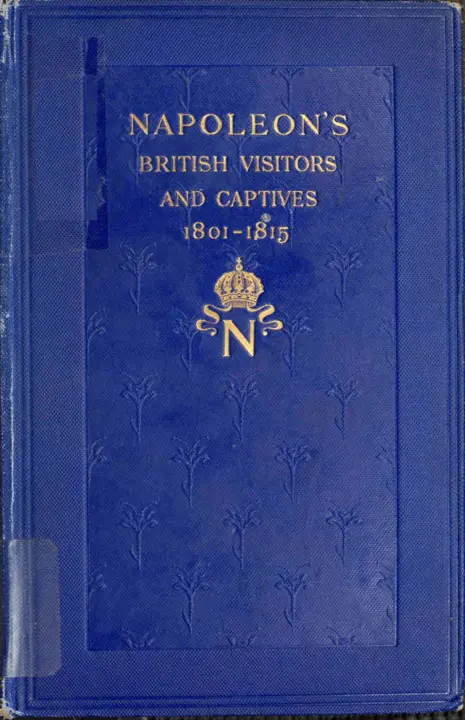
"Napoleon's British Visitors and Captives, 1801-1815" by John Goldworth Alger is a historical account written in the early 20th century. The book explores the interactions and experiences of British visitors and captives in France during the tumultuous period of Napoleon's rise and reign. Alger delves into the social dynamics, political undertones, and personal stories that emerged as Englishmen navigated their relationships with French citizens amid shifting allegiances and changing circumstances. The opening of the work sets the stage for a comprehensive examination of the vast impact of the French Revolution, highlighting the notable dislocation of individuals across Europe, particularly among the French nobility and other political figures. Alger outlines how the Peace of Amiens in 1802 marked a significant uptick in British travel to France after a decade of hostilities, with numerous English visitors eager to witness the transformative atmosphere of post-revolutionary France. The introductory chapter establishes a backdrop of historical context, emphasizing the social and political exchanges that occurred not only between British visitors and French society but also amidst the hardships faced by those who found themselves unexpectedly detained under Napoleon's regime.
Introduction adapted from the source catalogue; source summaries may be automatically generated.
Free to read · English · 89,397 words · No account needed
MAKE TIME FOR A GOOD BOOK
On by default. Untick to stop anonymous reading totals. Each page counts after 10 seconds in view. How this works.
Anonymous counting is on unless you have switched it off.
‘Monsieur, or rather Madame, Talleyrand’s dinners, exceed all others in Paris; about 80 persons sat down to the last dinner. On the table was placed every delicacy possible to be had, and a servant in livery, belonging to the house, behind every chair. The second course, put on like magic, more elegant than the first; around the room, in niches made for the purpose, were statues of the finest marble, each supporting a basket on its head, holding a branch of lustres of about ten lights each, altogether making more than four hundred lights in the room; the furniture of velvet and gold, corresponding with the other elegancies; three rooms were fitted up in this manner, forming a most complete suit. A very handsome salary is allowed to this Minister, exclusively for the support of his table.’
Talleyrand doubtless allowed his guests plenty of time to do justice to his sumptuous fare, whereas Napoleon unpleasantly hurried over his dinners in half an hour. He deputed prefects, however, to preside in his place at less expeditious state banquets.
Lechevalier, of the Foreign Office, who had lived in England and had taught French to Sir F. Burdett and his wife and her sisters, also laid himself out to be agreeable to British visitors. There was a rage for dancing, not dancing on a volcano ready to explode, as was said in July 1830, but on the ashes of an extinct one.
Conversation, on the other hand, as we learn from German visitors, languished. The salons of the old monarchy, where brilliant paradox and ruthless scepticism had flourished, found no successors. It was not safe to talk politics, for spies abounded, and even the Institute had to avoid philosophy, legislation, or sociology.[118] Riddles were consequently in vogue. But La Métherie, the mineralogist, and his guests ventured to condemn the tyranny of the Consulate, and Besnard relates how Lord Archibald Hamilton, after hearing one of these outbursts, exclaimed, ‘Too fortunate Frenchmen! You have apricots, peaches, cheap and good wine, and yet you complain,’ while, turning to Besnard, he whispered: ‘A peach with us costs 4/ or 5/ and a bottle of champagne or burgundy a guinea.’ The old nobility, indeed, such of them as had remained or returned, were too impoverished to live in great style, but the nouveaux riches, financiers and contractors, had installed themselves in rural mansions, yet did not succeed in imitating the old aristocracy. They were lavish in some things, parsimonious in others. Stables, gardens, and woods were allowed to become slovenly. ‘There is at present no veritable society,’ says a contemporary, and nobody in the country kept open house.[119] ‘Those people who chose to be presented at Bonaparte’s court,’ says Mrs. Villiers (afterwards Lady Clarendon), ‘were invited to many magnificent dinners and assemblies (balls) given by the ministers, but as ourselves, with a very few other exceptions, did not feel inclined to pay homage to Bonaparte, the theatres and the entertainments given by foreigners were mostly our resources.’[120] Mrs. Villiers was certainly, as she says, an exception, as also were Montagu and Ryder, a future peer who declined to be introduced to Napoleon, for it was not till the renewal of the war that admiration turned to hatred and that Bonaparte became a bogey with which children were frightened. Even then no Englishman would have gone the length of saying, as a French ecclesiastic has done nearly a century afterwards, that ‘Napoleon was the greatest enemy of God and of mankind. Would that his name could be effaced from human memories!’[121] A royalist agent remarks:--
Your reading position is saved on this browser. Take it to another device with a library code. Reading pages adapt to text, rather than matching a printed edition.
BEHIND THE BOOK
This eBook is for the use of anyone anywhere in the United States and most other parts of the world at no cost and with almost no restrictions whatsoever. You may copy it, give it away or re-use it under the terms of the Project Gutenberg License included with this eBook or online at www.gutenberg.org. If you are not located in the United States, you will have to check the laws of the country where you are located before using this eBook. Read the source licence.
The original source file, including credits and licence, is retained by this library. Request an original-format copy at no charge. Please include the book title and Project Gutenberg identifier #70408.
KEEP YOUR CURIOSITY GOING
Cécile Tormay

Moritz Busch
John L. Ransom
Frances Wright
Cécile Tormay

Mabel Potter Daggett