THE CLASSIC COLLECTION✦An outlaw’s diary: the CommuneCLASSIC FREE BOOKS
An outlaw’s diary: the Commune
Cécile Tormay
THE CLASSIC COLLECTION · 1904
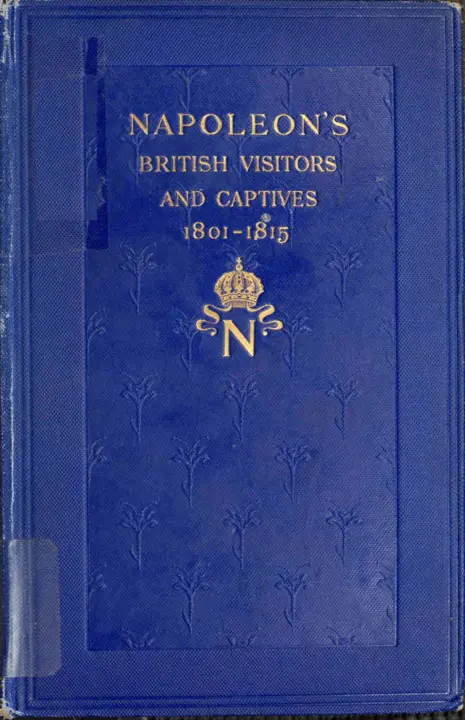
"Napoleon's British Visitors and Captives, 1801-1815" by John Goldworth Alger is a historical account written in the early 20th century. The book explores the interactions and experiences of British visitors and captives in France during the tumultuous period of Napoleon's rise and reign. Alger delves into the social dynamics, political undertones, and personal stories that emerged as Englishmen navigated their relationships with French citizens amid shifting allegiances and changing circumstances. The opening of the work sets the stage for a comprehensive examination of the vast impact of the French Revolution, highlighting the notable dislocation of individuals across Europe, particularly among the French nobility and other political figures. Alger outlines how the Peace of Amiens in 1802 marked a significant uptick in British travel to France after a decade of hostilities, with numerous English visitors eager to witness the transformative atmosphere of post-revolutionary France. The introductory chapter establishes a backdrop of historical context, emphasizing the social and political exchanges that occurred not only between British visitors and French society but also amidst the hardships faced by those who found themselves unexpectedly detained under Napoleon's regime.
Introduction adapted from the source catalogue; source summaries may be automatically generated.
Free to read · English · 89,397 words · No account needed
MAKE TIME FOR A GOOD BOOK
On by default. Untick to stop anonymous reading totals. Each page counts after 10 seconds in view. How this works.
Anonymous counting is on unless you have switched it off.
Law, physic, and divinity were not numerously represented. Besides Erskine and other barristers sitting or destined to sit in the House of Commons, there was John Campbell, a future Lord Chief-Justice and Lord Chancellor, and the biographer of his class. He saw the ‘little Corsican,’ and visited Tallien. Thomas Wilde, afterwards Lord Chancellor Truro, was registered, doubtless in joke by himself or his companions, as M.P., though he was as yet only twenty years of age. Curran, who had been before in 1787, dined with Fox. Deploring the failure of the Revolution, he disliked Napoleon. He little foresaw that he was about meanly to disown his daughter Sarah on account of her attachment to Emmet.[76] Stewart Kyd, a friend of Horne Tooke, prosecuted with other Radicals in 1794, had passed four months in the Tower, but had now sobered down and become a legal writer. The French police suspected him of being a spy. He had, in 1796, assisted Erskine in defending Thomas Williams, the publisher of Paine’s Age of Reason. A native of Arbroath, he died in London in 1811. William Duppa is best known as brother of the artist and as the biographer of Michael Angelo. Charles Henry Okey ultimately settled in Paris.
The physicians included Charles Maclean, who had been with Lord Elgin at Constantinople, and had also been in the East India Company’s service, but had been sent home by Wellesley on account of his quarrelsome disposition. Landing at Hamburg in 1801, he proceeded through Holland to Paris, in order to advocate the establishment at Constantinople of an international institute for the study of the plague. He was anxious for information on French suicides, and Holcroft had recommended him to apply not to a specialist but to Fauriel, the Sanscrit scholar. He denied the contagiousness of epidemics, and his medical crotchets, coupled with his controversial temper, prevented his being employed by the Government, wherefore he considered himself an ill-used man. George Birkbeck, the future founder of mechanics’ institutes, must be reckoned among the doctors: he accompanied Curran. Peter Mark Roget, a nephew of Romilly and a friend of Bentham, as yet Swiss rather than English, went as travelling tutor to the two sons of John Philips, a Manchester merchant, Edgeworth’s son accompanying them. His Treasury of English Synonyms is well known. William Woodville, the disciple of Jenner, and physician to the Smallpox Hospital, had been with Nowel to Boulogne in the summer of 1801, at the solicitation of Dr. Antoine Ambert, to introduce vaccination during a smallpox epidemic. He was an accomplished botanist. Dr. Wickham, another visitor, was likewise a friend of Jenner. On the other hand there were two strong opponents of vaccination. William Rowley, physician to the Marylebone Infirmary and an accoucheur of repute, and Benjamin Moseley, of Chelsea Hospital, who had been trained in Paris, and who had a strange theory that the changes of the moon influenced hemorrhage of the lungs. Tuthill (afterwards Sir George Tuthill) took over his handsome wife, of whom we shall hear again. James Carrick Moore, brother of Sir John, became director of Jenner’s vaccine institute. Benjamin Travers, as yet articled pupil to Sir Paston Cooper, was the first hospital surgeon to make of ophthalmia a special study. Thomas Young was inspector-general of hospitals. Of his distinguished homonym, although also a doctor, we shall speak among scientists. Of John Bunnell Davis and Farrell Mulvey we shall hear later on. James Carmichael Smyth, physician to George III., was destined to be the step-grandfather of Thackeray, for his son Major Henry Carmichael Smyth married Thackeray’s mother in India, and ‘sat’ for the character of Colonel Newcome. The physician received £5000 from Parliament for curing a jail distemper at Winchester in 1796 by nitrous acid; albeit a Dr. Johnston and a Frenchman also claimed the discovery. James Chichester Maclaurin, physician to the Paris Embassy 1790–1792, returned in the same capacity in 1802. He died in 1804 at the age of thirty-nine. His predecessor Macdonnal also revisited Paris. Michael O’Ryan had practised at Lyons, where Louis Badger, a silk-spinner of English descent, one of the victims of the Revolution--mistaken for his brother Pierre, he refused to undeceive his executioners, but Pierre was shot a week later--had married his wife’s sister. Fleeing from the Revolution back to Ireland, O’Ryan now went and settled in Paris. He was a great advocate of quinine.
Your reading position is saved on this browser. Take it to another device with a library code. Reading pages adapt to text, rather than matching a printed edition.
BEHIND THE BOOK
This eBook is for the use of anyone anywhere in the United States and most other parts of the world at no cost and with almost no restrictions whatsoever. You may copy it, give it away or re-use it under the terms of the Project Gutenberg License included with this eBook or online at www.gutenberg.org. If you are not located in the United States, you will have to check the laws of the country where you are located before using this eBook. Read the source licence.
The original source file, including credits and licence, is retained by this library. Request an original-format copy at no charge. Please include the book title and Project Gutenberg identifier #70408.
KEEP YOUR CURIOSITY GOING
Cécile Tormay

Moritz Busch
John L. Ransom
Frances Wright
Cécile Tormay

Mabel Potter Daggett