THE CLASSIC COLLECTION✦An outlaw’s diary: the CommuneCLASSIC FREE BOOKS
An outlaw’s diary: the Commune
Cécile Tormay
THE CLASSIC COLLECTION · 1904
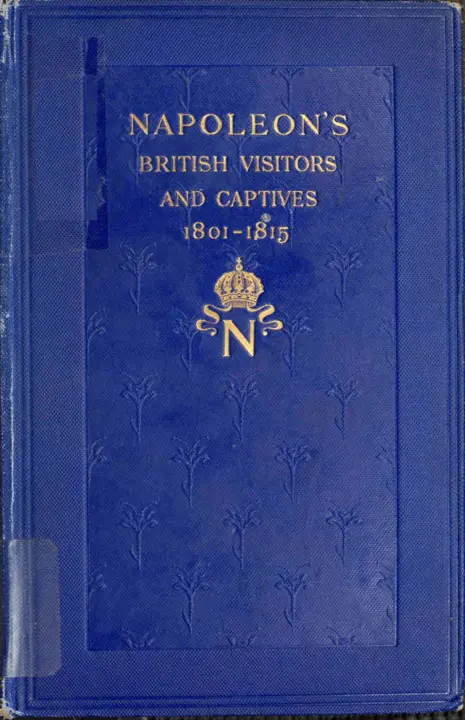
"Napoleon's British Visitors and Captives, 1801-1815" by John Goldworth Alger is a historical account written in the early 20th century. The book explores the interactions and experiences of British visitors and captives in France during the tumultuous period of Napoleon's rise and reign. Alger delves into the social dynamics, political undertones, and personal stories that emerged as Englishmen navigated their relationships with French citizens amid shifting allegiances and changing circumstances. The opening of the work sets the stage for a comprehensive examination of the vast impact of the French Revolution, highlighting the notable dislocation of individuals across Europe, particularly among the French nobility and other political figures. Alger outlines how the Peace of Amiens in 1802 marked a significant uptick in British travel to France after a decade of hostilities, with numerous English visitors eager to witness the transformative atmosphere of post-revolutionary France. The introductory chapter establishes a backdrop of historical context, emphasizing the social and political exchanges that occurred not only between British visitors and French society but also amidst the hardships faced by those who found themselves unexpectedly detained under Napoleon's regime.
Introduction adapted from the source catalogue; source summaries may be automatically generated.
Free to read · English · 89,397 words · No account needed
MAKE TIME FOR A GOOD BOOK
On by default. Untick to stop anonymous reading totals. Each page counts after 10 seconds in view. How this works.
Anonymous counting is on unless you have switched it off.
The baronets included, besides several already mentioned, William Call, John Chichester, Simon Clark, John Coghill, William Cooper, James Craufurd, Herbert Croft, Thomas Clavering, Michael Cromie, George Dallas, James De Bathe, Beaumont Dixie, N. Dukinfield, Alexander Grant, John Honywood, John Hope, John Ingilby, William James, Richard Jodrell, Thomas Lavie, John Morshead, George Prescott, George Shipley, Charles Talbot, Thomas Tancred, Grenville Temple, Henry Tichborne, Thomas Webb, Robert John Wilmot, and Charles Wolseley.
Some of these will be mentioned hereafter. At present we need speak only of Sir Charles Wolseley, who, like Sir Francis Burdett, boxed the political compass. He witnessed, and apparently took part in, the capture of the Bastille. In 1819 the Birmingham Radicals nominated him their so-called ‘legislatorial attorney,’ and in the following year he was sentenced to eighteen months’ imprisonment for a seditious speech at Stockport. He ultimately gave up political life, embraced Catholicism in 1837, and died in 1846.
Then there were also sons of baronets: William Abdy, who succeeded to the title in July 1803, Ashby Apreece, who predeceased his father in 1807, Alexander Don, Charles Jerningham, Raymond Pelly, John Wombwell, formerly a merchant at Alicante, Ralph Woodford, afterwards Governor of Bermuda, John Broughton, and William Oglander, who, already mentioned, succeeded to the title in 1806, while there were two future baronets, Thomas Hare and Charles Cockerell.
Next to legislators and aristocrats, military men were the most numerous class of visitors. Some passed through Paris on their way home from Egypt, which had just been evacuated, and others were actuated not so much by curiosity or love of dissipation as by professional duty, for they did not know how soon they might not have to encounter Bonaparte’s legions. Of this swarm of visitors I can only mention a few. There were the two sons of Sir Ralph Abercromby, who had been killed at Alexandria. The elder was General George already mentioned, who, eventually succeeding his mother in the peerage, became Lord Abercromby. The younger, Colonel Sir John, served with distinction, but died at forty-four years of age without reaching the highest grade. Sir Charles Ashworth became a general. Captain Benjamin Bathurst, son of the Bishop of Norwich, then eighteen years of age, was the diplomatist who in 1809 mysteriously disappeared on returning from a mission to Vienna. Napoleon was accused of having him murdered, but the probability is that he was killed for the sake of his valuables by the ostler of a German inn who was afterwards unaccountably affluent. His daughter Rose, at the age of seventeen, was drowned at Rome in 1824 by her horse slipping backwards into the Tiber, and his brother in a race at Rome was killed by a fall from his horse. Three disasters in one family.
Your reading position is saved on this browser. Take it to another device with a library code. Reading pages adapt to text, rather than matching a printed edition.
BEHIND THE BOOK
This eBook is for the use of anyone anywhere in the United States and most other parts of the world at no cost and with almost no restrictions whatsoever. You may copy it, give it away or re-use it under the terms of the Project Gutenberg License included with this eBook or online at www.gutenberg.org. If you are not located in the United States, you will have to check the laws of the country where you are located before using this eBook. Read the source licence.
The original source file, including credits and licence, is retained by this library. Request an original-format copy at no charge. Please include the book title and Project Gutenberg identifier #70408.
KEEP YOUR CURIOSITY GOING
Cécile Tormay

Moritz Busch
John L. Ransom
Frances Wright
Cécile Tormay

Mabel Potter Daggett